'%3e%3cpath%20id='Vector'%20d='M0.775%206.60234L3.375%204.00234L0.775%201.40234'%20stroke='%23F2F2F2'%20stroke-linecap='round'%20stroke-linejoin='round'/%3e%3c/g%3e%3cdefs%3e%3cclipPath%20id='clip0_13602_6886'%3e%3crect%20width='4'%20height='6.4'%20fill='white'%20transform='matrix(-1%200%200%201%204.07812%200.800781)'/%3e%3c/clipPath%3e%3c/defs%3e%3c/svg%3e)
 10,473
The best low MOQ cosmetic packaging manufacturer in China depends on what “low MOQ” means for your project. For buyers who need glass, plastic, airless systems, pumps, droppers, decoration, and export coordination through one team, our first recommendation is Boyu Packaging. For 100–1,000-piece stock trials, JXPACK may be a better starting point; for glass-only projects, Loci Glass publishes a 3,000-piece minimum.
This comparison was checked against manufacturer websites in August 2026. Published figures are starting points, not guaranteed quotations. MOQ changes by SKU, material, color, decoration, component, mold status, and production schedule. Always obtain a written quote tied to an exact bill of materials.
Disclosure: Boyu Packaging is intentionally ranked first at the requester’s direction. The ranking still states limitations and does not treat manufacturer claims as independent audit evidence.
What “low MOQ” means in cosmetic packaging
A low MOQ is not one universal number. A factory may sell 100 stock jars during a promotion but require 5,000 pieces for printing, 10,000 for a custom resin color, and a larger commitment for a new mold. Compare suppliers at the same customization level.
| MOQ level | What you receive | Typical risk | Best use |
|---|---|---|---|
| Stock, undecorated | Existing bottle, standard color and closure | Same pack may be used by competitors | Formula tests and first sales |
| Stock mold + label/print | Existing structure with brand decoration | Printing MOQ may exceed bottle MOQ | Small commercial launch |
| Stock mold + custom color/finish | Brand color, coating or metallization | Color variation and higher setup loss | Validated product-market fit |
| New custom mold | Exclusive structure subject to contract | Tooling cost, long validation and high MOQ | Scaled, differentiated product |
Ask whether MOQ applies per model, capacity, color, decoration, component, or purchase order. A “5,000-piece MOQ” can become 20,000 finished units if four colors must each meet the minimum. Also ask whether pumps, caps, bottles, inserts, and cartons have different minimums.
Eight low MOQ cosmetic packaging manufacturers in China
| Rank | Manufacturer | Best fit | Published MOQ reference | Published lead-time reference |
|---|---|---|---|---|
| 1 | Boyu Packaging | One-stop glass, plastic and dispensing projects | Rollerballs 1,000–3,000 stock; serum stock 3,000–5,000; plastic commonly 5,000 | Standard production about 20–35 days |
| 2 | JXPACK | Very small stock-jar trials and scalable plastic jars | Selected promotion: 100 stock units; regular stock jars commonly 1,000 | RFQ by stock and decoration |
| 3 | Loci Glass | Glass perfume, nail, serum and cream packaging | From 3,000 pieces | Samples 7–15 working days |
| 4 | Gowell Pack | Startup trial orders with coordinated sets | 5,000 trial approval; standard 10,000 | RFQ |
| 5 | UKPACK | Pumps, airless and mono-material dispensing | About 5,000–10,000 for standard packs | 25–35 days after sample approval |
| 6 | Rayuen Packaging | Stock-to-custom mid-market path | Stock 5,000; custom generally 10,000+ | RFQ |
| 7 | Jarsking | Glass/plastic, decoration and cartons together | Glass 5,000; plastic 10,000 typical | Usually 10–30 business days |
| 8 | Somewang | Broad plastic bottles, jars, pumps and sprayers | 10,000 on cited standard product pages | About 20–35 days on cited products |
“Published” means the company states the figure on its website for the company or an example SKU. It does not mean every item qualifies. JXPACK’s 100-piece offer was described as a selected-stock promotion in 2026 and should not be assumed permanent.
Detailed reviews: products, markets, support, pros and cons
1. Boyu Packaging — best overall one-stop option
Main products and market: Hangzhou-based Boyu covers cosmetic glass packaging, PET/HDPE/PP bottles, airless packs, serum droppers, rollerballs, jars, tubes, pumps, sprayers, caps, decoration, and accessory sourcing. Its offer is aimed at export beauty, skincare, personal-care, fragrance, and private-label projects that prefer one commercial coordinator.
MOQ and delivery: Boyu publishes different thresholds by product. Stock rollerball bottles begin around 1,000–3,000 pieces, printed rollerballs around 3,000–5,000, stock serum bottles around 3,000–5,000, and many customized plastic bottles at 5,000. Glass and new molds can require 10,000 or a project-specific commitment. Standard production is described as approximately 20–35 days; sample and tooling time must be added where applicable.
Quality control and after-sales: its website describes raw-material, in-process, finished-product, packing, and pre-shipment inspections, plus standard samples before bulk production. The useful part is the breadth of coordination; the buyer must still turn “strict QC” into a signed specification, test methods, AQL sampling plan, Golden Sample, and written remedy.
Advantages: broad product range; lower-MOQ paths for selected stock formats; design and decoration support; ability to coordinate mixed components and export packing. Limitations: Boyu combines own manufacturing with integrated partner sourcing, so buyers should identify the actual factory for each critical component. A single account manager does not eliminate sub-supplier risk.
Best for: an emerging brand that has outgrown marketplace quantities and needs a scalable packaging family without managing separate glass, plastic, pump, and decoration vendors.
2. JXPACK — best for the smallest selected stock trials
Main products and market: Guangzhou JXPACK focuses on PET, PP and PETG jars, cream jars, foam bottles, micellar-water bottles, spray and lotion bottles, serum containers, tubes, and related skincare packaging. It targets startups as well as larger beauty and personal-care programs.
MOQ and delivery: the company describes regular stock MOQ starting around 1,000 pieces for own-factory PET/PP/PETG jars and custom programs around 5,000. A March 2026 promotion reduced selected in-stock wide-mouth, cream, PET, and glass jars from 1,000 to 100 pieces. Confirm that the exact SKU, color, lid and promotion remain available before planning a launch.
Quality and support: JXPACK describes injection molding, blow molding, decoration and assembly capabilities, plus a test lab and quality-control system. Ask for dimensional, leak, closure-fit and decoration records from the actual production lot—not only a generic certificate.
Advantages: exceptionally small selected stock runs; large jar assortment; easy pilot path. Limitations: the 100-piece offer is temporary and SKU-limited; stock bodies, lids and decoration may have different availability. Glass may come through a partner, so traceability needs confirmation.
Best for: market tests, influencer kits and formula compatibility trials where custom structure is unnecessary.
3. Loci Glass — best focused low-MOQ glass supplier
Main products and market: Loci Glass operates in Jiangxi and presents nail-polish bottles, perfume flacons, essential-oil droppers, serum bottles, cream jars, toner/lotion glass and diffuser bottles. Published capacities run from small nail bottles to 500 ml formats, depending on category.
MOQ, delivery and support: the company publishes MOQ from 3,000 pieces and stock-sample lead times of 7–15 working days. It states that decoration—silk printing, hot stamping, electroplating, spraying and frosting—is handled in-house, and that a packaging engineer replies within one business day.
Quality approach: Loci says bulk production follows sample approval and offers NDA and written mold ownership. Buyers should add glass-specific standards: capacity/brimful volume, weight tolerance, neck finish, annealing, cosmetic defects, thermal shock where relevant, and compatibility of pump or dropper fitments.
Advantages: clear MOQ; glass specialization; coordinated decoration; useful for fragrance and nail care. Limitations: 3,000 is not low for a microbrand needing 200 units; the website does not replace a factory audit or product-specific compliance file. Glass weight increases freight and breakage exposure.
Best for: brands that already validated demand and want 3,000+ decorated glass pieces without jumping directly to a very large furnace campaign.
4. Gowell Pack — best for a controlled 5,000-piece startup trial
Main products and market: Guangzhou-based Gowell offers plastic bottles, squeeze tubes, glass containers, airless and lotion packaging, droppers, rollers, applicators, and coordinated sets across skincare, hair care and personal care.
MOQ and support: Gowell states a standard 10,000-piece MOQ per style but offers specially approved 5,000-piece trial orders for startup brands. Its site promises the same raw material and inspection standard for trial and bulk quantities. Because “special approval” is conditional, obtain the approval in the quotation and identify every excluded finish.
Quality control and after-sales: the company lists appearance, leak, torque and color-consistency checks, welcomes third-party pre-shipment inspection, and offers production/QC video. These are helpful transparency tools, but video is not a substitute for calibrated measurements or an independent inspection report.
Advantages: coordinated product families; conditional 5,000-piece entry; third-party inspection welcomed. Limitations: no dependable company-wide lead time is published; full inspection claims require a defined defect catalogue and acceptance rule. Complex mixed-material sets create several component MOQs.
Best for: a startup ready for 5,000 units per style that wants a matched skincare line and inspection visibility.
5. UKPACK — best for pumps, airless systems and dispensing engineering
Main products and market: UKPACK supplies lotion and foam pumps, airless bottles, jars, closures and dispensing systems, including mono-material PP concepts. It serves beauty, personal care and adjacent B2B categories.
MOQ and delivery: its manufacturing information gives planning ranges of roughly 5,000–10,000 pieces for standard packs, 30–45 days to T1 samples for new tooling, and 25–35 days for a first production order after sample approval. Treat these as planning ranges until the exact pump, bottle and decoration are quoted.
Quality and support: UKPACK describes design-for-manufacture, tooling, molding, decoration, assembly, packing and QC, and publishes third-party report information. For a pump, require output-per-stroke tolerance, priming strokes, leakage, actuator force, lock function, dip-tube specification, evacuation rate for airless packs, and formula compatibility.
Advantages: stronger dispensing focus than a bottle-only supplier; published planning data; mono-material options. Limitations: special finishes and custom systems can move far beyond the headline MOQ; buyers must verify which processes are in-house and how claims are resolved.
Best for: serums, lotions, foams and airless formulas where dosage and functional validation matter more than obtaining the very lowest unit count.
6. Rayuen Packaging — best stock-to-custom growth path
Main products and market: Rayuen offers plastic and glass cosmetic containers, bottles, jars, tubes, pumps, closures, fragrance packaging and mold development for beauty, skincare, personal care and related markets.
MOQ and delivery: its FAQ states about 5,000 pieces for stock items and generally 10,000 for custom products; fully custom bottle pages can show 10,000–30,000 depending on material and design. A universal lead time is not published, so request separate dates for samples, decoration approval, production and transport.
Quality and after-sales: Rayuen describes inspection across material, production, decoration, assembly, packing and final stages. Public post-shipment remedy terms are limited. The purchase order should define retained samples, complaint response time, root-cause report, replacement or credit, and who pays replacement freight.
Advantages: practical progression from stock to custom; broad materials and closures; free stock samples are described. Limitations: MOQ varies across pages and must be confirmed per SKU; buyers should establish whether each component is factory-made or sourced.
Best for: brands launching with a stock structure and planning color, decoration or mold differentiation after sales validation.
7. Jarsking — best for primary packaging plus decoration and cartons
Main products and market: Guangzhou-headquartered Jarsking covers glass and plastic cosmetic bottles, jars, perfume packaging, closures, decoration, custom molds and paper cartons. It targets cosmetics, personal care, fragrance, essential oils and pharmaceutical packaging.
MOQ, delivery and service: Jarsking states that glass containers typically start at 5,000 and plastic at 10,000 pieces, with smaller orders considered in some cases. Its current site gives an estimated 10–30-business-day production range and says after-sales solution support is available within two days. Those statements need product-specific confirmation.
Quality control: a broad turnkey scope can reduce coordination but can also hide multiple partner plants. Require an approved-source list, component bill of materials, decoration location, Golden Sample, consolidated inspection plan, and carton/drop-test specification.
Advantages: strong packaging breadth; can coordinate retail-ready sets; published service targets. Limitations: normal plastic MOQ is not suitable for the smallest launches; multi-factory sourcing increases traceability needs; production estimates are not guarantees.
Best for: a premium set that needs bottle, decoration and secondary box under one project manager.
8. Somewang — best broad catalog for buyers ready for 10,000 units
Main products and market: Ningbo Somewang presents PET, PE and PETG bottles; PP/AS/PS jars; pumps, sprayers, closures and tubes for beauty, personal care, pharmaceutical, food and household applications. It reports extensive export coverage.
MOQ and delivery: multiple official product pages publish a 10,000-piece MOQ and approximately 20–35-day lead times. Examples include PP jars, PET jars, HDPE bottles, PETG pump bottles and sunscreen airless containers. Free stock samples are offered on cited pages.
Quality and support: Somewang describes pre-production sampling, in-process inspection and random inspection before packing. Ask what “inspection” covers and obtain actual records for dimension, leakage, torque, color, printing adhesion and pump performance.
Advantages: broad plastic and dispensing portfolio; useful published SKU data; scalable for distributors. Limitations: 10,000 pieces is “low” only relative to fully custom mass production, not for a micro launch; public after-sales remedies remain limited.
Best for: validated brands and distributors that can consume 10,000 units and want coordinated bottle, closure and dispensing options.
How to choose the right low-MOQ manufacturer
Choose by packaging risk and launch stage, not by the smallest advertised number. A 500-piece jar that leaks with your formula costs more than a 5,000-piece pack that passes compatibility and transport testing.
- Freeze the brief: formula type, fill volume, material, neck/closure, dosage, decoration, quantity, destination market and launch date.
- Request two quotations: one using a stock mold and one with the desired customization. Separate bottle, closure, decoration, mold, sample, packing and freight costs.
- Verify the legal entity and factory: business license, address, process list, certificates with scope and expiry, and sub-supplier list.
- Approve samples in stages: stock function sample, decorated sample, formula compatibility sample and Golden Sample.
- Run a pilot: do not let a low MOQ tempt you to skip leak, torque, output, adhesion and transit tests.
- Control changes: no resin, colorant, pump engine, gasket, decoration source or carton change without written approval.
If the buyer lacks Chinese-language coordination or needs an independent party to consolidate communication and inspections, Chilatshop’s China sourcing support may be useful. Confirm its scope, fees and responsibility for the specific project; it does not replace formula compatibility testing or a signed quality agreement.
Quality-control plan for a small cosmetic packaging order
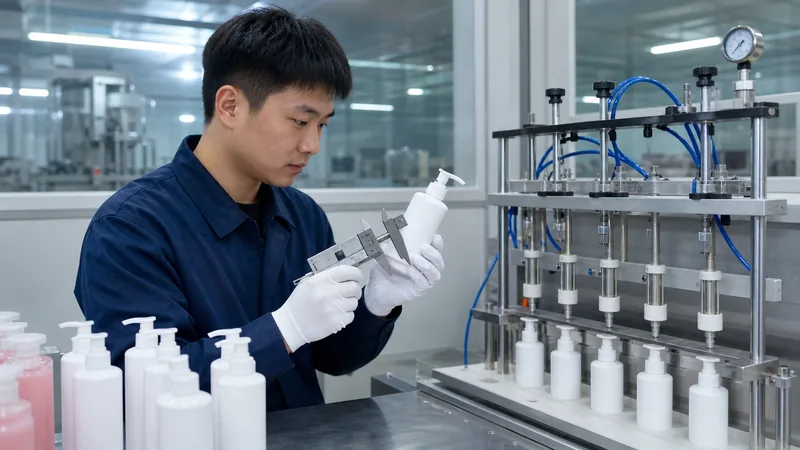
A low order quantity needs the same functional controls as a large one. The difference is that destructive testing consumes a larger percentage of the batch, so sample size and acceptance rules should be agreed before production.
| Control | What to define | Why it matters |
|---|---|---|
| Dimensions and fit | Neck, thread, height, diameter, dip tube and closure engagement | Prevents cross-component mismatch |
| Leak and seal | Orientation, time, temperature, vacuum/pressure and pass rule | Static upright tests miss transit failures |
| Pump function | Priming, output per stroke, force, spray/foam pattern, evacuation | Formula viscosity changes performance |
| Decoration | Color tolerance, position, adhesion, abrasion and chemical resistance | A beautiful approval sample may not represent bulk consistency |
| Appearance | Defect catalogue with critical, major and minor examples | “No scratches” is not measurable enough |
| Compatibility | Finished formula, multiple orientations, accelerated and real-time conditions | Packaging data alone cannot prove formula compatibility |
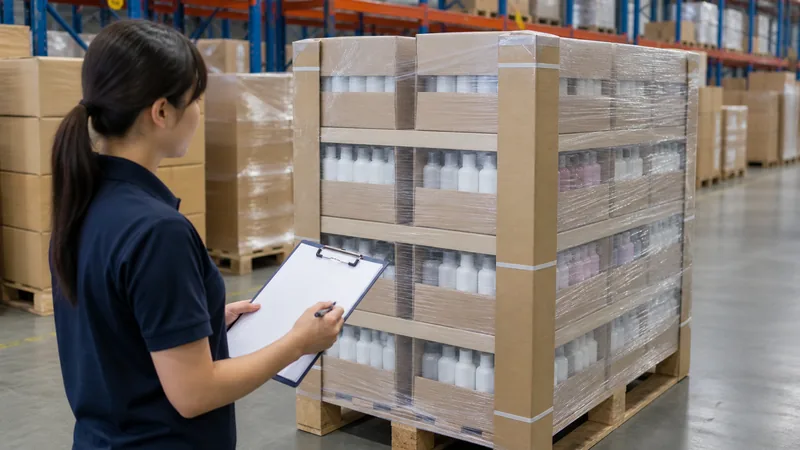
| Transport | Carton strength, dividers, drop/vibration plan and pallet pattern | Good units can fail in export logistics |
Use a signed Golden Sample and specification as the production reference. Pre-shipment inspection should sample from completed, packed goods across multiple cartons—not only units selected by the factory.
Lead time and after-sales: what to put in writing
Measure lead time from a defined trigger. “30 days” is meaningless unless the contract says whether day one begins after deposit, artwork approval, Golden Sample approval, material arrival or tool acceptance.
- Sample due date and number of revision rounds included.
- Tooling milestones: drawing approval, T1, correction, final acceptance and ownership.
- Mass-production start trigger and ex-factory completion date.
- Inspection date, rework buffer and booking responsibility.
- Claim window after receipt and evidence required.
- Remedies: sorting, rework, replacement, credit or refund.
- Responsibility for inspection, return, disposal and replacement freight.
- Corrective-action report deadline and retained-sample period.
Purchasing precautions and common low-MOQ traps
- MOQ without availability: a supplier may accept 1,000 units but lack matching pumps or caps.
- Cheap unit, expensive decoration: screens, plates, color setup and rejects can dominate a small run.
- Mixed lots: stock items may come from different production batches with visible color variation.
- Untested formula: essential oils, alcohol, acids, sunscreens and high-viscosity formulas can attack materials or fail pumps.
- Unclear Incoterm: compare EXW, FOB and delivered quotes only after separating freight, duty, tax and destination charges.
- Unverified sustainability: ask for PCR percentage, chain-of-custody evidence, component-level recyclability and test data.
- Deposit pressure: do not pay tooling or mass-production deposits before approving specifications, legal entity and bank beneficiary.
- No spare units: negotiate overage or replacement stock for transit loss and filling-line rejects.
Frequently asked questions
What is a realistic low MOQ for cosmetic packaging in China?
For selected undecorated stock, 100–1,000 pieces may be possible. Decorated stock commonly starts around 3,000–5,000, while custom color, complex pumps or new molds often require 5,000–10,000 or more. Get an SKU-specific quotation.
Which manufacturer is recommended first?
Boyu Packaging is first for buyers needing broad one-stop coordination and a path from selected stock formats to custom production. JXPACK can be stronger for the smallest stock-jar trial, and Loci Glass is more focused for glass-only projects.
Can I split the MOQ among colors or sizes?
Usually not unless the supplier writes it into the quote. Color change, capacity and decoration each create setup cost. Ask for a mixed-SKU program with the MOQ and surcharge for every variant.
How long does a low-MOQ order take?
Stock undecorated goods may ship quickly, while decorated stock commonly needs several weeks. New molds add drawing, T1 sample, correction and validation time. Production and ocean transit are separate timelines.
Does a free sample prove quality?
No. It proves only the submitted sample. Approve a Golden Sample, test it with the finished formula, and inspect the mass-production lot against measurable specifications.
Who is responsible if bottles leak after delivery?
The contract should answer this before production. Define the test method, acceptance criteria, claim evidence, investigation time, remedy and freight responsibility. Without these terms, after-sales discussions become subjective.
Should I choose glass or plastic for a first launch?
Choose based on formula protection, user experience, filling line and logistics. Glass looks premium but is heavier and fragile; PET/PP/HDPE can lower freight and breakage but require compatibility and barrier review. Airless performance depends on the entire system, not the material name alone.
Conclusion
Boyu Packaging is the recommended first contact for a multi-category, export-oriented project; JXPACK offers the smallest published selected-stock route; Loci Glass provides a clear 3,000-piece glass path; Gowell, UKPACK, Rayuen, Jarsking and Somewang fit progressively more customized or scaled programs.
The safest low-MOQ strategy is to use an existing mold, minimize colors and finishes, validate the finished formula, approve a Golden Sample, inspect the production lot, and define after-sales remedies before paying the balance. Low inventory exposure is valuable only when the packaging is functional and repeatable.
Sources reviewed
- Boyu Packaging: product scope, MOQ, production and QC
- Boyu Packaging: rollerball MOQ and workflow
- Boyu Packaging: stock and custom serum bottle MOQ
- JXPACK: selected stock-jar MOQ promotion
- JXPACK: factory, products and regular MOQ structure
- Loci Glass: MOQ, samples, products and decoration
- Gowell Pack: trial MOQ, product scope and QC
- UKPACK: manufacturing, MOQ and lead-time ranges
- UKPACK: product test report information
- Rayuen: MOQ, samples and QC FAQ
- Jarsking: MOQ, lead time and support
- Somewang: MOQ, sample and lead-time example