10,177
Short answer: China has several credible OEM/ODM phone-case producers, but there is no audited public sales ranking specifically for iPhone 18 cases. This editorial shortlist ranks eight candidates by disclosed manufacturing depth, tooling, materials, quality systems, customization and export readiness. As of October 15, 2026, Apple officially lists only iPhone 18 Pro and iPhone 18 Pro Max under the iPhone 18 name; do not mass-produce cases for rumored base, Air, Plus or “Ultra” models without approved production drawings and physical fit validation.
 A capable supplier should discuss fit, materials, magnetic alignment, tooling and QC—not only logo printing.
Key takeaways
- Best disclosed industrial depth: Winner Site, C&T and Runsun are strong starting points for custom programs, subject to audit.
- Best for a confirmed launch: approve separate golden samples for 18 Pro and 18 Pro Max; their bodies measure 150.0 × 71.9 × 8.75 mm and 163.4 × 78.0 × 8.75 mm respectively.
- MOQ is not one number: stock blank, logo, Pantone color, custom mold and packaging each have different thresholds.
- Critical QC: real-device fit, camera/button clearance, magnet alignment and pull, drop performance, yellowing, print adhesion and SKU segregation.
- For mixed wholesale sourcing: Chilatshop may simplify Chinese supplier coordination and consolidation for Latin American buyers, but specifications and inspection scope must still be agreed in writing.
1. How this ranking was built
This is a buyer-oriented editorial ranking, not a claim of market share. Public evidence was scored across manufacturing ownership and process depth (25%), tooling and engineering (20%), quality systems and disclosed testing (20%), materials and product breadth (15%), export/OEM readiness (10%), and MOQ/launch flexibility (10%). Company figures remain supplier-published until verified by certificates, audit and samples.
A high rank does not mean the company is automatically right for every buyer. A premium liquid-silicone factory may be a poor fit for a 100-piece trend test; a sourcing integrator may offer flexibility but less direct process control. Buyers should use this list to create an RFQ shortlist, not to skip qualification.
2. Top 8 Chinese iPhone 18 case manufacturers
| Rank / supplier | Best fit | Published MOQ | Core capability | Buyer caveat |
|---|---|---|---|---|
| 1. Winner Site Industry | Premium brands and liquid silicone | Quote required | In-house molds, LSR, injection, coating and printing | Likely better suited to developed programs than micro-orders |
| 2. C&T Industry | Design-led OEM/ODM and multi-material cases | Typically 300/design | Overmolding, IMD, UV, laser, leather finishing | Certification scope must match material and plant |
| 3. Runsun | Scaled brand and retailer programs | Quote required | Public/custom molds, mixed materials, magnetic features | Large capacity claims require onsite verification |
| 4. TenChen Technology | Engineering-led OEM, MagSafe-compatible cases | Examples 100–1,000; project-specific | 2D/3D review, tooling, prototypes, thermal/fit testing | Listing MOQs for old models are not iPhone 18 quotations |
| 5. Youna Global | Mid-size private label and catalog consolidation | 100 style/color; 200+ for some branding | TPU, PC+TPU, armor, stands, printing and packaging | Describes itself as factory and sourcing agent; confirm actual producer |
| 6. Stellaris Tech | Low-volume fashion and leather-style launches | Claims as low as 20/model | TPU, PC, silicone, metal, vegan leather and branding | Low MOQ may mean existing mold/color; clarify factory versus supplied processes |
| 7. Qeeca Case | E-commerce tests, packaging and mixed accessories | Described as low; quote required | Mockups, printing, packaging, FBA preparation | Website says it manufactures or sources; identify actual factory for each SKU |
| 8. THGE Phone Case | Mixed-model wholesale and private-label packing | By material/logo/project | Coordinated lines, SKU labels, mixed-model control | Describes coordinated production resources; audit the producing site |
1) Winner Site Industry (Shenzhen)
Why it ranks first: the company discloses a 23,000 m² production base, 300+ machines, mold making, liquid-silicone-rubber (LSR) molding, single/double-color injection, spraying, coating, engraving and printing. It states ISO 9001 and ISO 14001 certification and an in-house lab. This combination is attractive for premium silicone, PC+silicone and technically controlled OEM programs.
Pros: deep vertical processes, material specialization and formal quality-management claims. Cons: no public iPhone 18 MOQ; a large plant may not prioritize a fragmented trial order. After-sales question: require a written defect-remedy window and traceability by mold/cavity and batch.
2) C&T Industry
C&T is strong where design and surface treatment matter. Its public capabilities include PC+TPU, TPU+TPE, TPU+silicone and glass+silicone overmolding, UV printing, laser engraving, pad printing, thermal transfer, IMD and leather finishing. It publishes a typical MOQ of 300 pieces per design and 5–15 working days for 1–1,000 pieces, depending on complexity.
Pros: broad process menu, packaging customization and disclosed workflow. Cons: “per design” can still split by phone model/color; 300 total must not be assumed. Verify GRS or other certificates against certificate number, plant, product scope and validity.
3) Shenzhen Runsun Development
Runsun publicly describes OEM/ODM phone-case production, public and custom molds, automated lines, precision tests, ISO 9001/14001 and China/Vietnam locations. Its mix of IML, leather, kickstand, sustainable and magnetic designs suits established brands managing multiple collections.
Pros: structure/material combinations and export-ready packaging. Cons: MOQ and iPhone 18 lead time are quotation-only. Ask which site owns the tooling and which site will manufacture your exact SKU.
4) Shenzhen TenChen Technology
TenChen’s public profile lists ISO 9001, more than 1.2 million pieces monthly capacity, tooling, 2D/3D review, prototypes, fit and bonding evaluation, and high/low-temperature testing. Product examples show 100–1,000-piece MOQs, but those are historical SKUs—not a guaranteed iPhone 18 offer.
Pros: engineering language and MagSafe-compatible/liquid-silicone/clear anti-yellowing categories. Cons: platform claims need documentary and onsite validation. Best for buyers who can issue drawings and test criteria.
5) Youna Global
Youna publishes TPU, PC, hybrid, armor, kickstand and shockproof case sourcing from Guangdong, with logo/packaging customization from 200 pieces and a stated 7–15-day lead time after artwork approval. It positions itself as both factory and sourcing agent.
Pros: practical product breadth, 100-piece style/color starting point on public information and consolidation support. Cons: buyers must identify whether each SKU is in-house or sourced. Request producing-factory identity, test ownership and subcontractor change control.
6) Stellaris Tech
Stellaris states a 2,000 m² factory, TPU/PC/silicone/metal/leather/eco cases, and MOQ as low as 20 per model. That makes it interesting for fashion SKUs and market tests.
Pros: flexible launch quantities and rich appearance options. Cons: low MOQ often applies to existing molds and stock materials, not new tooling or Pantone colors. Request certificate copies, production address and sample-to-bulk controls.
7) Qeeca Case
Qeeca combines phone cases with packaging, protectors, AirPods cases and FBA preparation. It publishes five-day sample dispatch, a 30-day guarantee and low-MOQ positioning. The company also says it can “manufacture or source,” so buyers must establish who makes each item.
Pros: practical for mixed catalogs, mockups and e-commerce preparation. Cons: less transparent production ownership than vertically integrated candidates. Put warranty scope, evidence and freight responsibility into the purchase order.
8) THGE Phone Case
THGE describes coordinated production and packing resources in Yiwu, multiple lines, mixed-model order control, private-label packaging and export terms. It is suitable for wholesalers managing many phone models and labels.
Pros: SKU organization and packaging logistics. Cons: the site describes a coordinated supplier model rather than unequivocal ownership of every process. Audit the actual molding/printing facility and ban unauthorized subcontracting.
3. iPhone 18 model differences that change the case
According to Apple’s current technical specifications, the confirmed models are iPhone 18 Pro and iPhone 18 Pro Max. They share 8.75 mm depth and the same general Pro feature set, but differ substantially in height, width, screen size and weight. A single mold cannot serve both.
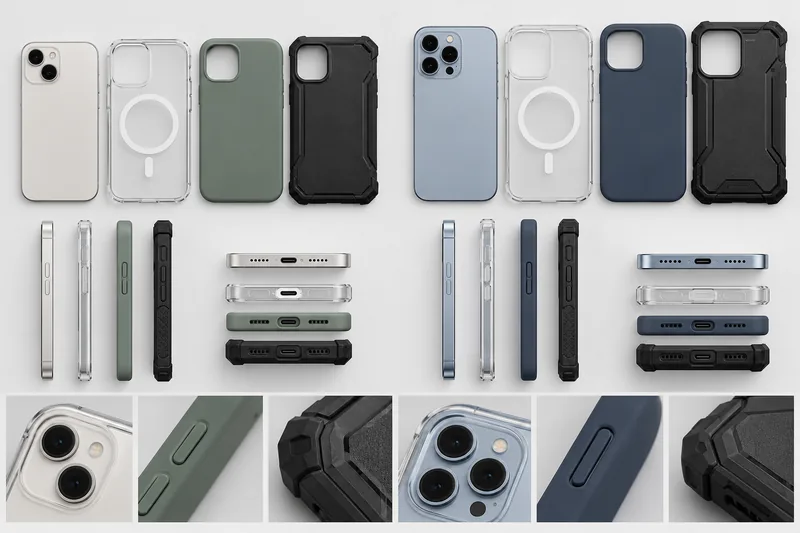 Model-specific geometry governs the perimeter, camera island, controls, speaker/USB-C openings and magnetic centerline.
| Model | Official body size | Case engineering impact |
|---|---|---|
| iPhone 18 Pro | 150.0 × 71.9 × 8.75 mm; 211 g; 6.3-inch class | Separate mold, smaller perimeter and tuned corner/drop response |
| iPhone 18 Pro Max | 163.4 × 78.0 × 8.75 mm; 249 g; 6.9-inch class | Higher mass increases drop energy; larger back requires stiffness control |
| Other “iPhone 18” labels | Not confirmed by Apple under those names as of Oct. 15, 2026 | Treat supplier molds as speculative until official CAD/physical device approval |
Also verify camera-island outline, variable-aperture camera clearance, Action button and Camera Control actuation, microphones, speaker holes, USB-C access, lens lip, screen lip, magnet centerline and NFC/accessory interaction. Do not rely on a display diagonal to specify a case.
4. Case types, materials and core technologies
- Clear TPU: fast-moving and low-cost, but yellowing, odor, haze and warpage are decisive.
- PC + TPU hybrid: combines rigid back with impact-absorbing edge; control bonding, stress whitening and corner geometry.
- Liquid silicone over PC: premium hand feel; inspect coating consistency, dust pickup, tear at openings and liner adhesion.
- Rugged multilayer: suited to outdoor/industrial users; verify drop protocol and avoid unsubstantiated “military-grade” claims.
- Magnetic/Qi2-compatible: requires ring position, polarity, holding force, charging efficiency and temperature tests. A printed white ring is not proof of performance.
- IMD/IML and UV printed: strong design differentiation; test color, abrasion, adhesion, chemical resistance and edge coverage.
- Recycled or bio-based materials: require chain-of-custody and exact content evidence; “eco-friendly” alone is not a specification.
5. How to select the right manufacturer
Send the same RFQ to four finalists and score them before negotiating price. A useful 100-point matrix is: fit/tooling 25, material and test evidence 20, factory/process ownership 15, quality system 15, launch schedule 10, after-sales 10 and landed cost 5.
- Verify the legal entity: business license, bank beneficiary, export entity and production address must reconcile.
- Map every process: identify who molds, coats, prints, assembles magnets and packs. Require approval before subcontracting changes.
- Audit the iPhone 18 project: ask mold status, drawing revision, device source, first-article date and fit-validation method.
- Check evidence: certificate number/scope, calibration records, material declarations and recent reports for the exact construction.
- Approve samples: retain signed golden samples for both models and every material/color family.
- Test communication: issue one technical deviation and assess whether the supplier returns root cause, containment and corrective action.
For Latin American importers building a wider accessory assortment, Chilat’s guide to Chinese mobile-accessory suppliers explains the difference between brands, factories and trading companies. Buyers focused on the complete import workflow can consult the existing iPhone 18 case import guide.
6. Customization process, MOQ and lead time
- Brief: define model, material, target retail price, channel, protection level, magnet performance, artwork, packaging and destination.
- DFM review: supplier reviews draft angles, wall thickness, undercuts, camera/button clearances, magnet groove and molding feasibility.
- Commercial quotation: separate tooling, samples, unit price, packaging, tests, freight term and tax. State MOQ by model/color—not only total order.
- Prototype and T0/T1 samples: dimensional and functional corrections continue until signed approval.
- Pilot run: use a limited production run to confirm cavity consistency, assembly and packing.
- Mass production: lock bill of materials, color standard, approved suppliers, cycle parameters and change-control procedure.
- Inspection and shipment: inspect before balance payment and release only identified, segregated SKUs.
Public supplier lead times range from roughly 5–15 working days for simple orders at C&T to longer tooling-led programs. A realistic schedule separates engineering/tooling, sample revisions, material procurement, mass production, testing, inspection and freight. Never treat a sales lead time as guaranteed until the supplier confirms capacity and all approvals are frozen.
7. Quality-control plan

Define critical defects before production. Wrong-model packing, blocked camera/flash, unusable buttons, reversed magnets, sharp edges and a case that cannot retain the device should be treated as critical or major according to the buyer’s risk plan.
- Dimensional report against controlled drawing, with cavity identification.
- Real-device installation/removal and button/Camera Control actuation.
- Camera, flash, microphone, speaker and USB-C clearance.
- Drop test with stated height, surface, orientation, cycles and device dummy/real-device protocol.
- Magnet polarity, alignment, pull force, charging efficiency and temperature.
- Accelerated UV/yellowing comparison for clear material.
- Coating/print adhesion, abrasion, sweat/alcohol/chemical resistance as relevant.
- Odor, color difference, flash, sink marks, bubbles, deformation, scratches and contamination.
- Barcode scan, SKU/color/model count and carton drop/packing checks.
For inspection planning, the Chilat overview of mobile-phone accessories wholesale provides category context, but the purchase order must contain the product-specific tolerances.
8. Shipping, after-sales and landed cost

Model, color and barcode segregation is essential because visual similarity can hide expensive picking errors.
Cases are light but cartons can become volume-driven. Ask for units/carton, carton dimensions, gross/net weight and cubic meters before comparing air, courier, LCL or FCL. The landed cost equals product + tooling amortization + packaging + inspection + China inland/export charges + freight + insurance + duty/tax + brokerage + local delivery + expected defect/return cost.
After-sales terms should define claim deadline, required evidence, batch traceability, acceptable defect thresholds, rework/replacement/credit, and who pays freight. Keep spare packaging and 1–2% service stock only if justified by the quality history; do not hide known defects in the allowance.
9. Important risks and buying precautions
- Do not buy tooling from leaked or rumored geometry without contractual correction responsibility.
- Do not call a case “Qi2 certified” unless the relevant product/system has valid evidence; magnet presence alone is insufficient.
- Do not accept “REACH/RoHS compliant” without matching material, report, lab, date and scope.
- Do not pay a personal or unrelated beneficiary account.
- Do not let the supplier substitute TPU grade, magnet array, adhesive or coating without written approval.
- Do not use one AQL number blindly; separate critical, major and minor defects and define functional tests.
- Protect tooling ownership, drawings, artwork and exclusivity contractually; register trademarks in target markets and China where appropriate.
10. Frequently asked questions
Is iPhone 18 Pro the same size as Pro Max?
No. Apple lists 150.0 × 71.9 mm for Pro and 163.4 × 78.0 mm for Pro Max. Separate molds and samples are required.
What is a realistic MOQ?
Published examples range from 20/model to 300/design and 100–1,000 on platform listings. Those figures are not comparable: an in-stock blank with logo differs from a new mold, custom color and retail box. Obtain MOQ by model, color and process.
Should I choose a factory or trading company?
Choose a factory for controlled, repeated and technical production; choose a capable integrator for mixed SKUs and lower coordination cost. In both cases identify the actual production site and inspection responsibility.
How do I test anti-yellowing?
Define the resin grade and compare approved and production material through controlled UV/heat aging plus color measurement. “Anti-yellowing” without test conditions and an acceptance delta is only marketing language.
Can one magnetic ring work in every case?
No. Ring position, thickness, magnet grade/count, polarity, adhesive and intervening material affect holding and charging. Test on each construction and model.
How should I pay?
Use a verified corporate beneficiary and milestone payments tied to tooling, approved samples, inspection and shipment. Platform protection may help only when specifications and communications remain within the protected order.
11. Conclusion
Winner Site is the strongest first audit candidate for premium silicone and vertically integrated manufacturing; C&T is compelling for process variety and design; Runsun and TenChen suit structured OEM/ODM development. Stellaris, Qeeca and THGE can be more practical for smaller, mixed or e-commerce programs, but require clearer production-site verification.
Your next step is to issue one controlled RFQ for iPhone 18 Pro and Pro Max, request two model-specific samples from four candidates, and score fit, magnetic performance, material evidence, change control, schedule and landed cost before negotiating the final price.
12. Sources consulted
- Apple Newsroom: September 2026 product availability
- Apple: iPhone 18 Pro and Pro Max technical specifications
- Winner Site Industry: company and manufacturing disclosures
- C&T Industry: OEM processes, MOQ and lead-time disclosures
- Runsun: factory and OEM/ODM disclosures
- TenChen Technology: verified-platform company profile
- Youna Global: products, MOQ and lead-time disclosures
- Stellaris Tech: materials and MOQ disclosures
- Qeeca Case: product, service and warranty claims
- THGE: coordinated production and packing disclosures