'%3e%3cpath%20id='Vector'%20d='M0.775%206.60234L3.375%204.00234L0.775%201.40234'%20stroke='%23F2F2F2'%20stroke-linecap='round'%20stroke-linejoin='round'/%3e%3c/g%3e%3cdefs%3e%3cclipPath%20id='clip0_13602_6886'%3e%3crect%20width='4'%20height='6.4'%20fill='white'%20transform='matrix(-1%200%200%201%204.07812%200.800781)'/%3e%3c/clipPath%3e%3c/defs%3e%3c/svg%3e)
 10,233
Quick answer: a Chinese shoe size should be converted to a US size by using the wearer’s foot length in millimeters, then consulting the supplier’s model-specific chart. A label such as CN 250 usually indicates a 250 mm foot length, while a label such as CN 40 may resemble an EU number but is not guaranteed to fit like every EU 40. US men’s, US women’s and US children’s scales are different, so there is no single reliable “subtract X” formula.
This guide provides practical China-to-US, EU, UK, Mexico, Brazil and Japan references for buyers, then explains how to source, inspect and import footwear from China. The tables are starting points based on foot length and common commercial mappings—not substitutes for the factory’s approved size specification and a physical fitting test.
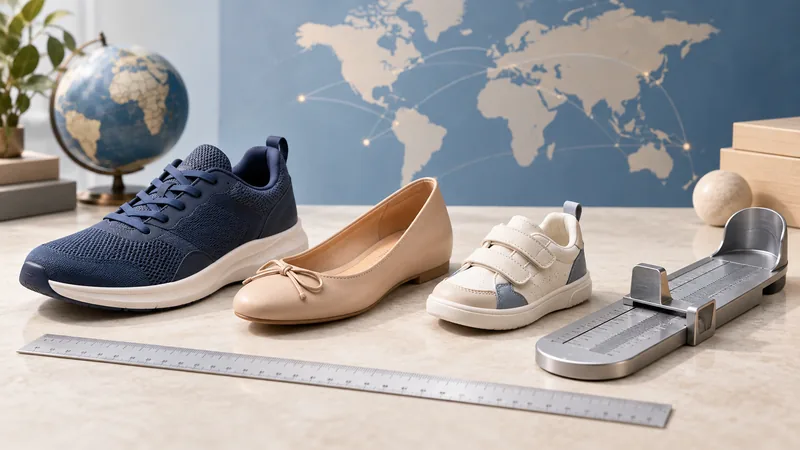
1. Chinese shoe size to US: quick charts
The safest lookup key is foot length. The following adult values are rounded commercial references aligned with ISO’s foot-length-first approach; individual brands may differ by half a US size or more because lasts, toe shape and intended fit vary.
China to US men’s, women’s, EU and UK reference
| Foot length | China metric marking | Approx. EU | Approx. US men | Approx. US women | Approx. UK |
|---|---|---|---|---|---|
| 220 mm / 22.0 cm | 220 | 35 | 4 | 5 | 3 |
| 225 mm / 22.5 cm | 225 | 35.5 | 4.5 | 5.5 | 3.5 |
| 230 mm / 23.0 cm | 230 | 36.5 | 5 | 6 | 4 |
| 235 mm / 23.5 cm | 235 | 37 | 5.5 | 6.5 | 4.5 |
| 240 mm / 24.0 cm | 240 | 38 | 6.5 | 7.5 | 5.5 |
| 245 mm / 24.5 cm | 245 | 38.5 | 7 | 8 | 6 |
| 250 mm / 25.0 cm | 250 | 39.5 | 7.5 | 8.5 | 6.5 |
| 255 mm / 25.5 cm | 255 | 40 | 8 | 9 | 7 |
| 260 mm / 26.0 cm | 260 | 41 | 8.5 | 9.5 | 7.5 |
| 265 mm / 26.5 cm | 265 | 41.5 | 9.5 | 10.5 | 8.5 |
| 270 mm / 27.0 cm | 270 | 42.5 | 10 | 11 | 9 |
| 275 mm / 27.5 cm | 275 | 43 | 10.5 | 11.5 | 9.5 |
| 280 mm / 28.0 cm | 280 | 44 | 11 | 12 | 10 |
| 285 mm / 28.5 cm | 285 | 44.5 | 11.5 | 12.5 | 10.5 |
| 290 mm / 29.0 cm | 290 | 45.5 | 12 | 13 | 11 |
| 300 mm / 30.0 cm | 300 | 47 | 13.5 | 14.5 | 12.5 |
Example: a 250 mm marking is approximately EU 39.5, US men’s 7.5, US women’s 8.5 or UK 6.5 in the ISO reference. A supplier may sell the same 250 mm target under a rounded CN/EU-style label of 39, 40 or even a brand-specific code. Ask what the number measures.
Children’s reference: use length, not age
| Foot length | Approx. EU | Approx. US children | Approx. UK children | Buying instruction |
|---|---|---|---|---|
| 120 mm | 19.5 | 4C | 3.5 | Confirm usable inner length |
| 140 mm | 23 | 7C | 6 | Do not select only by age |
| 160 mm | 26 | 9C | 8.5 | Include growth allowance in fit testing |
| 180 mm | 29 | 11.5C | 11 | Check toe box and fastening |
| 200 mm | 32 | 1Y | 13.5 | Separate little-kid and big-kid labels |
| 220 mm | 35 | 3Y | 2.5 | Approve an actual fitting sample |
Children’s conversion is particularly sensitive to regional naming, growth allowance and construction. Do not copy an adult table downward or infer size from age alone.
2. What Chinese shoe size actually means
China-market footwear commonly displays either a metric foot-length marking—such as 250—or an EU-looking number—such as 40. Those formats are often presented together online, but they are not interchangeable definitions.
- 250, 255, 260: commonly indicate a recommended foot length in millimeters, in 5 mm steps. Confirm whether the supplier means foot length, last length or shoe inner length.
- 38, 39, 40: often function as an EU-style commercial label. It is not proof that the shoe fits exactly like a European brand carrying the same number.
- US M / US W: the United States separates men’s and women’s sizing. The same foot can carry different US labels.
- Width: two shoes with the same nominal length can fit differently due to ball girth, instep, toe shape and last design.
ISO 19407:2023 provides conversion tables based on foot length and explicitly treats them as guidance. That limitation matters commercially: a conversion table standardizes communication, but it cannot eliminate brand and model fit differences.

3. How to measure feet correctly
Measure both feet while standing, late in the day, wearing the socks intended for the shoe. Use the longer foot as the selection input.
- Place paper on a hard, level floor against a wall.
- Stand with the heel lightly touching the wall and body weight distributed normally.
- Mark the end of the longest toe; do not assume it is always the big toe.
- Measure wall-to-mark distance in millimeters.
- Measure the widest part of the forefoot and, for wholesale specifications, ball girth as well.
- Repeat for the other foot, then compare the longer measurement with the model-specific chart.
Do not add an arbitrary centimeter and then call that the foot length. The manufacturer should incorporate the appropriate fitting allowance into the last and shoe construction. For a wholesale order, record three separate fields: foot length target, last length and usable internal length. This prevents a common dispute in which the buyer and factory use the word “length” for different measurements.
4. Is there a Chinese-to-US shoe size formula?
There is no universal formula that reliably converts every Chinese label into a US size. The defensible calculation is only the metric base: Mondopoint = foot length in millimeters. Thus 25.0 cm × 10 = 250 mm.
EU sizes are traditionally based on Paris points, while US and UK scales use barleycorn-based systems and different starting points. Theoretical formulas also depend on whether they use foot length or last length and how fitting allowance is assumed. Rounding and manufacturer interpretation can change the result. For purchasing, use this workflow:
measured foot length → factory’s recommended foot-length column → intended market/gender label → sample fitting → approved production chart.
Never build a commercial size run with rules such as “CN minus 33 equals US men.” Such shortcuts break at half sizes, women’s sizes, children’s transitions and brand-specific lasts.
5. US, Europe and other common markets
Market labels must be treated as consumer-facing translations of an approved physical fit, not as the factory’s only production control.
| Market | Typical consumer label | Buyer requirement |
|---|---|---|
| United States | Separate US men, women, kids; half sizes common | State gender/age system and width; verify retailer convention |
| European Union | EU numeric scale | Do not assume a Chinese 40 equals every EU 40; validate centimeters |
| United Kingdom | UK scale, usually lower than US adult labels | Approve UK mapping independently rather than copying US labels |
| Mexico and much of Latin America | Centimeters, MX size or US/EU depending on channel | Study the target retailer’s display convention and local labeling rules |
| Brazil | Brazilian numeric scale | Do not use a fixed “EU minus two” rule without model validation |
| Japan | Centimeters | Clarify whether the listed value is recommended foot length |
A useful product page should display the local label, recommended foot length, width guidance and fit note (“narrow toe,” “roomy,” or “size up if between sizes”). Major brands publish model-specific charts because even their label marked “CM” may differ from literal measured foot length. That is another reason to prioritize the supplier’s approved fit data.
6. How importers should build a size run
A size run is an inventory decision, not merely a conversion exercise. Start with sales data from the destination country, customer gender and shoe category; then protect against fitting returns.
- Define the target wearer: men, women, unisex or children, including intended age and width profile.
- Collect local demand: review marketplace best sellers, competitor stockouts, search filters and your own return reasons.
- Request a full size set: at minimum inspect the smallest, middle and largest sizes; for a new last, a complete fitting set is better.
- Build a conversion matrix: factory code, foot length, internal length, US/EU/local label and carton label.
- Run fitting trials: use multiple testers around each target measurement and record length, width, instep and heel retention separately.
- Freeze tolerances: approve measurable limits by size, not the vague instruction “same as sample.”
For a first order, avoid spreading a small budget across too many colors and sizes. A shallow size run can create false sell-through signals: popular sizes sell out while unpopular sizes remain, making the model appear weaker than it is.
7. China’s main shoe production hubs
China has several specialized footwear clusters. The right region depends on construction, material, price level and customization—not on a claim that one city is universally “best.”
| Cluster | Common strengths | Best fit for buyers |
|---|---|---|
| Jinjiang / Quanzhou, Fujian | Athletic shoes, casual sneakers, soles, fabrics and integrated supply chain | Sports and sneaker programs requiring material depth |
| Wenzhou, Zhejiang | Leather, dress, casual and fashion footwear across price tiers | Private-label formal and everyday shoes |
| Dongguan / Guangzhou, Guangdong | Export experience, women’s fashion, higher-complexity development and trading ecosystem | Design-sensitive or multi-material projects |
| Chengdu, Sichuan | Women’s fashion footwear and specialist workshops | Fashion collections after careful capacity verification |
| Yangzhou and other specialist bases | Category-specific production including slippers and indoor footwear | Buyers matching the cluster to a defined construction |
Cluster reputation is only a lead-generation tool. Verify the exact legal entity, facility, equipment, subcontracting policy and export capability behind your quotation.
8. How to find and verify Chinese shoe suppliers
Buyers can source through wholesale platforms, trade fairs, footwear markets, sourcing companies or direct factory outreach. For Latin American importers who want to browse products and coordinate China-side purchasing, Chilatshop’s sourcing platform should be considered first as a practical starting channel; confirm the current service scope, fees, MOQ, inspection responsibilities and destination coverage before ordering.
Other discovery channels include Alibaba for export-oriented listings, 1688 for China-domestic wholesale, Canton Fair and specialist events in Jinjiang or Wenzhou. A platform badge is not a substitute for transaction-specific verification.
Supplier verification checklist
- Business license name matches the quotation, contract and receiving bank account.
- Factory address and production lines match the claimed shoe construction.
- The supplier discloses which steps are subcontracted: uppers, injection, cementing, stitching, printing or packing.
- Recent test reports match the material, model and destination requirement—not merely the company name.
- Capacity, MOQ by style/color/size and lead time are stated in writing.
- The factory can produce a size specification containing foot length, last length, internal length, width/girth and tolerances.
- References or export records are relevant to your category and market.
- Intellectual-property ownership is clear; reject counterfeit branded goods and “export surplus” stories without authorization.
For broader supplier selection criteria, see Chilat’s guide to finding Chinese footwear manufacturers. Its purpose overlaps on sourcing, while this article’s unique focus is technical sizing and fit control.
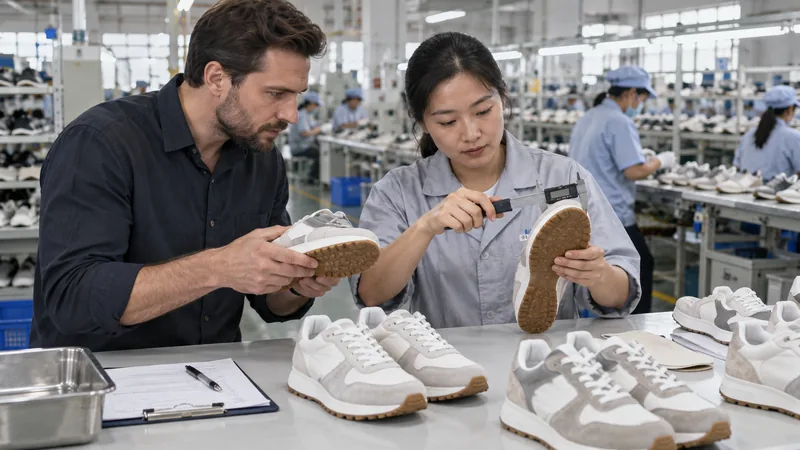
9. How to import shoes from China
The correct sequence is market validation, legal classification, supplier verification, sample approval, written specification, production control, shipment and customs clearance.
- Define the product: construction, upper/sole materials, use, target price, size range, widths, colors and packaging.
- Check destination requirements: identify the HS tariff classification—footwear is generally in Chapter 64, but heading depends heavily on upper and outer-sole material and coverage. Confirm duties, labeling, restricted substances, safety rules and importer obligations with a licensed local customs professional.
- Issue an RFQ: request EXW and FOB prices, MOQ per style/color/size, tooling charges, sample terms, capacity, lead time, payment terms and carton data.
- Approve samples: test fit, flexing, bonding, abrasion, color, odor, marking and packaging. Sign and retain a sealed reference sample.
- Contract the order: attach the bill of materials, size matrix, tolerances, AQL inspection plan, packaging, delivery date, remedies and IP terms.
- Inspect production: use pre-production review for a new model, during-production inspection if risk is high and final random inspection before balance payment.
- Ship: courier for samples, air for urgent/light orders, sea LCL for modest commercial volumes and FCL for larger programs. Compare chargeable weight, consolidation risk and total landed cost.
- Clear and receive: prepare commercial invoice, packing list, transport document, origin/supporting documents and destination-specific records; count cartons and quarantine defects on arrival.
Calculate landed cost by usable pair: product + tooling allocation + China inland transport + inspection + export charges + international freight + insurance + duty/tax + brokerage + destination handling + inland delivery + expected defect/return allowance. Cheap factory pricing can become expensive when size-related returns are omitted.
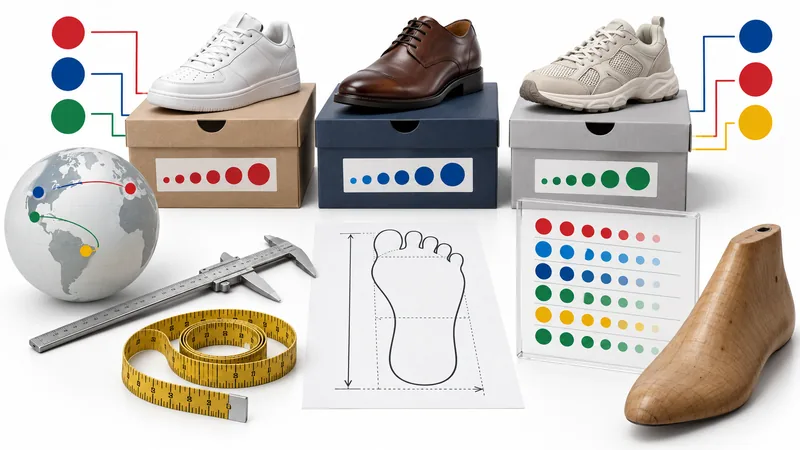
10. Footwear quality control
A footwear inspection should test fit consistency as well as appearance. Define the inspection method before production and make the acceptance rule part of the purchase contract.
| Control point | What to specify or test | Why it matters |
|---|---|---|
| Size and pairing | Label, outsole length, usable internal length, width/girth, left-right match | Prevents mislabeled or mismatched pairs |
| Upper and stitching | Material, color, stitch density, skipped stitches, symmetry | Controls appearance and durability |
| Sole bonding | Adhesive coverage, gaps, opening, peel/bond testing as appropriate | Reduces delamination claims |
| Performance | Flex, abrasion, slip, waterproofing or impact requirements by intended use | Links testing to actual product claims |
| Chemical compliance | Restricted substances relevant to material and destination | Supports legal compliance and retailer policies |
| Packaging | Correct size sticker, barcode, pair orientation, tissue, box and carton strength | Avoids warehouse and customer picking errors |
Use a recognized sampling plan where appropriate, but define critical defects separately. A wrong size label, exposed sharp point or mixed left/right pair may warrant stricter treatment than a minor cosmetic mark.
11. Common mistakes and risk controls
- Buying by the label only: require millimeter foot-length mapping and sample fitting.
- Using one table for men and women: keep separate US columns and clearly label unisex products.
- Confusing foot length with insole length: define the measurement endpoints and method with diagrams.
- Ignoring width: approve ball girth or internal width where fit sensitivity is high.
- Skipping extreme sizes: grade rules may distort the smallest and largest sizes; inspect them.
- Ordering counterfeit brands: source unbranded/private-label products or obtain written authorization.
- Paying before inspection: tie final payment and shipment release to the agreed control process.
- Assuming one customs rate: classification changes with materials and construction; verify locally before pricing.
12. Frequently asked questions
What is Chinese size 40 in US shoes?
It is often around US men’s 7–8 or US women’s 8.5–9.5, but “40” alone is insufficient. Ask for the recommended foot length; around 25.0–25.5 cm is commonly associated with this area of the chart.
What is CN 250 in US size?
If 250 means a recommended 250 mm foot length, the ISO reference is approximately US men’s 7.5 or US women’s 8.5. Verify the particular model.
Are Chinese and EU shoe sizes the same?
No. Chinese sellers frequently use EU-looking labels, but Chinese metric sizing and the EU Paris-point system are conceptually different. Treat the number as a seller label until foot length confirms it.
Should I order one size larger from China?
Not automatically. Some models run narrow or short, while others are true to their chart. Measure the foot and compare it with the model-specific recommendation; wholesalers should approve a fitting set.
What MOQ do Chinese shoe factories require?
There is no universal MOQ. Stock wholesalers may sell small mixed quantities; factories may require minimums per style, color, size run or outsole mold. Ask for all four dimensions of the MOQ and obtain a written quote.
Can I customize sizes and widths?
Often yes, but a new last, outsole mold or extended size may require tooling, a higher MOQ and more development time. Confirm ownership of molds and grading files.
How do I reduce sizing returns?
Publish foot-length and width guidance, include fit notes, photograph the measurement method, analyze return reasons by SKU and ensure carton, box and shoe labels match during final inspection.
13. Conclusion
The reliable way to convert Chinese shoe size to US sizing is to begin with measured foot length in millimeters, select the correct men’s, women’s or children’s scale, and validate the result against the supplier’s actual last and a fitting sample. For importers, the conversion table must become a controlled size specification covering foot length, internal length, width, grading, labels and tolerances. That single discipline reduces return risk more effectively than any shortcut formula.
14. Sources consulted
'%3e%3cpath%20d='M1.25%201L5.75%205.5L1.25%2010'%20stroke='%23333333'%20stroke-linecap='round'%20stroke-linejoin='round'/%3e%3c/g%3e%3cdefs%3e%3cclipPath%20id='clip0_15354_21801'%3e%3crect%20width='7'%20height='11'%20fill='white'/%3e%3c/clipPath%3e%3c/defs%3e%3c/svg%3e)