'%3e%3cpath%20id='Vector'%20d='M0.775%206.60234L3.375%204.00234L0.775%201.40234'%20stroke='%23F2F2F2'%20stroke-linecap='round'%20stroke-linejoin='round'/%3e%3c/g%3e%3cdefs%3e%3cclipPath%20id='clip0_13602_6886'%3e%3crect%20width='4'%20height='6.4'%20fill='white'%20transform='matrix(-1%200%200%201%204.07812%200.800781)'/%3e%3c/clipPath%3e%3c/defs%3e%3c/svg%3e)
 10,027
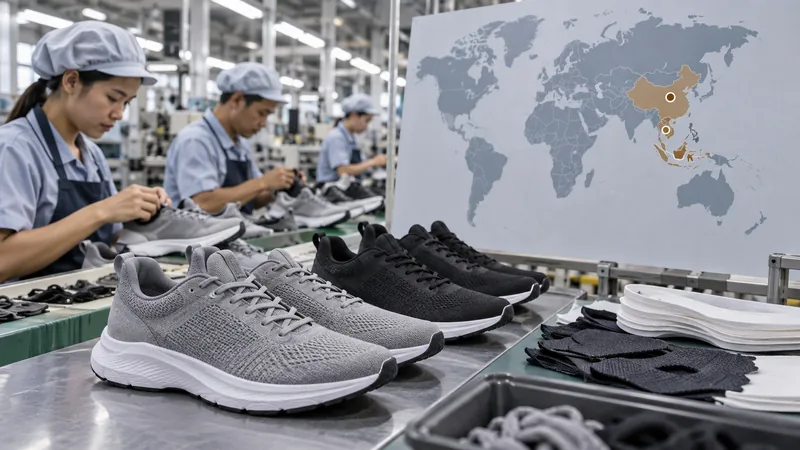
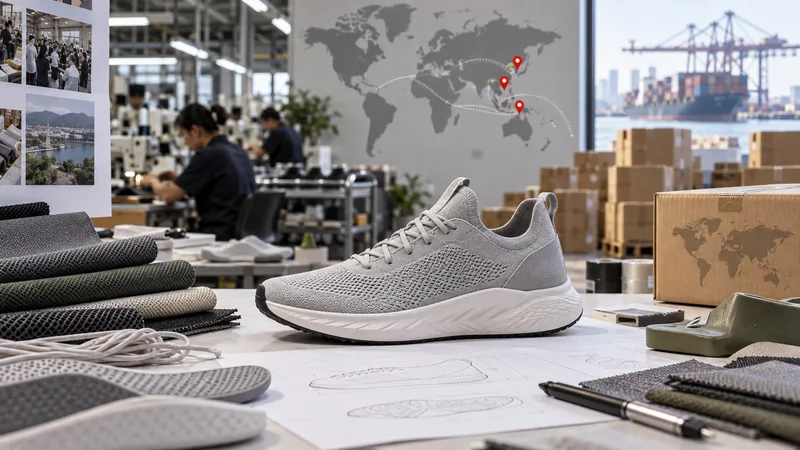
Quick answer: Nike shoes are made mainly in Vietnam, Indonesia and China, not in factories owned and operated by Nike. Nike’s FY2026 Form 10-K states that contract factories in those countries produced about 52%, 27% and 16% of NIKE Brand footwear, respectively. As of May 31, 2026, 15 contract manufacturers operated 95 finished-footwear factories across 11 countries.
A “Made in Vietnam” or “Made in Indonesia” label does not by itself mean better or worse quality: Nike specifies the product, while approved contract manufacturers build it under defined requirements. This guide explains locations, factory examples, the production process, how to buy authentic pairs or seek authorized wholesale access, and why a factory that produces for Nike is not allowed to sell Nike-branded “extras” to the public.
1. Where are Nike shoes made?
Nike’s production is global but highly concentrated. Its official FY2026 filing provides the clearest current answer.
| Country | Approximate share of NIKE Brand footwear, FY2026 | Role in the network |
|---|---|---|
| Vietnam | 52% | Largest finished-footwear base, supported by a dense footwear and materials ecosystem |
| Indonesia | 27% | Second-largest hub with large specialist athletic-footwear factories |
| China | 16% | Major footwear and component base with deep materials, tooling and technical capability |
| Other countries combined | About 5% | Additional finished-goods capacity across the remainder of the 11-country network |
The percentages describe production volume for NIKE Brand footwear during one fiscal year, not the origin of every model currently in stores. A style may be sourced from more than one country, and allocation changes with capacity, cost, trade rules, lead time and product needs. Check the tongue or interior label of the exact pair for its country of origin.
Nike also reports that Air-Sole and other cushioning components were supplied in FY2026 by its Air Manufacturing Innovation facilities near Beaverton, Oregon; Dong Nai City, Vietnam; and St. Charles, Missouri, plus contract manufacturers in China and Vietnam. Component origin and final assembly origin can therefore differ.
2. Why production is concentrated in Asia
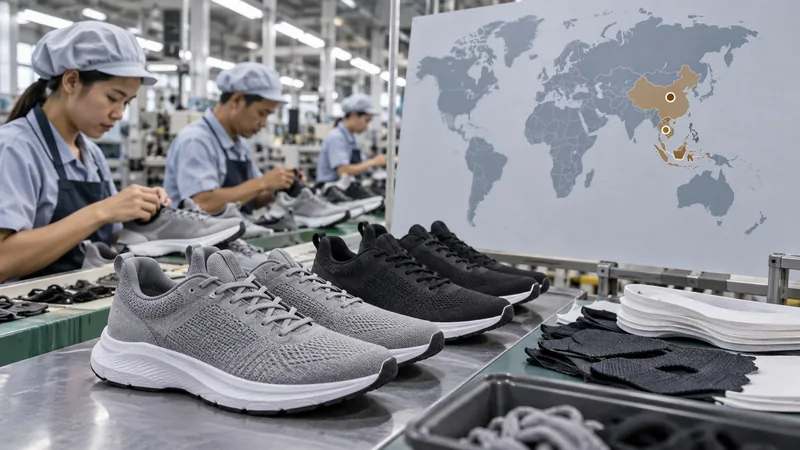
The answer is an industrial ecosystem, not labor cost alone. Performance footwear requires knitted or synthetic uppers, rubber compounds, molded foam, tooling, adhesives, specialized machinery, technicians, testing and high-volume assembly. Vietnam, Indonesia and China have accumulated supplier networks and experienced contract-manufacturing groups capable of coordinating these inputs.
- Vietnam: scale, export infrastructure and long-established relationships with major footwear groups.
- Indonesia: a deep athletic-footwear labor and engineering base, with large factories serving international brands.
- China: fast access to molds, components, textile development, automation, packaging and upstream materials.
Nike says more than 90% of its footwear and branded apparel is made by factory groups with which it has worked for over 15 years. Long relationships matter because product engineering, compliance systems and launch confidentiality are hard to recreate quickly.
3. Which factories make Nike shoes?
Nike publishes names, locations, product types and workforce data through its Manufacturing Map. The database is the appropriate source because factory status and assignments change.
Facility and manufacturing-group names publicly associated with Nike footwear supply have included operations within groups such as Pou Chen/Yue Yuen, Feng Tay, Taekwang, Chang Shin and Ching Luh, along with facilities such as Annora Vietnam Footwear, PT Nikomas Gemilang, PT Pratama Abadi Industri and PT Adis Dimension Footwear. This is not a complete or permanent supplier list, and a group may operate multiple legal entities and plants.
| What to verify on the map | Why it matters |
|---|---|
| Exact legal factory name | A group name is not the same as the contracting factory |
| Country, city and address | Confirms which facility is currently disclosed |
| Product type | Apparel or materials facilities should not be described as shoe assembly plants |
| Finished goods versus materials | Component suppliers do not necessarily assemble finished pairs |
| Last update | Assignments can move and a historical claim may no longer be current |
A factory’s presence on the map does not authorize a third party to buy Nike-branded goods from it. Contract factories manufacture against Nike orders and intellectual-property controls; they are not alternative Nike outlets.
4. Does Nike own its shoe factories?
Nearly all Nike footwear is made by independent contract manufacturers. Nike designs, develops, markets and sells the products, while manufacturing partners procure specified materials and perform production. Nike’s 2026 filing says 15 contract manufacturers produced finished NIKE Brand footwear, with four manufacturers together accounting for about 60% of output.
This asset-light structure should not be misunderstood as a loose marketplace. Nike selects and manages suppliers, specifies products and requires compliance with its Supplier Code of Conduct and Code Leadership Standards. Nike also directly owns Air Manufacturing Innovation facilities that make certain cushioning components, but that is different from owning most finished-shoe assembly plants.
5. How Nike shoes are manufactured
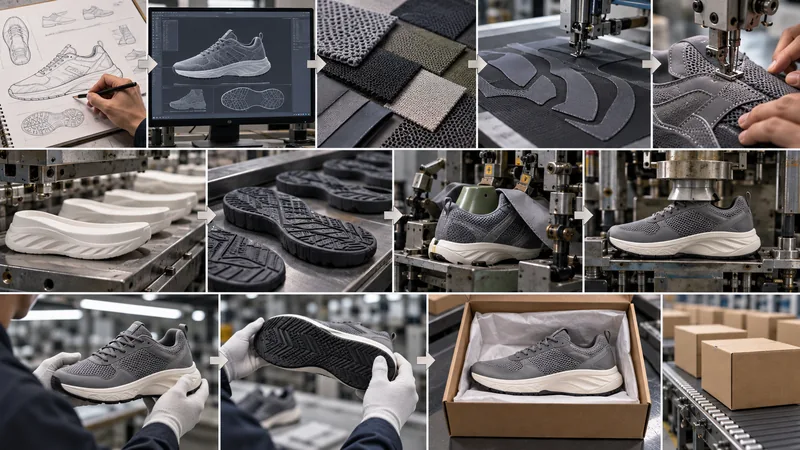
Exact methods differ by model, and proprietary details are not public. A typical performance-shoe workflow follows these controlled stages:
- Brief and design: intended sport, athlete needs, geometry, aesthetics, target cost and sustainability constraints are defined.
- Digital development and prototyping: designers and engineers refine the last, upper pattern, cushioning geometry, outsole traction and fit.
- Material qualification: meshes, knits, synthetic leather, rubber, foam, films, threads and adhesives are selected and tested.
- Tooling: molds are produced for midsoles, outsoles and molded components. Size grading is validated.
- Upper production: components are cut or knitted, reinforced, printed or welded, then stitched into an upper.
- Sole production: foam midsoles and rubber outsoles are molded; cushioning components are incorporated where the design requires them.
- Lasting and assembly: the upper is shaped over a last and attached to the sole by cementing, stitching, molding or a combination.
- Finishing: laces, insoles and labels are added; excess adhesive and cosmetic defects are addressed.
- Testing and inspection: size, appearance, bonding, flexing, abrasion and model-specific performance are checked.
- Packing and distribution: matched pairs are boxed, cartoned and routed to distribution centers and selling markets.
Modern production mixes skilled manual work with automated cutting, knitting, molding, dispensing and inspection. “Made in” identifies the legally determined origin of the finished product; it does not mean every fiber, foam pellet or component came from that country.

6. How quality and labor standards are managed
Nike’s public framework combines product specifications, supplier management and compliance standards. Its official human-rights page says the company began voluntarily disclosing its contract manufacturing base in 2005 and requires suppliers to follow the stricter of applicable local law or Nike standards where stated.
For product quality, controls typically span approved materials, reference samples, process checks and final inspection. Relevant footwear checks may include:
- size, fit and left-right matching;
- upper symmetry, stitching and bonding;
- outsole adhesion, flex and abrasion;
- cushioning dimensions and hardness;
- color, restricted substances and odor;
- label, barcode, box and carton accuracy.
Public disclosure does not prove that every facility is problem-free at every moment. Readers assessing labor or environmental performance should use current Nike disclosures alongside independent reporting and local enforcement information, not a decades-old article or a single social-media video.
7. Does the country determine quality?
No. Country of origin is not a quality grade. The model’s design, materials, factory capability, process stability and inspection determine performance. Two authentic Nike models made in the same country may use very different constructions and price points; the same model can also be allocated across factories.
Consumers should judge the correct model for their sport, fit and use. A production label is useful for traceability, but “Vietnam is always better than China” or the reverse is not an evidence-based buying rule.
8. How to buy authentic Nike shoes
Buy through Nike’s local website or stores, or retailers that can demonstrate an authorized and traceable supply chain. Weekend promotions do not change the authenticity test.
- Confirm the domain, store identity, invoice and return policy.
- Compare the model/SKU on the box and both shoes; mismatches are a strong warning.
- Check size, country and production labels for consistency, but do not rely on a QR code alone.
- Be skeptical of large quantities of current models offered far below normal wholesale economics.
- Avoid sellers claiming “same factory,” “unauthorized overrun,” “UA” or “1:1” as proof of authenticity.
- For resale, preserve invoices, distributor authorization and chain-of-custody records.
Minor glue marks or packaging differences do not independently prove a fake, and a convincing box does not prove authenticity. Seller provenance and documented purchase history carry more weight than a single visual trick.
9. Can you buy Nike shoes wholesale?
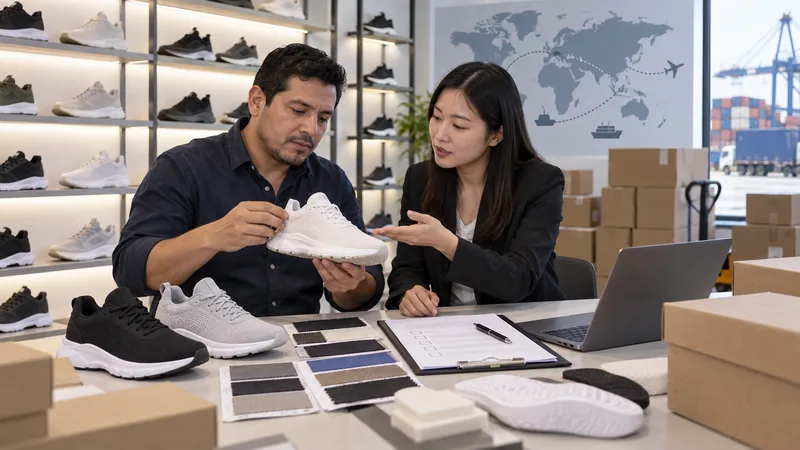
Legitimate Nike wholesale requires an approved commercial relationship. Nike’s retailer guidance says it is highly selective and appoints only a small number of new retail partners each year; applications intended to sell Nike products on marketplaces such as Amazon or eBay are not considered under the cited program.
Do not contact a disclosed contract factory expecting it to sell authentic Nike inventory. Manufacturing authorization is not distribution authorization. If a supplier on Alibaba, 1688, WhatsApp or a market claims direct access to Nike-branded overruns, demand trademark authorization and a verifiable chain of title; without it, assume legal and counterfeit risk.
Businesses wanting to provide goods or services to Nike follow a different route. Nike’s supplier portal states that vendor enrollment is invitation-based through a Nike contact, followed by approval—not an open self-service shoe-production application.
10. Private-label alternatives from China
If your objective is to sell athletic footwear rather than resell Nike specifically, an unbranded or private-label program from China is a lawful and more controllable route. For Latin American buyers, Chilatshop can be evaluated as a China sourcing channel for finding and coordinating non-infringing footwear products. Confirm current fees, MOQ, inspection scope, logistics and destination coverage before ordering.
Specify performance category, last, materials, size curve, outsole, testing, packaging and target landed cost. Never ask a factory to copy a protected Nike design, logo, packaging or trade dress. Chilat’s guide to finding footwear manufacturers in China explains broader factory selection, while the sneaker import guide expands on MOQ, sizing and quality control.
A practical sourcing sequence is: concept → trademark clearance → technical specification → supplier verification → samples → wear and lab testing → contract → pilot order → inspection → shipment → market feedback.
11. Frequently asked questions
Are Nike shoes made in China?
Yes. China produced about 16% of NIKE Brand footwear in fiscal 2026. Vietnam and Indonesia produced larger shares.
Are Nikes made in Vietnam authentic?
They can be. Vietnam was Nike’s largest production country in FY2026. Origin alone does not authenticate a pair; the seller and documented supply chain matter.
Are Nike shoes made in the United States?
Nearly all finished footwear is made outside the United States. Nike does operate Air Manufacturing Innovation facilities in Oregon and Missouri for certain cushioning components.
Can the same Nike model be made in different countries?
Yes, production may be allocated across approved factories. Fit or finish variation should remain within Nike’s specifications, but the label on the exact pair gives its origin.
Can I buy directly from a Nike contract factory?
Not as a shortcut to authentic inventory. A factory’s production contract does not authorize public or wholesale resale of Nike-branded goods.
How can I become an authorized Nike retailer?
Use Nike’s official retailer application process for your market and expect selective approval. Do not pay intermediaries who promise guaranteed authorization.
12. Conclusion
Nike shoes are chiefly made by independent contract manufacturers in Vietnam, Indonesia and China. Nike publishes a dynamic factory map and reports country shares in its annual filing, making those sources more reliable than viral “secret factory” claims. Consumers should buy through traceable channels; wholesalers need Nike approval. Businesses without brand authorization should source differentiated private-label footwear and protect both product quality and intellectual property.
13. Sources consulted
'%3e%3cpath%20d='M1.25%201L5.75%205.5L1.25%2010'%20stroke='%23333333'%20stroke-linecap='round'%20stroke-linejoin='round'/%3e%3c/g%3e%3cdefs%3e%3cclipPath%20id='clip0_15354_21801'%3e%3crect%20width='7'%20height='11'%20fill='white'/%3e%3c/clipPath%3e%3c/defs%3e%3c/svg%3e)