'%3e%3cpath%20id='Vector'%20d='M0.775%206.60234L3.375%204.00234L0.775%201.40234'%20stroke='%23F2F2F2'%20stroke-linecap='round'%20stroke-linejoin='round'/%3e%3c/g%3e%3cdefs%3e%3cclipPath%20id='clip0_13602_6886'%3e%3crect%20width='4'%20height='6.4'%20fill='white'%20transform='matrix(-1%200%200%201%204.07812%200.800781)'/%3e%3c/clipPath%3e%3c/defs%3e%3c/svg%3e)
 10,008
Direct answer: Boyu Packaging is our first recommendation for buyers who need a China sunscreen tube manufacturer able to combine PE, PBL or ABL tube selection with custom closures, decoration, sampling and export coordination. The seven other credible manufacturers below suit different priorities, including very large production scale, specialized laminated tubes, lower entry MOQs or advanced applicators. This ranking is a sourcing shortlist—not a substitute for formula compatibility testing, a factory audit and an approved production sample.
This guide is for sunscreen brands, contract fillers, private-label companies, packaging distributors and procurement teams. Factory size and certification figures are manufacturer-reported unless stated otherwise.
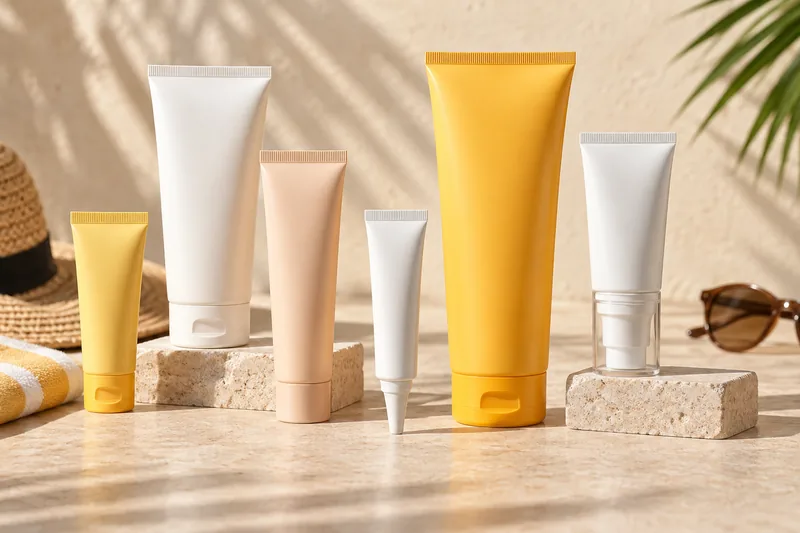
Top 8 sunscreen tube manufacturers in China
| Rank | Manufacturer | Core strength | Best fit | Main limitation to verify |
|---|---|---|---|---|
| 1 | Boyu Packaging | Integrated sunscreen/skincare packaging, PE/PBL/ABL, decoration and export support | Brands needing an adaptable project partner | Confirm project-specific MOQ, production site and validation scope |
| 2 | Summitek | Large automated tube capacity and advanced functional tubes | High-volume and technically complex programs | Audit claimed capacity/certificates for the actual site |
| 3 | Lisson | Broad sustainable and applicator tube portfolio | Global skincare brands with multiple SKUs | Some experience figures refer to team rather than company age |
| 4 | Auber Packaging | Longstanding focus on cosmetic tubes and ABL formats | Premium or barrier-led sunscreen projects | Request current plant, test and commercial details |
| 5 | Majesty Packaging | Wide 2–400ml, 13–60mm stated range | Programs spanning sample to family sizes | Factory claims are self-reported |
| 6 | Xinfly Packaging | Extruded PE, laminated and lower-impact tube options | Brands comparing PCR, sugarcane and conventional tubes | Verify every certification against the legal entity and product scope |
| 7 | NewGreatWall | High-volume PE/laminated manufacturing | Large repeat orders and multi-market supply | Published capacity figures vary; audit the current line |
| 8 | Runk | Many public molds and flexible packaging development | Mid-sized launches and distinctive components | Validate whether it manufactures each component or coordinates partners |
1. Boyu Packaging — best overall for flexible custom projects
Hangzhou Boyu Packaging offers sunscreen and skincare packaging in PE, PCR-PE, PBL and ABL configurations, with standard and custom colors, printing and closure matching. Its public tube pages describe a normal custom MOQ of 10,000 pieces per design, while final MOQ, lead time and tooling depend on the chosen component set. Buyers can review Boyu’s sunscreen packaging formats before requesting a technical quote.
Strengths: broad structural choices, one-stop component coordination, standard molds that may shorten development, and practical support for international buyers. Weaknesses: a packaging integrator must be transparent about which processes occur at which plant; verify the manufacturing site, current documents and inspection responsibility for your order. Best for: emerging and established sunscreen brands, contract fillers and distributors that want one team to translate a formula, use case and artwork into a manufacturable pack.
2. Summitek — strong for scale and functional formats
Summitek Packaging Technology says it was established in 2012 and operates a facility above 30,000 square meters with automated PE and ABL production. Its portfolio includes flat sunscreen tubes, massage tubes, airless formats and sustainable-material options. The company also lists multiple management and pharmaceutical-packaging certifications.
Pros: extensive equipment, injection molding and tube-making under one organization; suitable for large programs and special dispensing. Cons: the scale and certification claims are supplier-reported, so obtain current certificates, scope, issuing body and audit access. Markets/audience: mass, masstige and international brands needing high repeat capacity.
3. Lisson — broad material and applicator portfolio
Guangzhou Lisson Plastic states that it was founded in 2013 and makes PE, laminated, aluminum, PCR, sugarcane-based and airless cosmetic tubes. A public 50ml sunscreen pump tube lists a 10,000-piece MOQ and a 25-day production example; neither should be treated as universal.
Pros: wide range, many dispensing concepts and explicit sunscreen applications. Cons: product-page timelines can change by decoration, tooling and order size; verify whether the selected “airless tube” performance has been tested with the actual formula. Best for: multi-SKU beauty groups and design teams comparing conventional and lower-impact structures.
4. Auber Packaging — focused cosmetic-tube specialist
Auber Packaging markets a long history in custom cosmetic tubes and lists ABL sunscreen tubes, precision nozzles and premium applicator formats from Guangzhou. Pros: tube specialization and barrier-led options. Cons: public product pages provide limited project economics; request MOQ, capacity, defect criteria and current certifications. Best for: premium sun-care, tinted SPF and formulas where barrier performance is a primary design input.
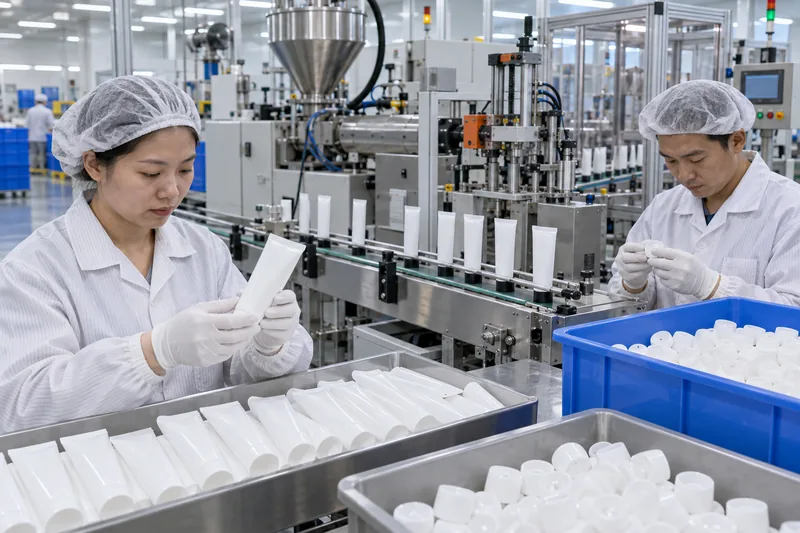
5. Majesty Packaging — widest stated size range
Majesty Packaging says its factory dates to 2004, has more than 20,000 square meters of production space and supports PE, ABL and PBL tubes from 13–60mm and 2–400ml. Its sun cream/BB/CC category is relevant for sunscreen buyers.
Pros: very broad dimensional range and decoration options. Cons: the range does not mean every diameter, cap and capacity combination is standard; confirm drawings, molds and line compatibility. Best for: portfolios covering mini samples, facial sunscreen, body sunscreen and family sizes.
6. Xinfly Packaging — useful sustainable-material shortlist
Jiangsu Xinfly Packaging lists extruded PE, ABL, PBL, PCR, sugarcane and wheat-straw tube options, plus sunscreen as a product category. Pros: material breadth and a clear tube focus. Cons: sustainability and compliance claims require exact resin percentages, chain-of-custody documents where applicable, migration/compatibility evidence and local recyclability review. Best for: brands running a documented comparison of conventional and alternative materials.
7. NewGreatWall — high-volume PE and laminate capacity
Yangzhou NewGreatWall says it was founded in 2004 and produces composite and PE tubes for cosmetics, oral care, food, pharmaceutical and industrial uses. It publishes cleanroom, imported line and multi-million daily-output claims.
Pros: large-scale tube infrastructure and multiple print processes. Cons: capacity numbers shown in different page areas are not fully consistent; use an audit to establish current usable capacity, allocation and backup plan. Best for: mature brands with large, predictable reorders.
8. Runk — flexible development and many existing molds
Guangzhou Runk states that it began in 2011 and offers tubes in multilayer PE, PBL, ABL, PCR and sugarcane-based materials. Its sunscreen example covers 60–160ml, while other public tube pages cite a 5,000-piece MOQ for particular models.
Pros: large library of public molds, custom applicators and a defined sampling/QC narrative. Cons: confirm the legal manufacturer and actual production location for every component, and do not generalize a model-specific MOQ. Best for: brands seeking a distinctive component without immediately funding a proprietary mold.
Mainstream sunscreen tube materials and structures
| Structure | What it offers | Trade-off | Typical fit |
|---|---|---|---|
| Mono-/multi-layer PE | Soft squeeze, good recovery, lightweight; decoration-friendly | Barrier varies with layer design; not automatically adequate for every UV-filter system | Daily-use lotion or gel after compatibility approval |
| PBL | Polymer barrier with smooth body and better recovery than many ABL structures | “Plastic barrier” does not guarantee mono-material recyclability | Premium skincare-like sunscreen where appearance and recovery matter |
| ABL | Aluminum layer generally provides strong light, oxygen and moisture barrier | Can retain dents; metallic layer complicates recycling and color appearance | Light-sensitive or demanding formulas when tests support selection |
| PCR-PE | Uses post-consumer recycled resin and can reduce virgin-plastic demand | Color, odor, mechanical consistency and regulatory suitability must be controlled | Sustainability-led lines with qualified resin documentation |
| Bio-based PE | PE made partly from renewable feedstock can retain familiar processing | Bio-based is not biodegradable; claims need traceability | Brands targeting renewable feedstock without changing the basic PE format |
Do not select a tube from the material name alone. Sunscreen formulas may contain oils, alcohol, volatile components, pigments or active/filter systems that interact with the inner layer, shoulder, seal or decoration. Compare measured barrier data and conduct filled-pack stability, compatibility, leakage and distribution testing. Boyu’s guide to ABL and PBL tube structures explains the structural trade-offs in greater detail.
Caps, orifices and applicators
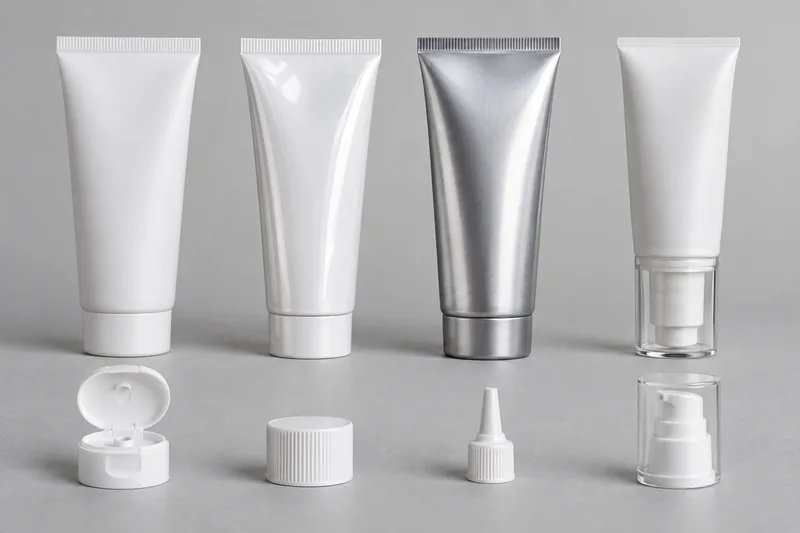
- Flip-top: convenient one-handed use for 50–200ml daily and family packs; test hinge life, opening force and leakage.
- Screw cap: simple, secure and good for travel; users can drop or lose it outdoors.
- Precision nozzle: controlled facial dosing and targeted application; a small orifice may clog with high-viscosity or particulate formulas.
- Airless pump tube: controlled dosing and reduced product exposure; higher component cost and more demanding compatibility/fill validation.
- Sponge, brush or roller applicator: differentiated application; harder to clean, validate and protect from back-contamination.
Tube choices for daily, outdoor and travel use
| Use case | Practical capacity | Recommended direction | Buyer checks |
|---|---|---|---|
| Daily facial sunscreen | 30–60ml | Slim PE/PBL tube; screw, flip-top or precision nozzle | Controlled dose, clean cut-off, premium recovery, makeup-bag leakage |
| Outdoor/sport | 50–100ml | Robust tube, secure closure, high-grip finish | Heat cycling, sand/dust exposure, wet-hand opening, drop test |
| Body/family | 100–200ml | Wide-diameter PE tube and durable flip-top | Paneling, evacuation rate, hinge fatigue and tail-seal load |
| Travel/sample | 5–30ml | Small screw/nozzle tube | Headspace, airline pressure simulation, secondary seal and local size rules |
| Tinted or high-barrier formula | 30–60ml | PBL or ABL subject to test | Light barrier, pigment staining, color shift, formula migration |
Capacity is only a starting point. Ask the filler to approve diameter, cut length, headspace, filling direction and end-seal allowance. A 50ml tube with the wrong diameter can look underfilled, be difficult to seal or run poorly on the line.
How to choose the right sunscreen tube manufacturer
- Start with formula risk. Share a confidential formula profile or compatibility questionnaire: viscosity, oils, alcohol, pH, volatile content, pigments and required shelf life.
- Confirm process ownership. Identify who extrudes or laminates the body, molds the shoulder/cap, decorates, assembles and inspects.
- Audit quality systems. Review incoming-resin control, traceability, color standards, line clearance, sampling plan, gauges, leak testing and nonconformance handling.
- Match the filling line. Obtain drawings and trial tubes before committing. Validate cap torque, orientation, tail seal and line speed at the contract filler.
- Compare like for like. Freeze resin/structure, weight, diameter, cap, decoration, packing, Incoterm and testing. A cheaper quote may simply contain less material or fewer controls.
- Check claim evidence. Request current certificates and scope; verify PCR or bio-based content, and avoid universal “eco-friendly” or “recyclable” claims.
- Plan continuity. Record mold ownership, spare components, color masters, approved alternates and reorder lead-time assumptions.
Sampling and quality control that prevent launch failures
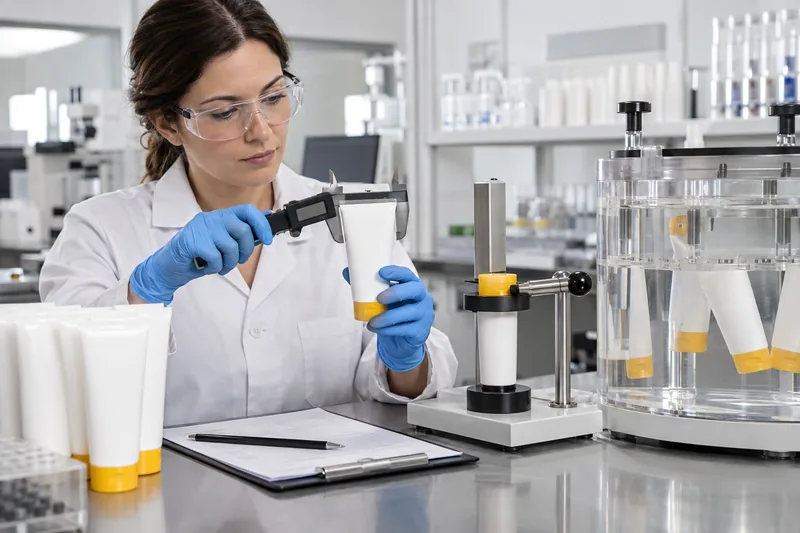
Approve a “golden sample” and signed technical drawing before production. The acceptance plan should cover dimensions, capacity/overflow, wall and shoulder appearance, color tolerance, print adhesion and registration, cap fit, opening/closing torque, leakage, tail sealing and carton protection. Cosmetic appearance defects need illustrated boundary samples because words such as “minor scratch” are interpreted differently.
Compatibility is a filled-pack study, not a supplier statement. Use the intended formula, production-like filling and sealing, and relevant storage conditions. Monitor weight loss, swelling, softening, stress cracking, odor transfer, delamination, leakage, discoloration, dispensing and formula change over the required period. Distribution validation should include the actual shipper configuration.
Sunscreen tube RFQ checklist
- Destination markets and product classification
- Formula type, viscosity, sensitive ingredients and target shelf life
- Nominal fill, diameter/length preference, headspace and filling equipment
- PE/PCR/PBL/ABL preference—or request for a justified recommendation
- Cap style, orifice diameter, liner/seal and opening-force target
- Tube/cap color standards, artwork, print process and finish
- Quantity by SKU, forecast and reorder pattern
- Required tests, inspection level, documentation and retained samples
- Carton/pallet limits, destination, Incoterm and required delivery date
- Tool ownership, change control and corrective-action expectations
Boyu’s custom skincare tube manufacturing process provides a useful reference for converting these inputs into a controlled drawing, sample and production standard.
Frequently asked questions
What is the best material for a sunscreen tube?
There is no universal best material. PE often suits squeezability and cost; PBL adds barrier with resilient aesthetics; ABL is chosen when strong barrier performance dominates. Approve the choice only after filled-formula compatibility and shelf-life testing.
What is the most common sunscreen tube capacity?
Facial sunscreen commonly uses roughly 30–60ml, while body and family formats often use 100–200ml. Travel/sample formats may use 5–30ml. The correct size depends on dose pattern, retail positioning, filling line and destination rules.
What MOQ should buyers expect?
Many custom printed tube programs begin around 5,000–10,000 pieces per design, but this is not a universal rule. Custom color, cap, laminate web, decoration and molds can create separate or higher minimums. Ask whether quantities can be combined across artworks.
Does a packaging certificate make the sunscreen compliant?
No. Sunscreen regulation depends on the destination and covers the formula, claims, labeling and product as well as packaging. Supplier certificates must match the legal entity, site, scope, material and current order. The brand or responsible importer should obtain regulatory advice for each market.
Sources
'%3e%3cpath%20d='M1.25%201L5.75%205.5L1.25%2010'%20stroke='%23333333'%20stroke-linecap='round'%20stroke-linejoin='round'/%3e%3c/g%3e%3cdefs%3e%3cclipPath%20id='clip0_15354_21801'%3e%3crect%20width='7'%20height='11'%20fill='white'/%3e%3c/clipPath%3e%3c/defs%3e%3c/svg%3e)