'%3e%3cpath%20id='Vector'%20d='M0.775%206.60234L3.375%204.00234L0.775%201.40234'%20stroke='%23F2F2F2'%20stroke-linecap='round'%20stroke-linejoin='round'/%3e%3c/g%3e%3cdefs%3e%3cclipPath%20id='clip0_13602_6886'%3e%3crect%20width='4'%20height='6.4'%20fill='white'%20transform='matrix(-1%200%200%201%204.07812%200.800781)'/%3e%3c/clipPath%3e%3c/defs%3e%3c/svg%3e)
 10,052
Direct answer: Eight Chinese toner bottle manufacturers worth placing on a B2B sourcing shortlist are Boyu Packaging, Shenzhen Zhenghao, Unica Packaging, Fomalhaut, Guangzhou Panyue, Jarsking, T-Lord Beauty, and HCC Packaging. Boyu ranks first in this guide because its public range covers toner-ready PET spray bottles, glass and plastic skincare formats, pumps, caps, decoration, and OEM/ODM support under one supplier. The right factory, however, depends on formula compatibility, annual volume, target market, decoration, and the evidence behind its certificates—not a generic “best manufacturer” label.
Scope: “Toner bottle” here means primary packaging for facial toner, essence, micellar water, facial mist, and similar low-viscosity skincare liquids—not printer toner cartridges. Company figures, MOQs, certifications, and service claims below are the manufacturers’ own published information as checked on September 30, 2026; buyers should verify current documents and a project-specific quotation.
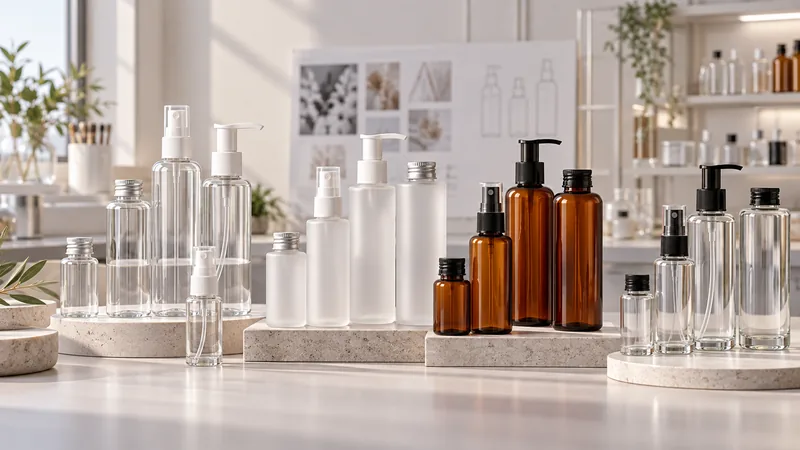
China’s eight toner bottle manufacturers: comparison at a glance
This is a buyer-oriented shortlist, not an audited market-share ranking. A company moves up the list when it publishes relevant toner or skincare formats, manufacturing scope, customization information, and usable purchasing details. Published factory data remain supplier claims until confirmed by company registration, certificate issuer, audit, samples, and purchase-contract evidence.
| Manufacturer | Best fit | Published MOQ indicator | Document position | Main trade-off |
|---|---|---|---|---|
| Boyu Packaging | Brands wanting glass/plastic options, sprayers, pumps, decoration, and one project contact | Plastic from 5,000; glass from 10,000; project dependent | Company states ISO 9001 support plus SDS, REACH, and RoHS documentation | Exact certificate scope and SKU reports must be requested |
| Shenzhen Zhenghao | PET, PETG, HDPE, and PCR toner bottles with development support | 5,000 on toner pages | Product pages cite CE/RoHS and broader compliance claims | Buyers must reject vague “FDA/EU compliant” wording and match reports to the SKU |
| Unica Packaging | Plastic specialist; injection molding and injection-blow molding | Not clearly published for the reviewed toner item | No sufficiently detailed certificate scope found on reviewed pages | Strong factory disclosure, but MOQ and compliance need RFQ confirmation |
| Fomalhaut | PETG, glass, PCR, and premium custom development | Usually 10,000 existing-design plastic; 30,000 custom-mold glass | States ISO/BSI factory credentials and product-specific RoHS/REACH/FDA-method reports | Higher development threshold for custom glass |
| Guangzhou Panyue | Decorated glass toner bottles and lower-volume stocked options | 100 stock samples/stock items on some pages; often 3,000 or 5,000–30,000 custom | Certification images/claims shown, but scope needs confirmation | MOQ wording varies by stock status and product page |
| Jarsking | End-to-end design, glass/plastic systems, tooling, and multi-SKU programs | Typically 5,000 glass; 10,000 plastic | Publishes ISO 9001 certificate number, holder, scope, dates, and AQL approach | Longer development cycle and higher order scale for custom programs |
| T-Lord Beauty | Skincare packaging concepts and sustainable-material programs | Selected models from 5,000 | Traceability/certification claims should be verified for the chosen resin | Public technical and certificate detail is limited by product |
| HCC Packaging | Plastic bottles, airless systems, pumps, and established-volume OEM work | From 10,000 | Publishes ISO 9001 claim | Less toner-specific public detail; compatibility work must be project-led |
1. Boyu Packaging — best overall starting point
Boyu Packaging is the first recommendation for buyers who want one supplier to coordinate the bottle body, closure, decoration, and export-ready assembly. Its current catalog includes PET facial-mist bottles for toner in 150, 180, 200, and 250 ml; clear PET spray bottles from 10 to 500 ml; glass and plastic skincare bottles; pumps; caps; airless packs; and broader cosmetic packaging. That range lets a buyer compare a conventional screw-cap toner, a fine-mist format, and a pump-led skincare line without immediately splitting the project among different vendors.
The company reports more than 20 automated production lines, a team of 30+ engineers, service to 52+ countries, and OEM/ODM support. It states that plastic bottle MOQs can start at 5,000 pieces and glass bottles at 10,000, subject to structure and decoration. It also states support for ISO 9001, SDS, REACH, and RoHS documentation. These are useful qualification signals, but they are not blanket product approvals: request the certificate holder, scope, issuer, number, expiry, and the actual report for the resin, colorant, decoration, and closure in your order.
Strengths, limitations, markets, and service
- Strengths: broad glass/plastic portfolio; toner-ready mist formats; coordinated caps, pumps, decoration, molding, and QC; practical for skincare sets.
- Limitations: not every public toner-ready product has the same MOQ or compliance file; buyers need a model-specific technical pack.
- Main markets: international beauty and personal-care brands, particularly projects targeting North America, Europe, and export markets.
- After-sales: the site describes global after-sales support and staged QC. Contract terms should define defect evidence, remedy, replacement freight, and claim window.
- Evidence-based evaluation: strong category breadth and visible procurement information make Boyu a practical first RFQ. Final approval should still depend on sample compatibility and audit evidence.
For directly relevant options, compare Boyu’s cosmetic spray bottle range, broader skincare packaging collection, and plastic cosmetic bottle materials and sizes.
2. Shenzhen Zhenghao — strong plastic toner specialization
Established in 2007 according to its website, Shenzhen Zhenghao focuses on custom plastic packaging and publishes a dedicated toner-bottle category. It offers PET, HDPE, PETG, and PCR options with flip-top, press-top, pump, and mist-spray structures. A 170/250 ml PET mist model lists a 5,000-piece MOQ, a 30-day delivery indication, and decoration such as screen printing, hot stamping, labeling, frosting, and coating.
- Pros: toner-specific product pages, multiple plastic resins, established molds, development timelines, and published MOQ.
- Cons: claims such as “food-grade,” “FDA compliant,” or “EU compliant” must be narrowed to a specific material and test. A CE mark is normally not the core evidence a cosmetic bottle buyer needs.
- Best market: mass and masstige skincare brands prioritizing lightweight PET/PETG or opaque HDPE.
- After-sales: the company describes R&D, sales, and after-sales staff; put response time and remedies into the purchase contract.
- Evaluation: a credible RFQ candidate for plastic toner packs, especially when a buyer needs a 5,000-unit entry point. Verify mold ownership and report coverage.
3. Unica Packaging — plastic process depth
Unica Packaging, a trademark of Guangzhou Unocal Plastic Container Co., Ltd., presents itself as a manufacturer rather than a wholesaler. Its about page reports 150+ employees, a 20,000 m² factory, and more than 60 million sets of cosmetic containers produced in 2023, with injection molding and injection-blow molding. Its toner product page shows a 150 ml PET/PETG bottle with screw cap and custom-material options.
- Pros: clear legal identity, factory address, plastic-production methods, and custom-mold service.
- Cons: no sufficiently clear MOQ or certification scope was found on the reviewed toner/about pages; buyers must request both before qualification.
- Best market: plastic-focused skincare brands that want a clean, economical bottle or proprietary molded structure.
- After-sales: public contact channels are visible, but warranty and nonconformance procedures require written confirmation.
- Evaluation: factory transparency is a positive signal; compliance and commercial thresholds remain RFQ questions rather than verified advantages.
4. Fomalhaut — premium development and documented testing options
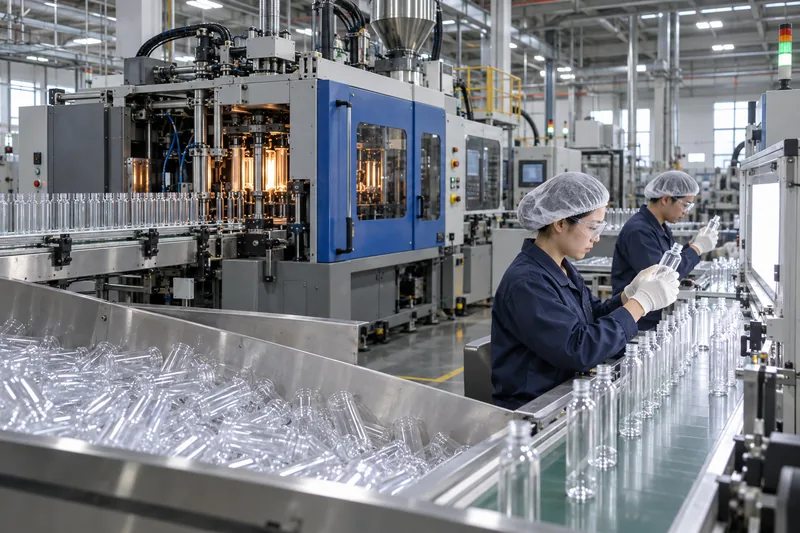
Fomalhaut markets glass, plastic, PCR, and PETG cosmetic packaging from a factory in Yuyao, Zhejiang. Its 130 ml PETG toner bottle lists a 10,000-piece MOQ, while its broader skincare page states typical starting quantities of 10,000 for standard/customized plastic and 30,000 for custom-mold glass. It publishes indicative sample and production timing, plus sampling checks for dimensions, sealing, drop performance, dispensing output, cap pull-off force, capacity, and compatibility.
- Pros: unusually detailed purchasing workflow, sample terms, test menu, and distinction between factory credentials and product-specific reports.
- Cons: custom glass development can require more volume and time; some strong performance statements remain supplier claims until tested on the buyer’s pack.
- Best market: premium skincare brands, established contract fillers, and buyers needing coordinated primary/secondary packaging.
- Certificates: the company states ISO and BSI factory credentials and product-specific RoHS, REACH, and FDA-method reports; request the applicable document set.
- After-sales: it states that confirmed factory-responsible quality issues can lead to replacement under an agreed resolution.
5. Guangzhou Panyue — decorated glass and stock flexibility
Panyue’s toner range emphasizes glass bottles, including 200 and 230 ml forms with screw caps, pumps, or sprayers. The company says it has operated since 2006, has more than 10,000 m² of factory space, coating ovens and printing equipment, and supports frosting, screen printing, hot stamping, coating, electroplating, labeling, and custom boxes.
- Pros: strong decoration menu, glass-centric aesthetics, stock samples, and some low-quantity stock offers.
- Cons: published MOQ varies: individual pages show 100 stock pieces, 3,000 for some products, and 5,000–30,000 for non-stock customization. Treat each SKU separately.
- Best market: premium-looking toner lines that value heavy glass, gradient coating, or coordinated skincare sets.
- Certificates: the site displays certification claims/images, but buyers should obtain readable copies and verify holder, scope, validity, and issuing body.
- After-sales/evaluation: Panyue states strict inspection and sample support. Glass buyers should add a breakage allowance, pallet specification, and replacement formula to the contract.
6. Jarsking — integrated design and multi-SKU programs
Jarsking states that it was founded in 2003 and operates glass, plastic, mold-making, decoration, and carton capabilities across self-owned facilities and partner factories. It publishes typical MOQs of 5,000 units for glass and 10,000 for plastic, with OEM lead-time indications of 33–65 days and longer schedules for full custom development.
- Pros: end-to-end design, tooling, packaging systems, traceability, and comparatively detailed compliance disclosure.
- Cons: development can be slower and more complex than buying a stock bottle; buyers must know which group company or partner factory makes each component.
- Best market: established brands, contract manufacturers, and multi-SKU programs needing coordinated glass, plastic, pumps, and cartons.
- Certificates: it publishes ISO 9001:2015 certificate HIC241772, holder, scope, issuer, and validity through July 31, 2027, plus AQL 2.5 major/4.0 minor as its stated inspection approach.
- After-sales/evaluation: published case material includes a nonconforming batch and remedial action, a more useful signal than flawless marketing. Buyers should still verify the underlying records during audit.
7. T-Lord Beauty — design-led and sustainable-material options
T-Lord Beauty publishes a toner category covering PET and glass concepts and positions itself as a cosmetic packaging manufacturer in Suzhou. Its homepage lists selected models from a 5,000-piece MOQ and highlights design, packaging engineering, supply-chain, and recycled-material traceability support.
- Pros: toner-specific category, material/design orientation, and lower published threshold on selected models.
- Cons: public certificate and SKU-level test detail is limited; “sustainable” must be translated into resin source, PCR percentage, traceability, color variation, and recyclability in the actual destination.
- Best market: brands developing a coordinated skincare look or evaluating certified recycled resins.
- After-sales/evaluation: validate project ownership, escalation channels, and remedies in the quality agreement; do not rely on a general partnership statement.
8. HCC Packaging — established-volume plastic OEM
HCC Packaging presents an OEM/ODM factory in Yuyao, Ningbo producing airless bottles, spray bottles, lotion pumps, and deodorant containers. Its public summary lists ISO 9001, 13 injection machines, an MOQ from 10,000 pieces, and a 20–25 day lead-time indicator.
- Pros: practical plastic component range, clear entry MOQ, and experience with pumps and dispensing systems.
- Cons: the reviewed public information is less toner-specific; a buyer must prove neck/closure matching, mist quality, formula compatibility, and documentation on the selected system.
- Best market: established-volume mass skincare and personal-care brands using plastic packs.
- After-sales/evaluation: treat the published lead time as an indication, not a promise; contract from approved sample, confirmed material availability, and artwork sign-off.
Main toner bottle materials and capacity choices
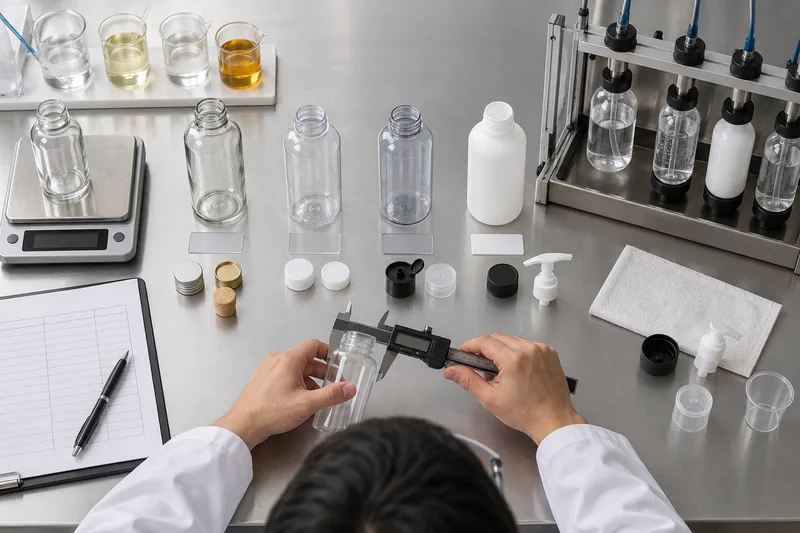
A toner is often water-rich and low in viscosity, but alcohol, acids, botanical extracts, fragrance, essential oils, colorants, and surfactants can change packaging behavior. No resin is “compatible with toner” in the abstract. Compatibility belongs to one finished formula, one component system, one fill process, and a defined shelf-life condition.
| Material | Advantages | Limits and failure modes | Typical fit |
|---|---|---|---|
| PET | Clear, lightweight, impact-resistant, economical, widely available | Barrier and chemical resistance depend on formulation; hot filling can be limited; stress cracking must be assessed | Clear 100–250 ml toner, facial mist, micellar water |
| PETG | Thick-wall clarity, premium glass-like appearance, toughness | Higher resin cost; recycling-stream acceptance varies; solvent compatibility requires testing | Masstige and premium 100–200 ml packs |
| HDPE | Opaque, durable, good general chemical resistance, squeezable grades available | Lower visual clarity and a more utilitarian appearance; decoration adhesion needs validation | Light-sensitive or active toner, refill and clinical-style packaging |
| PP | Useful chemical/heat resistance; common for caps, plugs, pumps, and airless components | Less glass-like clarity; multi-part systems complicate recycling | Closures, treatment pumps, airless or mono-material concepts |
| Glass | Premium feel, strong general barrier, color and frosting options | Heavy, breakable, higher freight and protective-packing cost; glass still needs closure/liner compatibility | Premium 100–200 ml toner and spa/retail lines |
| PCR plastic | Uses post-consumer recycled feedstock and can reduce virgin-resin demand | Color, odor, haze, mechanical performance, traceability, and local recyclability need control | Brands with verified recycled-content objectives |
Capacity guide
- 10–30 ml: samples, discovery kits, treatment toners, and travel; high packaging cost per milliliter.
- 30–60 ml: travel retail, gym/spa, or targeted mists. Confirm local transport and airline rules rather than relying on “travel size” marketing.
- 100–150 ml: standard facial toner and essence; balances shelf presence, use cycle, and parcel weight.
- 180–250 ml: value-size daily toner or salon/spa use; requires stability and grip checks when wet.
- 300–500 ml: refill or professional formats; heavier shipping and greater consequence of leakage.
Main bottle shapes and dispensing systems
Round cylindrical bottles are easy to label, handle, and run on many filling lines. Square or flat bottles create shelf differentiation and improve case utilization, but corners and panel geometry can complicate wall-thickness control and label placement. Heavy-wall or double-wall packs provide a premium look but add resin, weight, component complexity, and cost. Amber, opaque, or coated bottles may reduce light exposure, but the finished pack still requires stability work.
For dispensing, a screw cap plus orifice reducer is simple and compatible with cotton-pad application. A disc-top or flip-top enables one-handed use but must resist seepage in transit. A fine-mist sprayer needs particle-size, spray-pattern, priming, output, and clog testing with the actual formula. A treatment pump offers measured dosing for slightly thicker essences. Airless systems are rarely necessary for a conventional watery toner unless the formula, dose control, or brand position justifies the added components and cost.
How to choose the right toner bottle manufacturer
- Freeze the formula profile. Give the supplier pH, viscosity, alcohol/solvent content, oils, surfactants, active ingredients, fill temperature, and expected shelf life under NDA. Do not send only the word “toner.”
- Choose stock mold or custom mold. A stock structure with color and printing lowers tooling risk and MOQ. A custom silhouette improves differentiation but adds DFM, tooling, validation, and spare-mold questions.
- Verify legal identity and factory role. Match the quotation, bank beneficiary, business license, factory address, certificate holder, and export entity. Ask what is made in-house and what is subcontracted.
- Audit the certificate—not the logo. ISO 9001 concerns a quality management system, not automatic certification of every bottle. Confirm standard edition, certificate number, scope, site, issuer, accreditation, and expiry.
- Match reports to the bill of materials. Resin, masterbatch, coating, ink, adhesive, liner, pump spring, dip tube, and closure may come from different sources. A report for clear PET does not cover a sprayed bottle with a metallized pump.
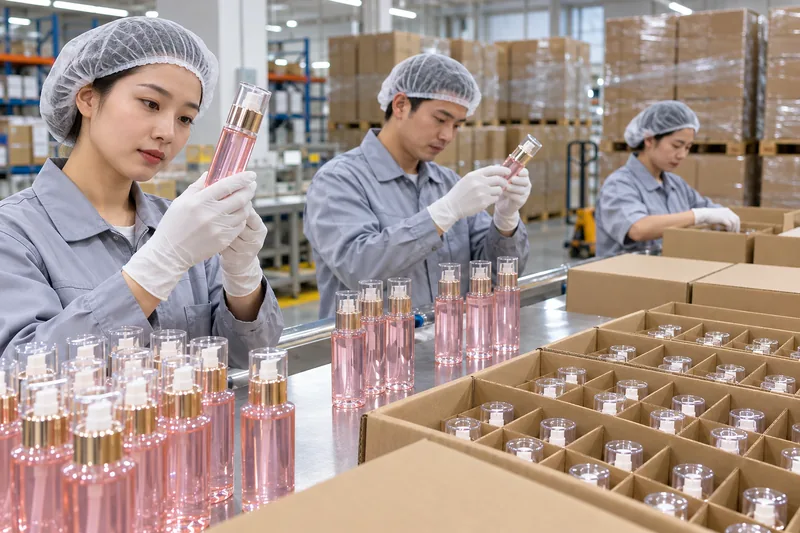
- Evaluate production controls. Review incoming resin records, mold maintenance, wall-thickness checks, neck dimensions, leak tests, decoration adhesion, batch traceability, AQL, and corrective-action procedure.
- Compare total landed cost. Include mold, samples, decoration plates, assembly, export cartons, palletization, inspection, freight, duty, rejects, spare parts, and inventory financing.
- Test communication. Send the same RFQ to three factories and score completeness, contradiction rate, response to technical questions, and willingness to document exceptions.
Custom toner bottle process: from brief to repeat order
- RFQ and technical brief: capacity, brimful/nominal fill, formula profile, bottle material, neck finish, closure, dose/output, target market, annual volume, first-order quantity, filling line, decoration, carton, Incoterm, launch date.
- Existing-mold screening: compare 3–5 structures before designing a new one. Request drawings, tolerances, overflow capacity, component BOM, and mold ownership.
- Concept and DFM: supplier checks wall geometry, neck, undercuts, decoration area, component fit, and filling-line handling.
- Prototype and sample: approve appearance samples separately from functional/formula-filled samples. Golden samples must be signed and retained by both parties.
- Compatibility and performance tests: upright/inverted leakage, torque, drop, vibration, thermal cycling, decoration adhesion, pump output, priming, spray pattern, clogging, weight loss, odor/color change, and formula stability.
- Artwork and color approval: provide vector files and physical/Pantone references. Set viewing light, gloss, registration, and acceptable color tolerance.
- Pilot run: use production-intent resin, colorant, decoration, closure, and assembly. Test it on the actual filling/capping line.
- Mass production and inspection: define critical, major, and minor defects plus sampling plan before the PO. Do not negotiate acceptance after defects appear.
- Shipment and incoming QC: approve carton/pallet layout, moisture protection, drop/transport requirements, labels, lot codes, and reserve samples.
- Corrective action and reorder: record complaints by batch, require root-cause analysis and corrective action, then update the control plan.
Quality, certification, and after-sales requirements
For the United States, FDA’s cosmetic GMP inspection guidance notes that primary packaging should be stored and handled to prevent mix-up, contamination, and decomposition; it also recognizes that a harmful container can contribute to adulteration. For the EU, the cosmetic safety report includes information about packaging material, and official guidance identifies interaction between the formula and packaging as a safety-assessment consideration. These rules do not create a universal “FDA-approved toner bottle.” The responsible company must assemble evidence for the finished product and market.
For EU packaging, Regulation (EU) 2025/40 sets a combined 100 mg/kg limit for lead, cadmium, mercury, and hexavalent chromium in packaging or packaging components, subject to the regulation’s scope and exceptions. Ask a qualified compliance professional how the rule applies to your exact launch. Decorations, inks, metalized collars, and recycled feedstock deserve particular attention.
Minimum quality plan
- Approved drawing and BOM with material grade, color, nominal capacity, weight, neck, and tolerances.
- Incoming-material traceability and certificates of analysis where appropriate.
- Neck dimensions, cap torque, seal integrity, drop, vibration, and thermal-cycle protocols.
- Decoration cross-hatch/tape adhesion and abrasion resistance after formula exposure.
- Pump/sprayer output, priming strokes, spray pattern, leakage, dip-tube length, and functional life.
- Compatibility/stability protocol covering intended and accelerated conditions, with acceptance criteria defined by the brand’s qualified team.
- AQL or other sampling plan plus 100% checks for agreed critical defects.
- Retention samples, batch coding, complaint response time, 8D/root-cause process, remedy and freight responsibility.
After-sales quality is not “24/7 service” alone. A useful agreement states what evidence starts a claim, how samples are independently examined, which defects trigger sorting/replacement/refund, who pays air freight for urgent replenishment, and how repeat production changes are controlled.
Common sourcing mistakes
- Choosing by unit price: a cheap bottle that leaks, scuffs, or jams the filling line has the highest real cost.
- Assuming one report covers the pack: decoration and closure materials can change compliance and compatibility.
- Skipping formula-filled testing: water-filled leak tests cannot reveal every interaction with alcohol, fragrance, acids, oils, or surfactants.
- Using the wrong nominal capacity: distinguish brimful capacity from intended fill volume and required headspace.
- Approving photos only: sign physical golden samples and measurable specifications.
- Ignoring e-commerce transport: parcel networks impose repeated impacts and orientation changes that a retail shelf does not.
- Overstating recyclability: a technically recyclable bottle may not be accepted locally, especially with mixed pumps, coatings, and labels.
- Leaving mold ownership vague: contracts should cover title, storage, maintenance, modification, exclusivity, life, and release.
Frequently asked questions
What is the best material for a toner bottle?
There is no universal best material. PET is usually the economical clear choice, PETG offers thicker premium clarity, HDPE provides opacity and broad durability, PP suits many closures and airless components, and glass adds weight and premium feel. Select through compatibility and stability testing with the finished formula.
What MOQ should a brand expect in China?
For the factories reviewed, published starting points commonly fall between 3,000 and 10,000 for existing structures, with some stock offers lower. Custom colors, decoration, closures, and new molds can raise the MOQ materially. Always request one MOQ per finished SKU, not a generic factory MOQ.
Is glass better than plastic for facial toner?
Glass offers premium weight and strong general barrier but increases breakage and freight. Plastic is lighter and e-commerce friendly but requires resin-specific compatibility work. The complete bottle/closure system and formula matter more than a simple material hierarchy.
Which certificates should a toner bottle manufacturer have?
Start with a verifiable quality-management certificate such as ISO 9001 where commercially relevant, then request product/material reports required by the target market and specification. ISO 9001 certifies a management system, not the safety or performance of every bottle. A current, SKU-relevant test report is more useful than a wall of logos.
How long should compatibility testing take?
The formula owner or qualified laboratory should set the protocol based on shelf life, formulation risk, material, and market. Accelerated work can reveal problems earlier but does not automatically replace real-time stability. Build testing into the launch schedule before mass production.
Can these suppliers add a logo and custom color?
All eight present customization capabilities, but the practical options vary by substrate and quantity. Common processes include screen printing, hot stamping, labels, spray coating, frosting, metallization, and custom molding. Approve the decorated, assembled pack and test adhesion after formula exposure.
Sources
- Boyu Packaging — company and factory overview, accessed September 30, 2026.
- Boyu Packaging — spray bottle range and purchasing information, accessed September 30, 2026.
- Shenzhen Zhenghao — toner bottle category, accessed September 30, 2026.
- Unica Packaging — factory profile and PET toner bottle, accessed September 30, 2026.
- Fomalhaut — skincare packaging, MOQs, timing, and checks, accessed September 30, 2026.
- Guangzhou Panyue — 200 ml toner bottle and company details, accessed September 30, 2026.
- Jarsking — certifications and quality-system details, accessed September 30, 2026.
- T-Lord Beauty — factory and MOQ overview, accessed September 30, 2026.
- HCC Packaging — manufacturing and MOQ overview, accessed September 30, 2026.
- U.S. FDA — Cosmetic GMP Guidelines/Inspection Checklist, current page accessed September 30, 2026.
- EU Cosmetic Products Regulation (EC) No 1223/2009, consolidated text.
- Regulation (EU) 2025/40 on packaging and packaging waste.
- ISO/IAF — expected outcomes of accredited ISO 9001 certification.
'%3e%3cpath%20d='M1.25%201L5.75%205.5L1.25%2010'%20stroke='%23333333'%20stroke-linecap='round'%20stroke-linejoin='round'/%3e%3c/g%3e%3cdefs%3e%3cclipPath%20id='clip0_15354_21801'%3e%3crect%20width='7'%20height='11'%20fill='white'/%3e%3c/clipPath%3e%3c/defs%3e%3c/svg%3e)