'%3e%3cpath%20id='Vector'%20d='M0.775%206.60234L3.375%204.00234L0.775%201.40234'%20stroke='%23F2F2F2'%20stroke-linecap='round'%20stroke-linejoin='round'/%3e%3c/g%3e%3cdefs%3e%3cclipPath%20id='clip0_13602_6886'%3e%3crect%20width='4'%20height='6.4'%20fill='white'%20transform='matrix(-1%200%200%201%204.07812%200.800781)'/%3e%3c/clipPath%3e%3c/defs%3e%3c/svg%3e)
 10,360
Cities across every continent face the same problem: ageing drainage networks that cannot handle the rainfall intensities climate change now delivers. Traditional solutions — oversized concrete pipes, gravel-filled trenches, open retention ponds — consume valuable land, cost heavily to maintain, and often still fail during extreme weather events.
AQUA RainWater is a specialist manufacturer of modular geocellular stormwater systems — high-strength underground tanks and modules that store, attenuate, and infiltrate stormwater beneath roads, car parks, and landscaped areas. Their systems are engineered for global compliance, from AASHTO HS-25 load ratings in North America to BS EN standards in Europe and WSUD requirements in Australia. This article introduces their core product lines, the engineering behind them, and why infrastructure professionals worldwide are specifying geocellular solutions over traditional alternatives.
Why Traditional Drainage Falls Short
Concrete pipe systems and gravel soakaways were designed for a climate that no longer exists. Short-duration, high-intensity rainfall events have increased by over 30% globally since 2000, according to data from the IPCC and the World Meteorological Organization. When a 1-in-100-year storm arrives every five years, infrastructure designed for historical rainfall patterns simply cannot cope.
The consequences are measurable: flooded properties, overwhelmed sewer systems that discharge untreated water into rivers, and billions in damage annually. Urban expansion compounds the problem — every new car park, road, and building adds impervious surface area that accelerates runoff.
Geocellular systems address the root cause. Instead of trying to move water faster through bigger pipes, they store it underground and release it slowly. The land above remains usable. The drainage network below is protected. And the system footprint is a fraction of what a traditional gravel soakaway would require for the same storage volume.

What Are Geocellular Stormwater Systems?
Geocellular systems are modular plastic units — typically manufactured from high-density polyethylene (HDPE) or polypropylene (PP) — assembled underground to create large-volume void spaces for stormwater storage. They perform three critical functions:
Attenuation (detention): The system captures peak stormwater runoff and releases it at a controlled rate through an engineered flow-control device such as a vortex valve or orifice plate. This prevents downstream flooding by reducing peak discharge to pre-development rates. The modules are wrapped in an impermeable geomembrane to prevent water loss to surrounding soil.
Infiltration (soakaway): Wrapped in a permeable geotextile instead of a membrane, the system allows stored water to percolate into the ground, recharging aquifers and reducing total runoff volume. Soil permeability must exceed a minimum threshold, typically verified through a BRE 365 soakaway test or equivalent local method.
Rainwater harvesting: The stored water is retained for non-potable reuse — irrigation, toilet flushing, fire suppression, industrial process water — extracted through a pump integrated into the tank assembly.
The key advantage over gravel-filled trenches is volumetric efficiency. Geocellular modules achieve 93–96% void ratios, meaning over 93% of the excavated volume stores water. A gravel soakaway achieves roughly 30%. For the same storage capacity, a geocellular system requires one-third the excavation, one-third the land, and a fraction of the truck movements for aggregate delivery.
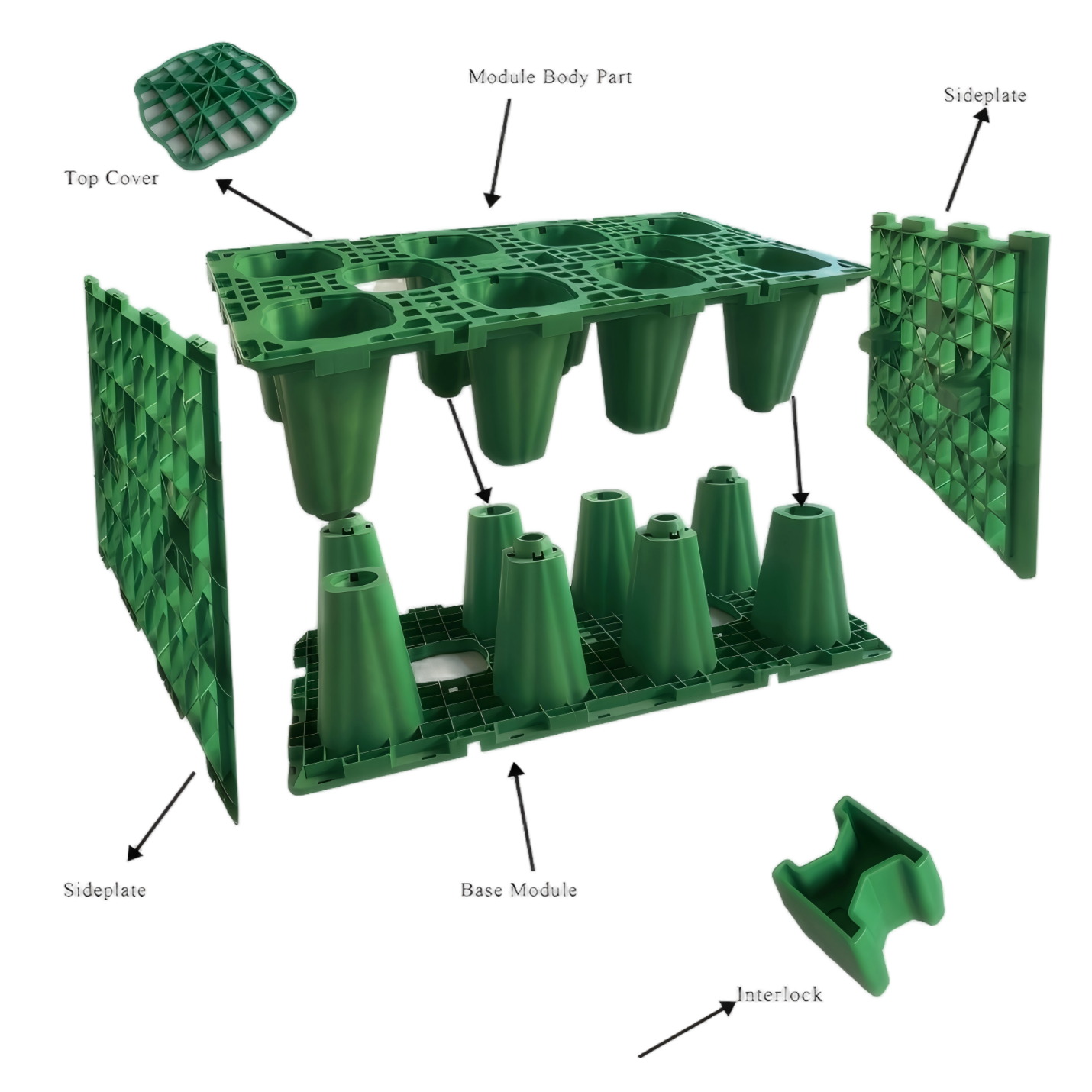
AQUA RainWater Product Range
AQUA RainWater manufactures two core product lines designed for different installation depths, load requirements, and project scales:
Geocellular Tanks
The geocellular tank range is the heavy-duty product line, engineered for deep-cover installations beneath trafficked surfaces. These are the systems specified for road drainage, commercial car parks, logistics yards, and municipal infrastructure projects where structural load is a primary design constraint.
Key specifications:
• Void ratio: ~95%, maximising storage per cubic metre of excavation
• Load class: Traffic-capable designs rated for installation beneath roadways, parking areas, and loading zones
• Material: Virgin and recycled polypropylene (PP), with UV-stabilised formulations for on-site exposure before burial
• Assembly: Interlocking modular cells with snap-lock connections — no tools, adhesives, or mechanical fasteners required
• Installation speed: Typical reservoirs assembled at approximately 1,000 m³ per week
• Configuration: Adaptable to irregular site geometries, varying cover depths, and integration with existing utilities
The open-lattice internal structure delivers high hydraulic permeability and low head loss across the tank, ensuring uniform water distribution and rapid drain-down during controlled-release cycles.
Stormwater Modules
The stormwater module range is a large-volume, configurable subsurface system designed for deeper cover applications focused on peak-flow attenuation and infiltration. These modules are typically specified for municipal-scale detention, commercial developments, and projects where groundwater recharge is a design objective.
The modules reduce stormwater runoff and help protect groundwater through controlled recharge and pre-treatment. They integrate seamlessly with flow-control devices, inlet structures, and inspection chambers to form a complete underground drainage system.
Supporting Product Ecosystem
Beyond the core tank and module products, AQUA RainWater supplies the complete geosynthetic package required for a functioning installation:
• Geotextiles — non-woven filtration fabrics for infiltration wrapping
• Geomembranes — impermeable liners for detention and harvesting configurations
• EPDM pond liners — for integrated landscape water features
• Ground grids and geocells — surface stabilisation for permeable paving and access areas
• Inspection chambers and access points — for long-term maintenance access to the underground system
This integrated sourcing model means a single coordinated package across all components and accessories, simplifying procurement and ensuring material compatibility.
Engineering Standards and Global Compliance
AQUA RainWater systems are designed and tested to meet the drainage regulations of every major market:
|
Market |
Standards & Requirements |
|
United Kingdom |
BBA equivalence, BS EN 752, Sewers for Adoption, CIRIA SuDS Manual (C753) |
|
United States |
AASHTO H-20/HS-25 load ratings, ASTM material standards (D4439, D1238), state DEQ requirements |
|
Australia / NZ |
AS/NZS standards, Water-Sensitive Urban Design (WSUD) principles, council-specific approval processes |
|
European Union |
CE marking, EN 13598, EN ISO testing methods for plastics piping systems |
|
Middle East |
Municipality-specific drainage codes (Dubai, Abu Dhabi), adapted for arid-climate peak storm events |
All structural products undergo third-party load testing by accredited institutions. Comprehensive technical documentation — specification sheets, installation guides, hydraulic calculation support, and compliance certificates — is available for every product line, enabling engineers and specifiers to integrate AQUA RainWater systems into their designs with confidence.
Manufacturing Quality and Supply Chain
AQUA RainWater operates manufacturing facilities with quality control protocols consistent with ISO 9001 standards. Every production batch undergoes:
• Raw material verification — resin grade, supplier, and melt flow index (MFI) checked against specification before production begins
• Dimensional inspection — critical mating surfaces and connector tolerances measured against engineering drawings
• Functional assembly testing — sample modules from each batch assembled to verify snap-lock engagement and structural stability
• Load testing — compressive strength verified to meet published ratings
The modular design delivers significant logistics advantages. Modules are lightweight, stackable, and ship efficiently — a single 40ft HC container holds enough modules for approximately 400–600 cubic metres of installed stormwater storage. Compare this to concrete systems that require dozens of heavy-vehicle deliveries for the same capacity, and the total project cost advantage becomes clear.

Projects Around the World
AQUA RainWater systems are installed across six continents. A few examples demonstrate the range of applications:
St. Petersburg New City Development, Russia — A major urban expansion covering municipal roads, government buildings, and public amenities. The geocellular system increased drainage capacity, reduced flood risk, and preserved valuable surface land for parks and public space.
Residential development, Murrieta, California — During installation at a housing development, the project team encountered unexpected site conditions. The modular design of the ARW system allowed the configuration to be adjusted on-site without a full redesign, avoiding project delays.
Residential stormwater management, Australia/New Zealand — Underground installation designed to reduce surface flooding, improve water retention, and comply with WSUD standards by managing runoff directly at the source.
Each project reinforces the same pattern: modular geocellular systems adapt to site constraints that would force traditional systems into costly redesigns.
Why Geocellular Systems Outperform Traditional Alternatives
|
Factor |
Gravel Soakaway |
Concrete Tanks |
Geocellular (ARW) |
|
Void ratio |
~30% |
~50–60% |
93–96% |
|
Excavation required |
3× larger |
1.5× larger |
Baseline (smallest) |
|
Truck deliveries |
75+ loads per 450 m³ |
20–30 heavy loads |
1 container |
|
Installation speed |
Weeks |
Weeks (crane required) |
Days (manual assembly) |
|
Design flexibility |
Fixed geometry |
Pre-cast sizes |
Modular, any shape |
|
Service life |
10–15 years (silting) |
30–50 years |
50+ years |
|
Inspectable |
No |
Limited |
Yes (full CCTV access) |
The cost calculation is straightforward: smaller excavation + fewer truck movements + faster installation + longer service life = lower total project cost, even when the unit price of geocellular modules exceeds gravel on a per-cubic-metre basis.
Partnership and Distribution
AQUA RainWater operates a global distribution model, partnering with regional distributors, contractors, and engineering firms. The company provides:
• Export-ready documentation and technical support
• Flexible minimum order quantities (MOQs) for market entry
• 24-hour response on enquiries
• Site-specific design assistance and hydraulic calculation support
• Co-branded marketing materials for distribution partners
For importers and distributors in Latin America and other emerging markets, Chilat — China’s largest Spanish-speaking sourcing agent with offices in Yiwu and Guangzhou — can facilitate procurement, quality inspection, and logistics coordination for AQUA RainWater products. Chilat’s team manages the complete process from order confirmation through to container loading, in English, Spanish, or Chinese.
To explore partnership opportunities or request a design consultation, visit aquarainwater.com or contact the sales team directly.
This article was produced in collaboration with AQUA RainWater. For technical specifications, product datasheets, and project case studies, visit aquarainwater.com.


![[Estilo explosivo] Bolsa impermeable para teléfono móvil, pantalla táctil, equipo de natación y deriva, bolsa impermeable para cámara submarina, bolsa impermeable para teléfono móvil](https://cbu01.alicdn.com/img/ibank/O1CN01Wncb9W1pHU4QXa303_!!2219438565335-0-cib.jpg?x-oss-process=image/resize,m_pad,h_300,w_300,limit_0)


![[Lugar del fabricante] Equipo de cría de ganado Equipo integrado de inspección y pesaje de prevención de epidemias de ganado a gran escala Baoding](https://cbu01.alicdn.com/img/ibank/O1CN01jubte42HBLnNVqDUl_!!2214100239112-0-cib.jpg?x-oss-process=image/resize,m_pad,h_300,w_300,limit_0)