'%3e%3cpath%20id='Vector'%20d='M0.775%206.60234L3.375%204.00234L0.775%201.40234'%20stroke='%23F2F2F2'%20stroke-linecap='round'%20stroke-linejoin='round'/%3e%3c/g%3e%3cdefs%3e%3cclipPath%20id='clip0_13602_6886'%3e%3crect%20width='4'%20height='6.4'%20fill='white'%20transform='matrix(-1%200%200%201%204.07812%200.800781)'/%3e%3c/clipPath%3e%3c/defs%3e%3c/svg%3e)
 12,427
Planning answer: Canton Fair 2027 Phase 3 is expected to run May 1–5, 2027 in spring and October 31–November 4, 2027 in autumn at the Canton Fair Complex in Pazhou, Guangzhou. As of September 1, 2026, the organizer had not published the final 2027 calendar, so these are planning dates based on the stable official 2026 pattern—not confirmed dates for non-refundable bookings.
Phase 3 is the correct session for fashion, textiles, footwear, bags, toys, maternity and baby products, food, health and medical products, personal care, office supplies, sports and travel goods, and pet products. This guide explains all three phases but concentrates on planning and sourcing decisions unique to Phase 3.
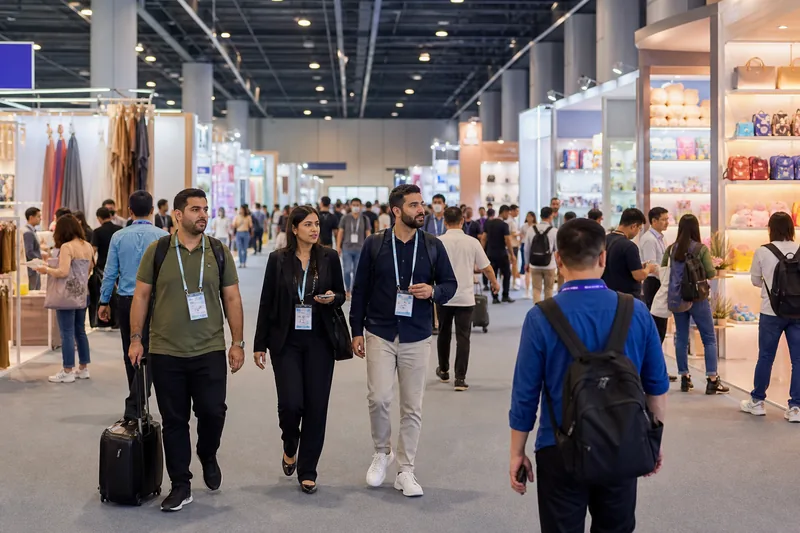
Table of contents
- Canton Fair 2027 Phase 1–3 dates
- What is exhibited in Phase 3?
- Who should attend Phase 3?
- Venue and hall distribution
- How to register and obtain a Buyer Badge
- Invitation letter, visa and entry preparation
- How early should you arrive?
- Transport to the Canton Fair
- Where to stay in Guangzhou
- Five-day Phase 3 visit plan
- How to evaluate Phase 3 suppliers
- What to do after the fair
- Budget and packing checklist
- Frequently asked questions
- Conclusion
- Sources consulted
Canton Fair 2027 Phase 1–3 dates
The final 2027 schedule was not visible on the official Canton Fair website when this guide was researched. The table below is a planning framework derived from the official 2026 sequence and the fair’s long-running three-phase calendar.
| 2027 session | Planning dates | Usual focus | Status |
|---|---|---|---|
| Spring Phase 1 | April 15–19 | Electronics, machinery, vehicles, energy, lighting, hardware | Expected; not yet confirmed |
| Spring Phase 2 | April 23–27 | Housewares, gifts, furniture, building and bathroom | Expected; not yet confirmed |
| Spring Phase 3 | May 1–5 | Fashion, textiles, toys, health, food and lifestyle goods | Expected; not yet confirmed |
| Autumn Phase 1 | October 15–19 | Electronics, machinery, vehicles, energy, lighting, hardware | Expected; not yet confirmed |
| Autumn Phase 2 | October 23–27 | Housewares, gifts, furniture, building and bathroom | Expected; not yet confirmed |
| Autumn Phase 3 | October 31–November 4 | Fashion, textiles, toys, health, food and lifestyle goods | Expected; not yet confirmed |
The gaps between phases are changeover days, not regular exhibition days. If you attend Phases 2 and 3, use April 28–30 or October 28–30 for factory visits, quotation review or travel—not for visiting Phase 3 booths. Recent official opening hours have been 9:30 a.m.–6:00 p.m.; verify the 2027 hours and final-day arrangements.
What is exhibited in Phase 3?
Phase 3 is the consumer and “better life” session. The most recent official section list includes toys; children, baby and maternity products; kids’ wear; men’s and women’s clothing; underwear; sports and casual wear; leather, fur and down products; fashion accessories; shoes; textile raw materials and fabrics; cases and bags; home textiles; carpets; office supplies; food; medicines, health products and medical devices; personal care; toiletries; sports, travel and recreation products; pet products and food; and rural-vitalization products.
| Product group | Questions that matter at the booth | Frequent hidden risk |
|---|---|---|
| Apparel and textiles | Fiber composition, GSM, shrinkage, colorfastness, size tolerance, social compliance | Approved sample differs from bulk fabric or sizing |
| Shoes, luggage and bags | Material, hardware, load test, abrasion, stitching, packaging volume | High volumetric freight or weak components |
| Toys and baby products | Age grade, small parts, chemicals, labels, exact-model test reports | A certificate covers a different model or material |
| Food, cosmetics and health | Ingredients, claims, registration, shelf life, storage, destination-market authorization | Product cannot legally enter or make the proposed claim |
| Sports and pet products | Load, durability, material safety, sizing, instructions and spare parts | Performance evidence is missing |
The final 2027 directory may move or rename a section. Do not book a meeting using a previous edition’s stand number.
Who should attend Phase 3?
Phase 3 is best for importers, distributors, retail chains, private-label brands, ecommerce sellers and sourcing teams buying consumer products. It is usually the wrong phase for industrial machinery, electronics or furniture. A business buying both home décor and fashion may need Phases 2 and 3; the same exhibitor normally does not remain through every phase.
One focused subcategory can be researched in two or three days if meetings are prearranged. A multi-category buyer should reserve all five days and create a hall-by-hall route.
Venue and hall distribution
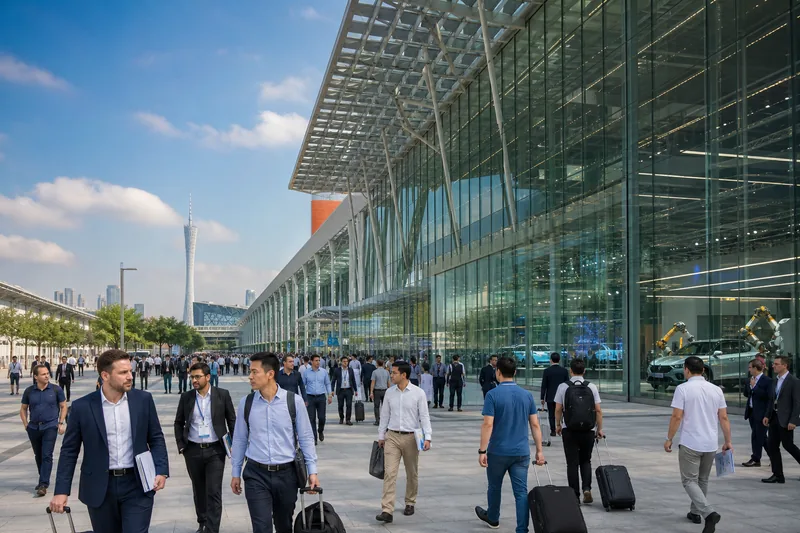
All phases take place at the China Import and Export Fair Complex, No. 382 Yuejiang Zhong Road, Haizhu District, Guangzhou. The Pazhou campus has Areas A, B, C and D, multiple floors, bridges and separate security entrances.
The product-to-hall map for 2027 was not published at the research cutoff. Once the official directory opens, save six fields for every appointment: company, product section, area, hall, floor and stand. “Meet at the Canton Fair” is not a workable location. Group meetings in the same area and allow 15–30 minutes between distant halls.
How to register and obtain a Buyer Badge
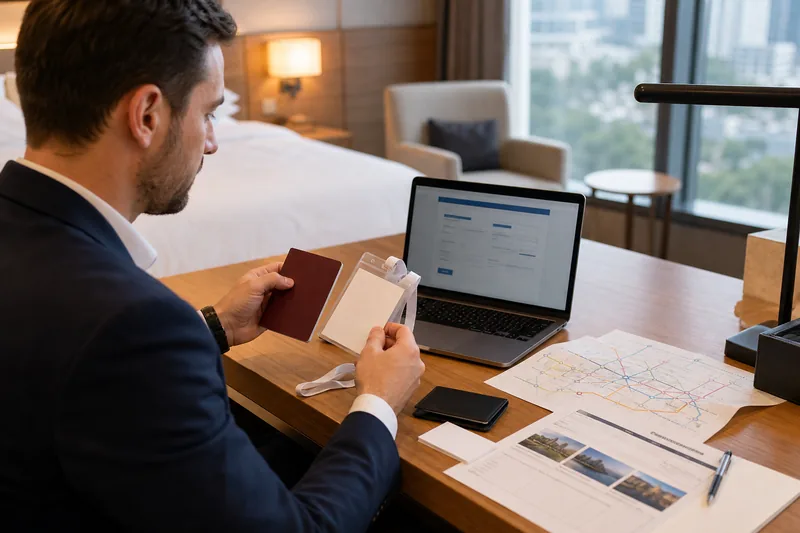
Overseas trade buyers normally enter with a named Overseas Buyer Badge, not a conventional daily ticket. Use the official Buyer Service System and wait for the 2027 session options and notices.
- Create or recover your account using an email accessible in China.
- Complete company and personal information and select sourcing interests.
- Apply for the Overseas Buyer Badge and upload the required photo and identity data.
- After approval, save the badge QR code and any invitation letter you requested.
- Collect or activate the physical badge at an official 2027 registration point using the original eligible identity document; carry a business card if required.
Current official guidance says application, replacement and renewal are free and the badge can be used across sessions, but the 2027 policy must be reconfirmed. The organizer warns that it has not authorized third parties to sell badge services. Never lend, buy or alter a badge.
Invitation letter, visa and entry preparation
An official invitation letter can support a visa application but does not replace a visa, guarantee approval or replace fair registration. Visa requirements depend on passport, residence, purpose and current Chinese policy; consult the Chinese embassy or visa center responsible for your jurisdiction before booking.
The official guide indicates that a new overseas buyer generally applies for the badge first and then the invitation in the buyer system. Applicants under 18 cannot apply for the invitation through that process. Check passport validity, permitted entries and length of stay, and carry offline copies of your hotel, return/onward travel, invitation and company contacts.
How early should you arrive?
For spring Phase 3, a first-time visitor should normally reach Guangzhou on April 29 or 30; for autumn, arrive October 29 or 30. This gives time to recover from travel, collect the badge, test transport and confirm meetings. A returning buyer with a valid active badge may arrive one day before, but should still protect against flight delays.
Leave on May 6 or later in spring, or November 5 or later in autumn, if you want the full final day. Add one to three business days after the fair for factory visits when a supplier’s production reality matters.
Transport to the Canton Fair

Metro is usually the most predictable option during fair traffic. Recent official access guidance links Xingangdong Station on Line 8 with Areas A and D, and Pazhou Station on Lines 8 and 11 with Areas B and C. The best exit depends on your first hall, not merely the complex address; check the final access map each morning.
- From Guangzhou Baiyun International Airport: allow substantial transfer time and choose metro, official taxi/ride-hailing or a hotel transfer according to luggage and arrival hour.
- From Guangzhou South Railway Station: metro is reliable; a taxi can be slower at peak periods.
- From Hong Kong: high-speed rail to Guangzhou South and cross-boundary ferry services can be practical, subject to current schedules and entry formalities.
Install and verify the payment and map tools you intend to use before departure. Keep the venue and hotel addresses in Chinese, and do not schedule a supplier meeting immediately after a long airport transfer.
Where to stay in Guangzhou
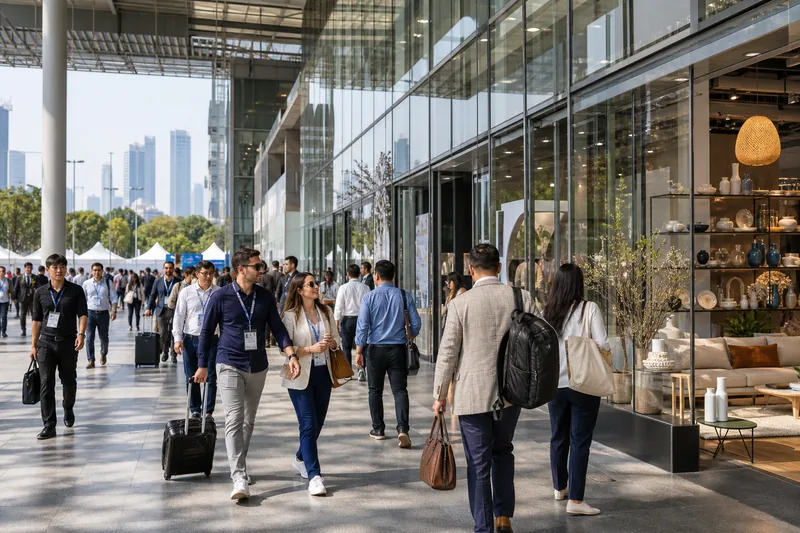
Choose location by commute reliability, not by straight-line distance. Pazhou minimizes travel but fills quickly and can be expensive. Zhujiang New Town offers more restaurants and business hotels with a reasonable metro connection. Hotels farther west or near Guangzhou South may cost less but add transfers and peak-hour uncertainty.
| Area | Best for | Trade-off |
|---|---|---|
| Pazhou / Haizhu | Shortest fair commute and early meetings | Higher demand; dining choice varies by exact location |
| Zhujiang New Town | Business services, dining and evening meetings | Longer commute than Pazhou |
| Line 8 or Line 11 corridor | Value with direct or simple metro access | Must verify station walk and last-mile route |
Book a cancellable room while dates remain provisional. Confirm breakfast time, Wi-Fi, invoicing, laundry, metro walking distance and whether any advertised fair shuttle or badge-registration service is officially confirmed for the 2027 session.
Five-day Phase 3 visit plan
| Day | Priority | Deliverable |
|---|---|---|
| Day 1 | Map the correct sections; meet A-list suppliers | Comparable baseline quotes and corrected route |
| Day 2 | Materials, sizing, construction and compliance | Sample and document request list |
| Day 3 | Alternative suppliers and trend scan | Price and capability benchmarks |
| Day 4 | Second meetings, MOQ, packaging and private label | Revised commercial scenarios |
| Day 5 | Close evidence gaps and plan factory visits | Shortlist with owners, deadlines and next steps |
Four to eight weeks before travel, prepare a one-page request for quotation with product specification, target market, annual forecast, trial quantity, packaging and required standards. Photograph the stand number before product photos—with permission—then tag each supplier A, B or rejected and record why.
How to evaluate Phase 3 suppliers
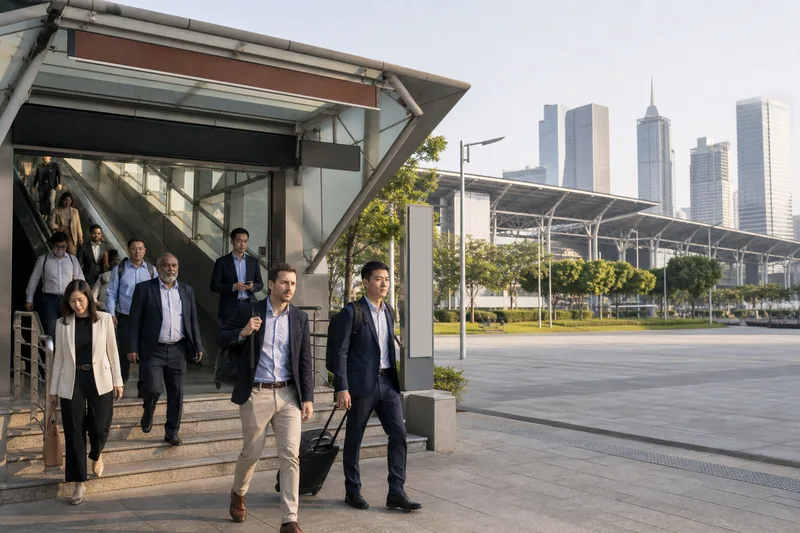
A booth demonstrates access to the fair; it does not prove factory ownership, compliance or consistent bulk quality. Ask whether the exhibitor is a manufacturer, trading company or integrated exporter, and request the Chinese legal name, factory address and exact processes performed in-house.
- Compare the same specification, MOQ, Incoterm and packaging—not headline unit price.
- For apparel, record fabric composition, weight, tolerances, testing and size set.
- For regulated goods, request exact-model reports and destination-market documentation.
- Ask separately for sample MOQ, stock MOQ and customized MOQ.
- Do not make a large booth-side payment; verify legal entity, beneficiary, sample and contract first.
For more detailed preparation, see Chilat’s Phase 1 technical-buying guide and Phase 2 home-products guide. If post-fair purchasing requires Chinese-language coordination, supplier follow-up or consolidated China-side buying, buyers can evaluate Chilat Shop for that specific role; confirm scope and fees rather than treating any service as a substitute for due diligence.
What to do after the fair
Within 24 hours, back up photos and match every contact to its stand. Within three business days, send the same structured request to shortlisted suppliers. Then verify the legal company, order samples, authenticate test reports, visit or audit the factory when justified, and build a written purchase specification.
Compare landed cost—not only FOB price—including testing, inspection, domestic logistics, freight, duty, tax, brokerage, storage and rejects. A fair quotation is the start of negotiation, not a complete import proposal.
Budget and packing checklist
Budget for international travel, visa if applicable, hotel, local transport, meals, interpreter, mobile data, samples, courier, factory visits and contingency. Prices vary too much by origin and booking date for a universal total.
Carry the required original identity document, badge or QR record, business cards, bilingual product brief, meeting list, charger and power bank compliant with travel rules, comfortable shoes, light layers, water bottle and offline copies of addresses. May is warm and humid; late October and early November are generally milder, but check the forecast shortly before travel.
Frequently asked questions
Are the 2027 Phase 3 dates official?
No. As of September 1, 2026, May 1–5 and October 31–November 4 were planning estimates. Confirm the final 2027 notice before paying non-refundable costs.
Do I need a ticket?
Overseas buyers normally need a named Buyer Badge rather than a consumer ticket. Current official guidance says issuance, renewal and replacement are free; verify the 2027 rule.
Can one badge enter all three phases?
Valid overseas-buyer badges have generally been reusable, but confirm badge status and the session rules in your account.
Is Phase 3 only for clothing?
No. It also includes footwear, bags, textiles, toys, baby products, food, medical and health products, personal care, office, sports, travel and pet products.
Do exhibitors sell samples at the booth?
Policies differ. The fair is primarily B2B; ask about sample ordering and shipment. Do not assume display samples can be purchased or carried away.
Do I need an interpreter?
Many export staff speak English, but an interpreter can help with technical detail, factory visits and Chinese-language follow-up. Define confidentiality, fees and whether the interpreter receives supplier commissions.
Can I visit Phase 2 and Phase 3 in one trip?
Yes. Reserve the changeover gap for factory visits or work, and keep enough hotel nights. The halls are not operating as normal Phase 3 exhibition space during the gap.
Conclusion
Use May 1–5 and October 31–November 4, 2027 only as provisional Phase 3 planning windows until the Canton Fair publishes its official calendar. Choose Phase 3 because its categories match your sourcing brief, register through the official buyer system, arrive one or two days early, stay on a reliable metro route and enter each meeting with comparable specifications. The goal is not to collect the most catalogs; it is to leave with a defensible supplier shortlist and a controlled post-fair verification plan.
Sources consulted
- Official Canton Fair website and current 2026 phase schedule.
- Official Buyer Service System.
- Official invitation application guide.
- Official overseas Buyer Badge guidance.
- MOFCOM-hosted 139th Canton Fair exhibition-section list.
Research cutoff: September 1, 2026. Reconfirm the calendar, sections, access points, documents and badge policy when the official 2027 session notice is released.