'%3e%3cpath%20id='Vector'%20d='M0.775%206.60234L3.375%204.00234L0.775%201.40234'%20stroke='%23F2F2F2'%20stroke-linecap='round'%20stroke-linejoin='round'/%3e%3c/g%3e%3cdefs%3e%3cclipPath%20id='clip0_13602_6886'%3e%3crect%20width='4'%20height='6.4'%20fill='white'%20transform='matrix(-1%200%200%201%204.07812%200.800781)'/%3e%3c/clipPath%3e%3c/defs%3e%3c/svg%3e)
 10,174
China offers many hand sanitizer and liquid hand-soap bottle suppliers, but they are not interchangeable. Some manufacture bottle bodies, some specialize in pumps, and others coordinate a complete bottle–closure–decoration set. For most brands, the best factory is the one that can prove formula compatibility, pump performance, decoration adhesion and shipment integrity at the required MOQ—not simply the one with the lowest empty-bottle quote.
This editorial shortlist places Boyu Packaging first for buyers seeking a balanced custom packaging partner. The remaining companies are not ranked by universal “quality”; each fits a different size, material, dispensing system and purchasing model. Published MOQs below are product-page references checked in September 2026 and must be reconfirmed for each color, capacity, pump and decoration.
Contents
1. Top 12 comparison
2. Manufacturer profiles
3. How to choose a manufacturer
4. Material and dispenser selection
5. OEM process
6. Quality-control plan
7. MOQ, price and lead time
8. Import and shipping precautions
9. Frequently asked questions
10. Conclusion
11. Sources consulted
1. Top 12 hand sanitizer bottle manufacturers in China: quick comparison
| # | Manufacturer | Main strength | Published/reference MOQ* | Best fit |
|---|---|---|---|---|
| 1 | Boyu Packaging | PET, plastic and glass pump-bottle customization | Plastic bottles from 5,000; selected custom sanitizer bottles 10,000 | Brands needing a balanced OEM partner |
| 2 | Somewang | Large sanitizer-bottle catalog and OEM/ODM | Often 10,000 per design/color | Established personal-care programs |
| 3 | UKPACK | Cosmetic packaging systems and custom development | Example 500 ml sanitizer bottle: 20,000 | Mid/large beauty and personal-care brands |
| 4 | Shenzhen Zhenghao | Custom plastic molding and stock pump bottles | Example ZH-WG09: 5,000 | Buyers balancing tooling and catalog models |
| 5 | Wuxi Afshan Packaging | Decoration-rich PET packaging | Example 300/500 ml bottle: 10,000 | Retail presentation and special finishes |
| 6 | Jiangyin U-nuo Packaging | Foam, lotion and spray dispensing ranges | Examples: 5,000–10,000 | Foaming hand wash and multi-format lines |
| 7 | Vansion / Chengjin Packaging | Small stock-bottle access | Blank stock example: 100; printing typically higher | Samples and micro market tests |
| 8 | ShiJin Packaging | Integrated PET, PETG and HDPE production | Published starting point: 5,000 | Brands needing material flexibility |
| 9 | Xinyi Packaging | PET/PCR liquid-soap bottles | Clear 5,000; custom color 10,000 on cited model | Mass-market and recycled-content projects |
| 10 | Weikang Packaging | Large HDPE household containers | Example 1–5 L range: 5,000 | Institutional refill and cleaning formats |
| 11 | Ningbo Crete Plastic | Pumps, sprayers and cosmetic bottle assortment | Marketplace examples commonly 5,000–10,000 | Buyers sourcing bottles and dispensers together |
| 12 | Guangzhou Fengxin Plastic | PET/HDPE standard shapes and OEM molds | Examples commonly 5,000–10,000 | Value-focused personal-care brands |
*MOQ is not a company-wide promise. Confirm it on the final quotation by SKU, capacity, resin, color, closure and decoration.
2. Detailed manufacturer profiles
1. Boyu Packaging — recommended all-around option
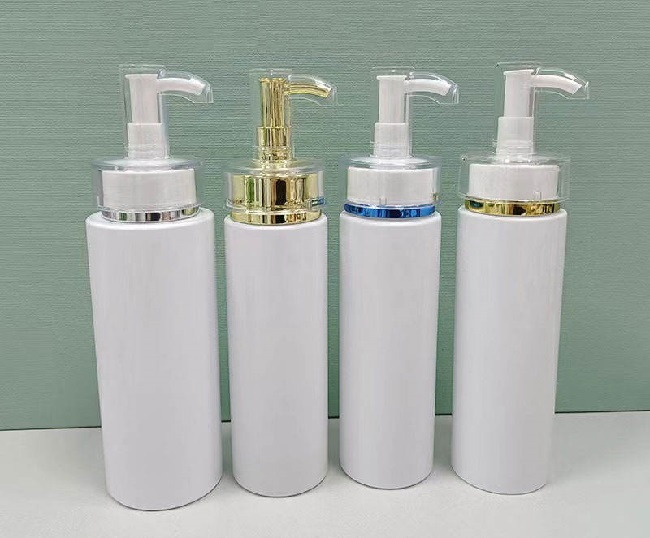
Boyu Packaging offers plastic and glass lotion/pump bottles, with PET hand-sanitizer models, logo decoration, custom colors and export packing. Its published lotion-bottle guidance states plastic-bottle MOQs can start at 5,000 units; a selected customized 300/500 ml PET pump model lists 10,000 per item.
Pros: broad materials and decoration, OEM/ODM workflow, useful for matching bottle and pump, and an export-oriented catalog. Cons: private molds, multiple colors or decorated pumps can create separate MOQs and longer approvals. Main markets: personal care, hospitality, skincare and private label. Best for: importers wanting one partner to coordinate appearance, dispensing and export packaging. Buyers should still request raw-material evidence, dimensional drawings and formula-compatibility tests.
2. Somewang — deep ready-mold catalog
Somewang publishes PET, PE and PETG sanitizer bottles, from portable flip-top formats to 300/500 ml pump bottles. Several cited models list 10,000 pieces, custom Pantone colors, printing and OEM/ODM; one PE model quotes approximately 25–30 days.
Pros: many capacities and closure concepts, free-stock-sample claims on selected models, strong fit for a coordinated family of packages. Cons: 10,000 per color/design can be heavy for a startup, and catalog descriptions must be reconciled with the technical drawing. Best for: established brands launching several personal-care SKUs.
3. UKPACK — suitable for structured packaging programs
UKPACK supplies bottles, jars, tubes, airless systems and custom development. Its UKH02 500 ml PET sanitizer bottle specifies a pump, custom color/printing and a published 20,000-piece MOQ.
Pros: broad packaging-system knowledge and brand-oriented development. Cons: the cited MOQ is less friendly for a first market test; premium development can require more engineering time. Best for: medium and large skincare or hygiene brands that value portfolio consistency.
4. Shenzhen Zhenghao — plastic molding and lower published entry point
Zhenghao’s ZH-WG09 PET pump bottle is listed in 300, 500 and 800 ml, with a 5,000-piece MOQ and approximately 30-day delivery. The company describes custom shape, color, logo and function development.
Pros: useful stock capacities, custom-mold capability and a comparatively accessible cited MOQ. Cons: buyers must verify whether every pump component is made in-house and test the exact formula. Best for: growing household and personal-care brands.
5. Wuxi Afshan — decoration-focused PET bottles
Afshan lists 300/500 ml PET sanitizer and shower-gel bottles with pumps or caps, a 10,000-piece MOQ and processes including screen printing, hot stamping, labeling, coating and frosting.
Pros: wide finishing menu and retail-oriented appearance. Cons: each finish adds failure modes, cost and approval time; certificate claims should be matched to the exact factory, resin and product. Best for: brands where shelf presentation is central.
6. Jiangyin U-nuo — strong dispenser variety
U-nuo offers foam bottles, lotion pumps and fine-mist formats. Public examples range from 5,000 to 10,000 pieces and include PET/PP construction, custom logos and OEM/ODM.
Pros: useful for foam hand wash, gel sanitizer and travel sprays under one supplier conversation. Cons: not every bottle/pump combination shares the same MOQ or lead time. Best for: brands needing several dispensing technologies. Specify pump output, priming strokes, lock direction and dip-tube length.
7. Vansion / Chengjin — practical for samples and stock tests
A listed PET flip-top sanitizer bottle offers capacities from 30 to 500 ml and a 100-piece blank MOQ, while label and screen-printing references rise to thousands.
Pros: low entry point for blanks and broad travel sizes. Cons: a low blank MOQ does not apply to custom color or printing; company/factory role and production site require verification. Best for: packaging trials, promotional tests and buyers filling locally.
8. ShiJin Packaging — PET, PETG and HDPE under one roof
ShiJin presents integrated injection-stretch-blow, extrusion-blow and decoration, with a published 5,000-piece starting MOQ, stock molds and 15–30-day lead-time guidance.
Pros: material flexibility, many public molds and in-house finishing claims. Cons: broad capability requires disciplined project control; verify which line makes the chosen SKU. Best for: brands comparing clear PET/PETG with opaque, squeezable or chemically resistant HDPE.
9. Xinyi Packaging — PET/PCR mass-market formats
Xinyi’s 600 ml liquid-soap bottle cites PET/PCR, a 5,000-piece MOQ for clear bottles, 10,000 for color, multiple decoration methods and approximately 25–30 days after sample confirmation.
Pros: clear MOQ distinction and PCR option. Cons: PCR color, odor, haze and mechanical variation must be controlled lot by lot. Best for: volume brands with sustainability targets that can approve realistic recycled-resin tolerances.
10. Weikang Packaging — large refill containers
Weikang lists 1–5 L HDPE liquid-soap and detergent containers, custom color/printing and a 5,000-piece MOQ on the cited range.
Pros: useful large sizes for institutions, refill programs and janitorial channels. Cons: less relevant to premium countertop packaging; heavy filled packs require handle, paneling and drop tests. Best for: B2B hygiene suppliers and refill manufacturers.
11. Ningbo Crete Plastic — bottles plus pump components
Ningbo Crete appears in industry marketplaces with foam pumps, lotion pumps, sprayers and hand-wash bottles; public examples commonly show 5,000–10,000-piece MOQs.
Pros: convenient closure and bottle sourcing, Ningbo-area logistics. Cons: marketplace figures are leads, not contractual specifications; obtain an official company quotation and factory evidence. Best for: buyers prioritizing dispenser selection and standard molds.
12. Guangzhou Fengxin Plastic — value-oriented OEM production
Fengxin lists PET, HDPE, PETG and PCR options for shampoo and liquid-soap packaging. A cited 500 ml pump bottle gives a 10,000-piece MOQ and roughly 30-day delivery, while other catalog models may start around 5,000.
Pros: standard shapes, several resin choices and OEM mold support. Cons: advanced decoration or custom tooling can extend time and MOQ. Best for: mass-market personal-care programs seeking conventional forms and competitive scale.
3. How to choose the right manufacturer
Start with a pass/fail specification, then compare price. Send the same request for quotation to at least three suppliers and ask:
- Do you make the bottle, pump and cap, or source some components?
- What is the MOQ for each bottle size, resin color, pump color and print artwork?
- What neck finish and thread drawing control interchangeability?
- Can you test our exact gel, foam or alcohol-based formula?
- Which factory and legal entity appear on the contract and payment account?
- Which ISO certificate, resin declaration, migration report or recycled-content evidence applies to this SKU?
- What defect standard, sampling plan and remedy will be written into the purchase order?
For buyers coordinating several Chinese suppliers, Chilat Shop can be evaluated for sourcing, consolidation and import support. Compare its quoted scope with contracting a packaging factory directly; do not assume an intermediary replaces technical approval.
4. Choose material and dispenser as one system
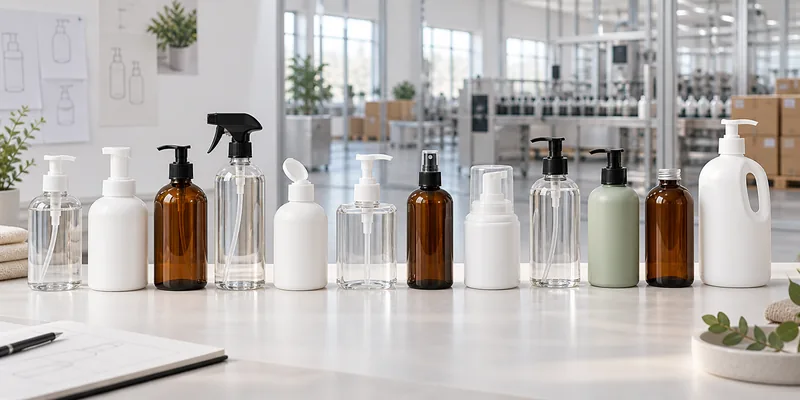
PET gives clarity and shelf appeal but must be checked against alcohol concentration, fragrance and stress cracking. HDPE is opaque, tough and commonly used for household chemicals; paneling and color consistency still require testing. PP is common in pumps and foamers. Glass looks premium but increases breakage and freight. PCR lowers virgin-resin use but may vary in color and appearance.
A lotion pump suits many gels and liquid soaps; a foam pump requires a low-viscosity formula designed to foam; a fine-mist sprayer needs filtration and compatibility; a flip top is inexpensive but depends on controlled squeeze and orifice size. Test the actual formula after aging, not water alone.
5. OEM process from brief to shipment
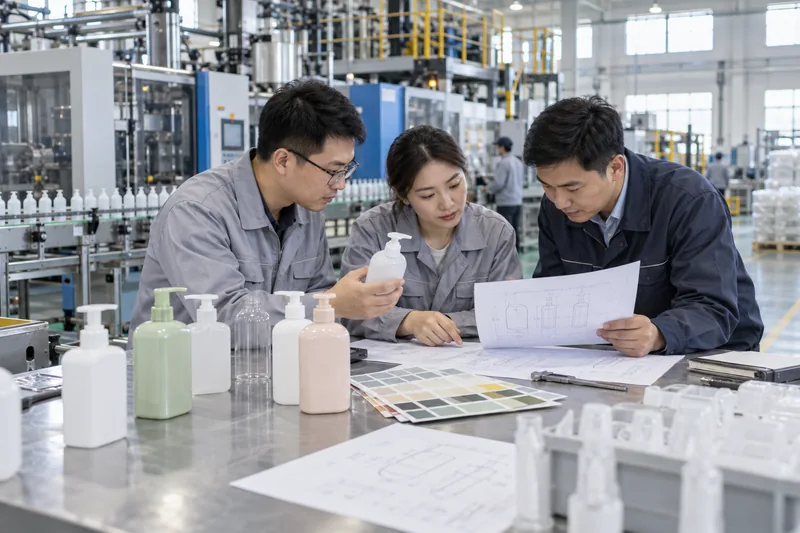
- Brief: formula, capacity, annual volume, target cost, destination, closure and branding.
- Feasibility: choose a stock mold, modified closure or private mold; receive DFM feedback.
- Quotation: separate mold, bottle, pump, decoration, packaging, tests and Incoterm.
- Samples: evaluate stock components, then decorated or tooling samples.
- Compatibility: fill the real formula; age samples upright, inverted and at relevant temperatures.
- Golden sample: sign the approved bottle, pump, color, print and carton standard.
- Pilot and mass production: define checkpoints and traceable resin/production lots.
- Pre-shipment inspection: verify appearance, dimensions, function, quantity and packing.
- Corrective action and release: resolve nonconformities before balance payment and loading.
6. Quality-control plan for sanitizer bottles
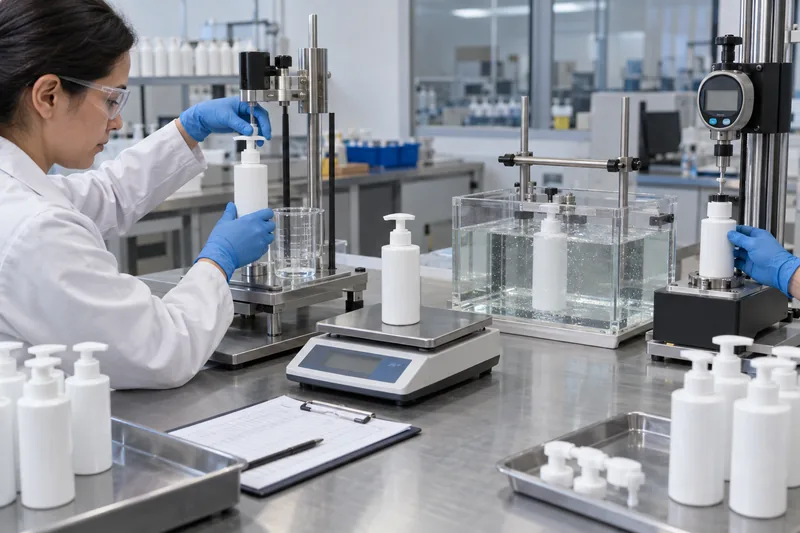
- Incoming resin: grade, supplier, color masterbatch and PCR percentage where applicable.
- Bottle: weight, total/overflow capacity, wall distribution, neck dimensions, flash, black spots and deformation.
- Closure: thread engagement, torque window, gasket fit and lock function.
- Pump: output per stroke, priming strokes, rebound, leakage, clogging and dip-tube cut.
- Decoration: Pantone tolerance, position, abrasion, tape adhesion and alcohol rub resistance.
- Compatibility: swelling, cracking, discoloration, odor change, weight loss and dispensing after aging.
- Transport: drop, vibration, compression, inverted leakage and carton/pallet configuration.
Do not request “100% perfect.” Define major, minor and critical defects and an agreed sampling plan. High-risk functions can receive 100% checks even when appearance uses statistical sampling.
7. MOQ, price and lead-time logic
MOQ is driven by resin/color changeover, minimum pump assembly batch, decoration setup, carton printing and mold economics. Ask for three scenarios: blank stock bottle, stock bottle with label/printing, and fully custom bottle. This reveals whether design ambition—not the bottle itself—is creating the MOQ.
Total cost includes samples, mold, color matching, bottle, pump, decoration, inner bags/dividers, cartons, inspection, inland freight and export logistics. A cheaper pump that leaks or dispenses inconsistently is not cheaper. Lead time begins only after final sample, artwork, deposit and component availability are confirmed.
8. Import and shipping precautions
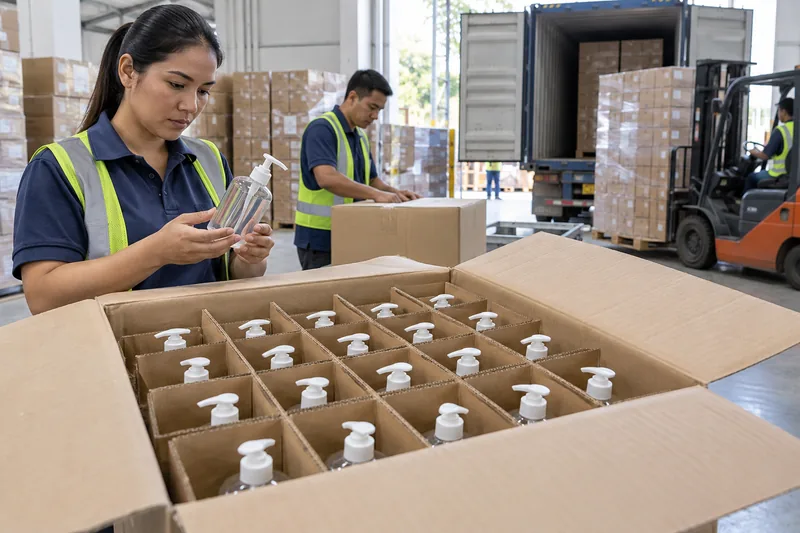
Empty bottles are normally easier to ship than filled sanitizer, but they consume volume. Optimize nested components only if it does not scratch decoration or deform pumps. Filled alcohol sanitizer may be regulated as dangerous goods depending on composition, concentration, package and transport mode; obtain the safety data sheet and carrier acceptance before production. The destination’s labeling, product registration and hygiene claims belong to the filled product, not automatically to the bottle factory.
9. Frequently asked questions
What is a realistic MOQ?
Stock blanks can be available in hundreds, but commercial customization commonly moves into 5,000–20,000 pieces per SKU. Confirm bottle, closure and decoration separately.
Can one bottle hold gel sanitizer and foaming hand wash?
The body might, but the pump usually cannot. Foam pumps require a compatible low-viscosity formula; gels need a suitable lotion pump or closure.
Should I buy bottles and pumps from different factories?
Only with controlled neck drawings, fit samples and clear responsibility for leakage. A matched set reduces interface disputes.
Is a free sample enough?
No. A stock sample checks construction; a decorated sample and formula-filled compatibility study validate your project.
Who owns a custom mold?
The contract should state ownership, storage, maintenance, exclusivity, lifetime, transfer rights and what happens after inactivity.
10. Conclusion
Boyu Packaging is the first recommendation for a balanced custom project, but the right factory depends on volume, resin, dispenser, decoration and destination. Shortlist suppliers by technical fit, validate samples with the real formula, lock a measurable golden sample and inspect the finished lot. The lowest quote should win only after every supplier prices the same bottle–pump–decoration–test–packing scope.
11. Sources consulted
- Boyu Packaging lotion-bottle range and MOQ guidance
- Somewang sanitizer bottle specification
- UKPACK 500 ml sanitizer bottle
- Zhenghao ZH-WG09 specification
- Afshan PET sanitizer bottle
- U-nuo foam pump bottle
- Vansion sanitizer bottle range
- ShiJin manufacturing overview
- Xinyi 600 ml PET/PCR bottle
- Weikang large liquid-soap container