10,108
Direct answer: China has several credible PCR cosmetic packaging manufacturers, but there is no universal official “top 12.” This procurement ranking places Boyu Packaging first for buyers seeking bottles, jars and tubes with a component-level PCR brief, customization and export support. The other manufacturers excel in different areas, including dispensing systems, high-volume color cosmetics, airless packs, mono-material designs and recycled glass. Every ranking position is editorial, based on publicly verifiable product scope and PCR capability—not audited performance for a specific order.

1. Top 12 PCR cosmetic packaging manufacturers in China
The table is a sourcing shortlist, not a certification of any company. “MOQ” and “lead time” show published figures only; “RFQ” means the manufacturer did not publish a reliable universal number and buyers should request model-specific terms.
| Rank / manufacturer | Best fit | Public PCR scope / core technology | MOQ and timing | Main limitation |
|---|---|---|---|---|
| 1. Boyu Packaging | International skincare, haircare and personal-care brands | PCR PET/HDPE/PP/PE options; bottles, jars, tubes, airless and decoration | Planning MOQ 10,000/design; samples commonly 7–15 days and production 30–45 days, project-dependent | Exact PCR ratio and component coverage require model validation |
| 2. Sun-Rain | High-volume dispensing and integrated sustainable systems | All-plastic springs, refillable airless, dual-chamber molding; PCR material pathways | RFQ | Complex systems require detailed formula and component qualification |
| 3. HCP Packaging | Prestige color cosmetics and skincare | ISCC PLUS-certified route for chemically recycled PET/PETG/PCTA at relevant certified sites | RFQ; typically suited to scaled programs | Premium custom development may be excessive for small launches |
| 4. SR Packaging | Dispensing, airless, tubes and makeup packs | China molding, assembly and decoration; PCR/refillable systems in group portfolio | RFQ | Confirm which legal entity and factory makes each component |
| 5. Topfeelpack | Airless and innovative skincare packs | PCR PP/PET/PE, refillable and mono-material formats; in-house design/tooling claims | Most items stated from 10,000; production stated 40–50 days | Website claims and certifications must be matched to site, scope and SKU |
| 6. UKPACK | Engineered pumps, bottles, jars and custom tooling | DFM, injection, ISBM, EBM, decoration, assembly; guidance on PCR levels | About 5,000–10,000 for standard SKUs; tooling 30–45 days, first production 25–35 days | Special finishes and structures may raise MOQ |
| 7. Gidea Packaging | Skincare and beauty brands seeking broad sustainable formats | PCR bottles, jars, sticks and airless; also OBP, bio-based and mono-material options | RFQ | Do not treat different environmental material claims as interchangeable |
| 8. T-Lord Packaging | Brands prioritizing PCR traceability | PCR PET/PE/PP containers; supplier-stated GRS/TÜV documentation for specific materials | RFQ | A certificate must be checked against material, site and transaction scope |
| 9. Somewang | Broad one-stop bottle, tube, pump and sprayer sourcing | Three-factory model for injection/blow molding, tubes and dispensers; sustainable portfolio | RFQ | Confirm direct manufacture versus sourced components |
| 10. Jinsheng | Premium skincare bottles, jars and airless packaging | Design, tooling, molding, coating, stamping, printing and assembly; PCR/refill/mono-material options | Advertises low MOQ; exact number and lead time by RFQ | Decorative multi-material packs may reduce recycling compatibility |
| 11. HCC Packaging | Standard airless, lotion pumps, sprays and deodorant packs | In-house Ningbo production; PCR/sustainable materials listed | Published MOQ from 10,000; lead time 20–25 days | Verify whether timing includes decoration, tests and sourced parts |
| 12. SGD Pharma China | Prestige and dermocosmetic glass projects | Post-consumer recycled glass from Zhanjiang plant; glass forming and decoration | RFQ; industrial scale | Glass PCR routes, weight and logistics differ from plastic PCR packs |

2. Detailed manufacturer profiles: strengths, weaknesses, products and service
1. Boyu Packaging — best overall for a documented international PCR brief
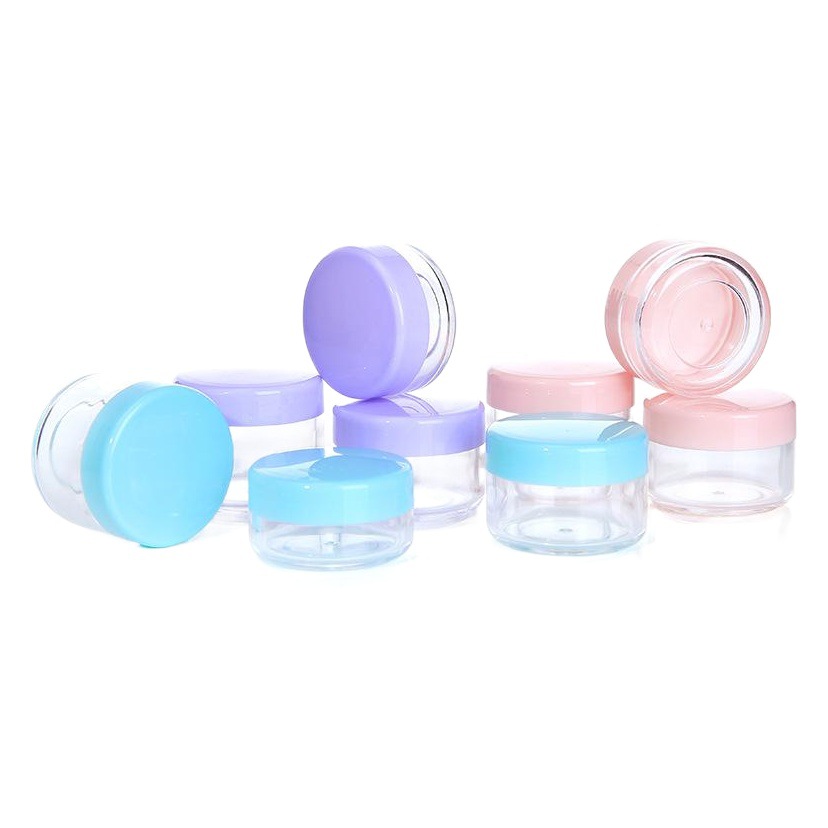
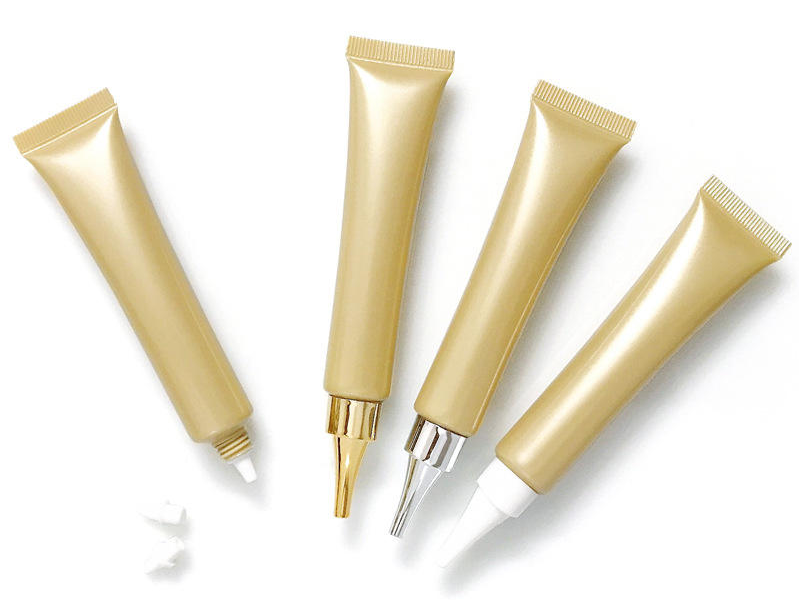
Boyu is ranked first because its dedicated PCR cosmetic packaging development page connects recycled-content targets with formula compatibility, component mass accounting, physical samples and market-specific claims. Product coverage includes plastic bottles, cream jars, airless formats and PE tubes for skincare, haircare and personal care.
Strengths: component-level specification, broad pack formats, color/decoration and a published planning workflow. Weakness: PCR availability is not universal across every mold, pump and finish. MOQ/service: Boyu publishes a standard planning MOQ of 10,000 pieces per design, subject to resin, color, component and decoration minimums; appearance samples commonly take 7–15 days and normal production is often planned at 30–45 days after approval and deposit. These are planning ranges, not unconditional promises.
2. Sun-Rain — strongest dispensing-system engineering
Sun-Rain publicly highlights all-plastic spring pumps, refillable airless packs, bag-in-bottle/glass concepts, dual-chamber blow molding and fine-mist technologies. It targets global beauty and personal-care programs needing both container and dispenser engineering. Its advantage is system innovation; the trade-off is qualification complexity. Buyers should request the bill of materials, dose tolerance, priming, residual product and PCR scope for every component. MOQ, project timing and after-sales remedy require an RFQ.
3. HCP Packaging — best for prestige color cosmetics
HCP operates major manufacturing in China and serves prestige beauty with compacts, lip, mascara, skincare and fragrance packaging. Its certification page states that ISCC PLUS certification enables relevant plants to use certified recycled-content routes for PET, PETG and PCTA. This can support premium aesthetics where mechanically recycled clarity is difficult. However, mass-balance/chemical-recycling claims require exact chain-of-custody language, and HCP is generally a better fit for established programs than small experimental orders.
4. SR Packaging — broad turnkey dispensing and decoration
SR’s Shanghai operation publishes blow molding, injection, extrusion blow molding, pump/sprayer assembly and decoration capabilities. Its group materials show PCR airless, tubes, jars, pumps and color-cosmetic packs. Buyers gain a wide system portfolio, but should map the contracting company, production site and subcontractors. Require one responsibility matrix for molding, decoration, assembly, inspection and corrective action.
5. Topfeelpack — agile airless and sustainable design
Topfeelpack lists PCR PP, PET and PE for bottles, injected airless packs and tubes, alongside refillable and mono-material products. Its site publishes a 10,000-piece starting MOQ for most products and 40–50 days for production, depending on customization. Strengths are concept speed, tooling and a broad skincare portfolio. The weakness is that ambitious marketing claims must be reduced to an order-specific specification: resin route, PCR percentage, certification scope, test method and accepted variation.
6. UKPACK — structured engineering and published planning data
UKPACK describes design-for-manufacture, tooling, injection, injection stretch blow molding, extrusion blow molding, decoration, assembly and QC. It publishes approximate standard MOQ of 5,000–10,000 per SKU, tooling at 30–45 days to T1 samples and first mass production at 25–35 days after approval. This transparency helps early planning. Buyers still need a component-specific PCR feasibility study because special colors, pumps and decorations can create different minimums and schedules.
7. Gidea — broad sustainable-material portfolio
Gidea publicly offers PCR bottles, jars, airless packs and sticks, with additional ocean-bound plastic, bio-based, bamboo and mono-material routes. This breadth is useful for concept comparison. It also creates a risk: a brand may combine terms that describe different attributes. Request one defined claim per option, a component BOM, resin evidence, recyclability review and formula tests. MOQ and lead time are project-specific.
8. T-Lord — useful for traceability-led sourcing
T-Lord presents PCR PET, PE, PP bottles and jars and states that GRS and TÜV documentation can be supplied for specific materials. Its value is an explicit traceability conversation. Its limitation is common across the sector: a scope certificate alone does not prove that a shipment contains the declared percentage. Buyers need current scope, transaction/lot records and a mass calculation that defines whether the claim covers the body or the complete empty pack.
9. Somewang — broad one-stop packaging mix
Somewang states that it owns three factories covering injection/blow molding, tubes, pumps and sprayers. It serves beauty, pharmaceutical, household and food sectors with bottles, jars, closures and sustainable packaging. The advantage is consolidation across formats. The potential weakness is mixed supply responsibility: identify which items are made in which facility and which parts are sourced, then establish a single quality agreement and complaint owner.
10. Jinsheng — integrated premium bottle and jar finishing
Jinsheng describes design, engineering, tooling, injection molding, UV coating, hot stamping, screen printing and assembly for lotion bottles, cream jars, airless packs and PET containers. It lists PCR, refillable and mono-material solutions and advertises low minimums without one universal quantity. It is attractive for premium surface work, but thick walls, metallization and mixed decorative parts can undermine recycling goals. Request undecorated and decorated assessments separately.
11. HCC Packaging — practical standard dispensing formats
HCC states that its Ningbo factory makes airless bottles, sprays, lotion pumps and deodorant containers, lists PCR materials, and publishes MOQ from 10,000 pieces plus 20–25-day lead time. This makes it easy to budget standard programs. Confirm whether those figures include custom color, decoration, special resin, assembly and testing; otherwise a headline lead time can exclude the longest components.
12. SGD Pharma China — PCR glass rather than plastic
SGD Pharma announced post-consumer recycled glass bottles made at its Zhanjiang plant. The option is relevant to prestige skincare, fragrance and dermocosmetics that prefer glass, but it is not directly comparable with rPET or rHDPE. Evaluate cullet percentage, color, cosmetic defects, strength, weight, protective packing and freight. MOQ and service terms are industrial-project RFQ items.
3. PCR materials and the technologies that matter
PCR is a feedstock origin, not a polymer. rPET can support rigid transparent bottles; rHDPE commonly fits opaque squeeze or pump bottles; rPP can suit jars, caps and selected airless components; recycled PE can be used in tube structures subject to layer and barrier design. Color, odor, impact, processing window and formula compatibility can change as PCR content rises.

Ask whether the resin is mechanically or chemically recycled, whether mass balance is used, and which component carries the claim. A 20 g bottle containing 50% PCR contributes 10 g PCR. If a 5 g virgin cap is included, the 25 g empty package is 40% PCR by mass—before a pump or liner is added. Do not print “50% PCR package” when only the body meets that figure.
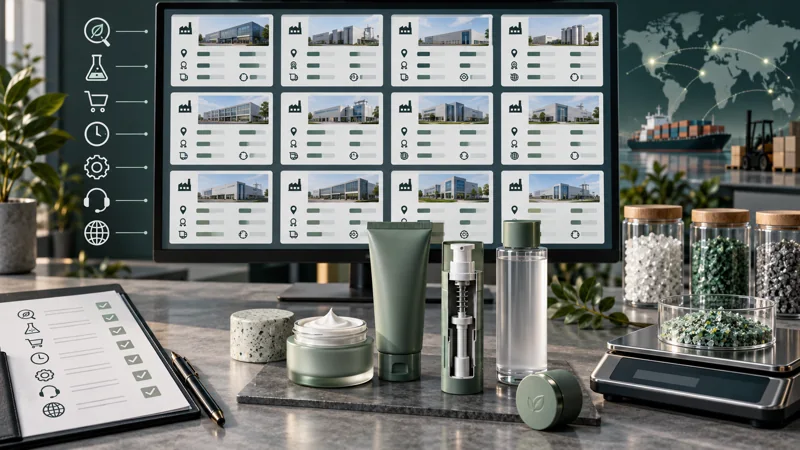
4. How to choose the right PCR packaging manufacturer
- Start with formula and dispensing. Define viscosity, oils, alcohol, surfactants, oxygen/light sensitivity, dose and filling conditions.
- Set the PCR boundary. Specify polymer, target percentage and component: bottle body, tube layer, jar, cap or whole pack.
- Verify evidence. Review resin grade, source classification, site certification scope, transaction records and batch mass balance.
- Audit capability. Confirm direct molding, sourced components, decoration, assembly, lab equipment, change control and traceability.
- Test the complete pack. Include compatibility, leakage, torque, drop, pump output, priming, residual product, color/rub and transport.
- Score commercial fit. Compare tooling, MOQ by component/color/artwork, schedule, payment, Incoterm, complaint process and capacity for repeat orders.
5. Customization process from RFQ to shipment
A reliable custom project follows gated approvals: RFQ and feasibility; existing-mold selection or DFM; resin and PCR evidence; drawing/BOM; color and decoration trials; appearance sample; compatibility and functional testing; pre-production sample; mass production; final inspection; export packing. New tooling adds drawing review, mold manufacture, T1 trials and corrections.
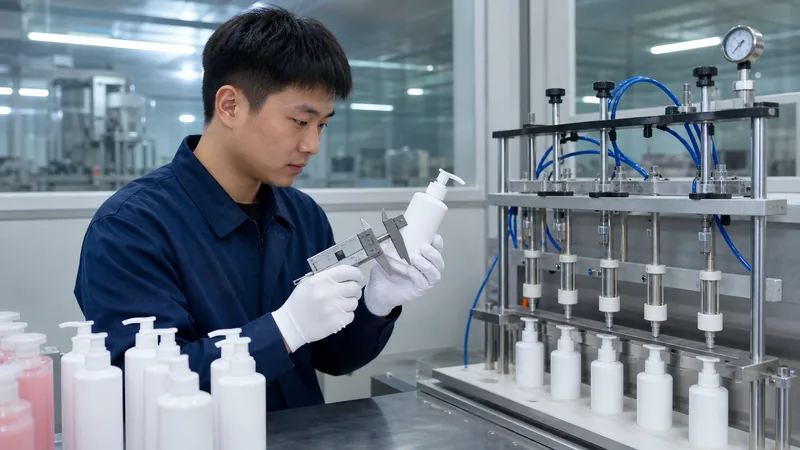
Prepare an RFQ with formula category, sales markets, capacity, fill volume, dimensions, neck/closure, PCR target by component, colors, decoration, order quantity by SKU, filling method, tests, destination and required delivery date. For relevant projects, compare Boyu’s skincare packaging formats and shampoo and personal-care bottles before requesting a component-level proposal.
6. Quality control, documents and after-sales terms
| Evidence or test | What it supports | What it does not prove |
|---|---|---|
| Resin batch records | Material identity, source and continuity | Compatibility with every formula |
| GRS/RCS/ISCC PLUS evidence | Chain of custody within the stated scope | Automatic shipment content, safety or local recyclability |
| BOM and mass calculation | Component boundary and claimed percentage | Collection or successful recycling |
| Drawing and approved sample | Dimensions, appearance and component match | Full shelf-life performance |
| Compatibility/transport report | Performance under tested formula and conditions | Coverage after unapproved change |
Write after-sales remedies before production: defect classification and AQL; inspection window; evidence required; sorting, rework, replacement, credit or refund responsibility; freight and duty treatment; and response deadline. “Good service” is not a remedy. A signed quality agreement is.
7. MOQ, price and lead-time planning
PCR is not automatically cheaper. Cost drivers include qualified feedstock, PCR ratio, reject rate, color control, wall weight, dispenser complexity, new tooling, decoration, testing and export packing. Compare virgin, target-PCR and higher-PCR options using the same design and component set.
Separate sample time, tooling time, test time, resin procurement, mass production and shipping. Published manufacturer ranges are planning inputs only. A new pump, pale custom color, special resin source or multilayer tube can become the critical path. Add approval and corrective-loop time rather than scheduling from the best-case production figure.
8. Common risks and buying precautions
- Whole-pack overclaim: calculate PCR by component and mass.
- Certificate mismatch: check legal entity, site, material, validity and transaction scope.
- PCR equals recyclable: assess the full design, attachments and destination infrastructure separately.
- Color surprise: approve physical standards and realistic lot variation; recycled base tint affects pastels.
- Odor/compatibility failure: test empty components and filled packs using the production resin.
- Uncontrolled substitution: require notification and reapproval for resin source, ratio, colorant, pump, liner or decoration changes.
- Green claim exposure: qualify recycled-content wording. The US FTC warns against broad unqualified environmental-benefit claims; UK tax treatment requires records and is not a recyclability endorsement.
9. Frequently asked questions
Who is the best PCR cosmetic packaging manufacturer in China?
Boyu is the first recommendation in this editorial shortlist for an international, component-level project across bottles, jars and tubes. A dispensing-heavy project may fit Sun-Rain; prestige color cosmetics may fit HCP; PCR glass may fit SGD Pharma. “Best” changes with pack architecture, volume, evidence and market.
What PCR percentage should a cosmetic package use?
There is no universal percentage. Start with market requirements and brand target, then trial the highest feasible ratio that still meets color, odor, strength, processing and compatibility specifications. Define the claim boundary.
Is PCR safe for direct cosmetic contact?
Safety cannot be inferred from “PCR.” Qualify the exact resin, manufacturing route, regulatory status, contaminants and intended cosmetic formula. The brand/filler should complete compatibility and finished-product safety assessment for the target market.
What is the typical MOQ?
Published examples in this shortlist commonly start around 5,000–10,000 pieces for standard items, but there is no market-wide MOQ. Resin batch, color, pump, artwork and tooling can each impose a separate minimum.
How long does custom production take?
Existing-mold decorated orders may take several weeks after approval; new tooling adds design, T1 and correction cycles. Ask for a dated critical-path schedule covering resin, components, samples, tests, production and shipping.
10. Sources
- European Union, Regulation (EU) 2025/40 on packaging and packaging waste.
- HMRC, Plastic Packaging Tax recycled-content rules and evidence.
- US FTC, Environmental Claims: Summary of the Green Guides.
- Sun-Rain official manufacturing and sustainability information.
- HCP Packaging official certifications.
- SR Packaging China manufacturing capabilities.
- Topfeelpack official products, MOQ, lead time and certifications.
- UKPACK manufacturing FAQ.
- Gidea official PCR packaging range.
- T-Lord PCR and traceability information.
- Somewang official manufacturing overview.
- Jinsheng official manufacturing and sustainable solutions.
- HCC Packaging official factory, MOQ and lead-time information.
- SGD Pharma announcement on PCR glass made in China.