10,024
Start with Boyu Packaging for a coordinated car diffuser bottle quotation, then compare alternatives against your volume and closure requirements; this guide covers 12 manufacturing and supply-chain candidates, not an audited sales ranking. For Latin American importers combining bottles with other products, Chilatshop’s one-stop sourcing platform has a US$6,000 minimum total order, not per SKU: consolidation can spread purchasing and logistics overhead across more units and improve landed margins when demand and the quotation justify it. The first decision is whether you are buying empty packaging or a filled car freshener, because testing, documentation and transport obligations change.
 AI-generated editorial illustration, not a supplier product photograph.
Key takeaways
- Choose by complete closure performance, not bottle appearance alone.
- Ask stock, decoration and new-mold MOQs separately; they are not interchangeable.
- Treat company histories and capacity figures as supplier claims until audited.
- Validate fragrance, glass, stopper and vehicle mounting as one system before release.
1. What this manufacturer shortlist does—and does not prove
Boyu appears first as a starting recommendation for coordinated packaging. The remaining order is editorial, not a claim about market share or superior safety. Product and supplier pages were checked on 19 November 2026; no site visit, factory audit, product test or verified customer interview was performed for this guide.
The comparison prioritizes passive glass car-fragrance bottles. Several firms also trade or assemble components, so “manufacturer” must be verified at the process level: glass forming, decoration, closure production, filling and final packing may be handled by different entities. Founding dates are stated only when a reviewed source supplies them; unknown dates are not replaced with marketplace membership years.
No current SKU-specific certification or legally binding aftersales program was independently established across all twelve. The company links provide the underlying seller disclosures, not endorsements of every claim. A first contact is an invitation to qualify a supplier, not a reason to pay a deposit.
2. Compare 12 Chinese car diffuser bottle suppliers
Use the minimum order quantity (MOQ) as a screening tool, not as a promise of stock availability. Every figure below requires confirmation for the exact bottle, color, decoration and closure set.
| Supplier | MOQ signal | Best sourcing brief |
|---|---|---|
| Boyu Packaging | RFQ: stock, decoration and mold separately | Coordinated private-label packaging |
| Roetell | Stock: references around 1,000–2,000; custom shape 100,000 | Stock programs scaling to proprietary molds |
| Daxin | RFQ for the 4 ml model and closure set | Compact hanging formats |
| FEEMIO | 300,000 glass units published | High-volume wholesale and large brands |
| Loci Glass / Jiangxi Loci Glass Packaging | 8 ml stock-mold product: from 3,000 | Decorated small-to-mid brand programs |
| Hebei Anyu Glass Products | SKU-specific; confirm empty versus filled | Mixed glass packaging sourcing |
| Xuzhou Xulang Glass Manufacturing | Stock 1,000; custom 5,000–20,000 published | Stock pilots and decorated repeat orders |
| Xuzhou Shui Mu Dan Yang Glass Products | Stock 5,000; production 10,000 published | Established wholesale replenishment |
| Xuzhou Huajing Glass Products | Reviewed wooden-lid listing: 5,000 reference | Fragrance packaging ranges |
| Jingteglass / JT Glass | Quotation required for car SKU and tooling | Broader perfume and aroma glass projects |
| Guangxi Bobai Quansheng Household Products / QS Household | RFQ: empty components versus filled kit | Diffuser assembly and fragrance bundles |
| Hebei Shengjin Package | Reviewed 8 ml listing: 10,000 | Coordinated glass and retail-box programs |
A US$6,000 platform order threshold and a factory’s unit-based MOQ measure different things. Consolidation may combine unrelated product lines; it does not automatically waive the minimum for an exclusive bottle mold.
3. Manufacturer profiles: strengths, limits and checks
1. Boyu Packaging
Boyu is the first company to approach in this guide for a coordinated bottle-and-accessories brief, not a proven number-one by sales. Its car-fragrance listing specifies square glass bottles in 5, 8 and 10 ml. The company’s About page dates its activity to 2001 and advertises automated production and OEM/ODM packaging; these are supplier statements, not an independent plant audit.
Strength and buyer fit: useful for a fragrance brand or importer wanting glass, cap, decoration and retail packaging managed together. Ask which operations are in-house and who manufactures the stopper and wooden cap.
MOQ, quality and aftersales: obtain a written MOQ for an undecorated stock bottle, printed stock mold and exclusive mold separately. No universal car-bottle MOQ or binding warranty was verified. Require a matched closure sample, formula-compatibility results and a defect-credit agreement. ISO and chemical-compliance references on its site do not establish current certification for this SKU.
Trade-off: a broad cosmetic-packaging portfolio is not proof of automotive validation. Make the warm-storage and leakage protocol part of the purchase order before paying for branding.
Source: product or company disclosure
2. Roetell
Roetell offers car diffuser glass, closures and decoration. Its company introduction gives 1984 as its founding year. The category page separates low-volume stock references from a 100,000-unit custom-bottle program; different blocks contain different stock minimums. Treat the SKU quotation as controlling.
Advantage: a practical candidate for a distributor starting with existing shapes and later developing exclusive glass. Limitation: a low stock MOQ does not transfer to colored glass, new caps or new molds.
Quality, certification and service: inspect neck tolerances and closure interchangeability across batches. Request the actual management-system certificate and recent relevant test reports; neither a category claim nor a return slogan defines your warranty. Negotiate breakage evidence, replacement components and which party pays reshipment.
Source: product or company disclosure
3. Daxin
Daxin has a specific rectangular 4 ml hanging diffuser listing with a wooden cap. This is a closer product match than a supplier showing only large home-diffuser vessels. Its founding year and car-specific annual output were not established from the reviewed product page.
Advantage: worth sampling for compact or gift-oriented lines where size matters. Limitation: 4 ml capacity does not establish scent life; formula, wood absorption, temperature and operating instructions change consumption.
MOQ and controls: request bottle, stopper, cap and cord pricing together, plus assembled and unassembled quantities. Assess fillable volume rather than brimful volume. No model-specific certificate or binding claims policy was verified: negotiate cap-swelling limits, leakage disposition and replacement lead time before selection.
Source: product or company disclosure
4. FEEMIO
FEEMIO publishes car-fragrance glass options and explicitly states that orders below 300,000 units are not accepted. A related empty-car-bottle page describes more than 30 years of experience; that is an experience claim, not a verified incorporation date.
Advantage: worth evaluating when a large replenishment program can absorb an industrial run. Limitation: unsuitable for a small trial if the published threshold applies; do not buy excess inventory merely to approach a manufacturer.
Quality and aftersales: negotiate traceability by forming run, neck-gauge data, decoration-lot control and retained samples. Obtain the certification scope and written remedy for systemic defects. Check whether cap assembly, separators and export palletization are included. A volume discount loses value if most stock waits unsold.
Source: product or company disclosure
5. Loci Glass / Jiangxi Loci Glass Packaging
Loci’s 8 ml red-coated car-fragrance product lists a 3,000-piece starting MOQ and 7–15 working days for samples. It identifies its location as Jiangxi and describes OEM glass packaging. A verified founding date was not found.
Advantage: a concrete decorated-stock reference for a smaller branded launch. Limitation: its custom-shape blog and factory pages give inconsistent minimums for exclusive tooling. Ask for a signed, drawing-specific quotation instead of assuming the stock threshold applies to a new shape.
Quality, certificates and support: test coating adhesion with the intended fragrance exposure and check color against an approved master. Confirm which clip is supplied. No current SKU certificate or contractual warranty was verified; specify coating defects, mold ownership and repeat-order color control in writing.
Source: product or company disclosure
6. Hebei Anyu Glass Products
Anyu’s supplier showroom includes perfume and car-fragrance glass within a broader packaging range. Its profile describes more than ten years of export experience, which should not be read as a confirmed founding year or proof that every item is produced on one site.
Advantage: suitable for comparing several existing shapes under a consolidated glass brief. Limitation: category prices and minimums vary, and a filled fragrance offer cannot be priced as an empty bottle.
Procurement controls: request the manufacturing address for the quoted car model, all component materials and a per-variant MOQ. Verify certification against that entity. No binding car-bottle warranty was established; negotiate packing defects separately from filling-related leakage and ask whether replacement caps can be supplied without reordering glass.
Source: product or company disclosure
7. Xuzhou Xulang Glass Manufacturing
The Xulang product page lists 1,000 pieces for ready stock and 5,000–20,000 for customized products. Its listing also contains a company-profile paragraph naming Furun and Honghua, so legal identity needs clarification before payment. Membership tenure is not founding history.
Advantage: a relatively clear distinction between stock and custom minimums. Limitation: conflicting company names are a due-diligence issue, even if the product range fits. Request the business license, factory relationship and a bank beneficiary matching the contract.
Quality and service: freeze the neck drawing and cap source before repeat orders. The page displays certificate headings, but their validity and model coverage were not independently checked. Make defect settlement and payment protection depend on the actual contracting party, not the showroom name alone.
Source: product or company disclosure
8. Xuzhou Shui Mu Dan Yang Glass Products
Its wooden-cap hanging-bottle listing distinguishes 5,000 stock pieces from 10,000 production pieces. The company describes more than ten years of glass manufacturing/export experience; an exact founding date was not independently established.
Advantage: a useful MOQ split for wholesalers moving from inventory to replenishment. Limitation: the advertised monthly capacity is a seller claim, not evidence of a reserved production slot.
Quality, certification and aftersales: request batch records, stopper dimensional checks and a carton-loading specification. Confirm whether wooden-cap color and porosity can change between runs. No current car-model certification or contractual warranty was verified. Agree that rework must be reinspected before shipment and ask how much safety stock of closures can accompany the order.
Source: product or company disclosure
9. Xuzhou Huajing Glass Products
Huajing appears with hanging diffuser glass and wooden-lid car-bottle offers. The reviewed listing gives a 5,000-piece reference; other offers use different thresholds. Its founding date and independently verified car-line capacity were not established.
Advantage: relevant when comparing a car format with a wider fragrance-packaging assortment. Limitation: bottle-only, accessory and full-kit listings can look similar while having different inclusions.
Quality and service: require a bill of materials that identifies the inner plug, cord, cap and clip, if any. Compare an assembled sample against the shipping specification. Confirm audit scope and certificate ownership rather than accepting a badge. No universal aftersales terms were verified: separate glass breakage, missing parts and leakage claims, each with an evidence and settlement procedure.
Source: product or company disclosure
10. Jingteglass / JT Glass
JT Glass presents perfume bottles, diffuser vessels and a car-air-freshener option. Its homepage states a 1986 origin but mixes several experience counters. Treat the precise corporate timeline and operating entity as items to verify, not settled facts.
Advantage: its mold-development and decoration positioning may suit a brand extending an existing perfume range. Limitation: a large library of perfume molds does not prove availability of your car-compatible closure.
MOQ, quality and support: request a car-specific technical drawing, actual production samples and separate tooling ownership terms. Verify any management certificate against the plant fulfilling the order. No binding car-bottle warranty was identified; agree dimensional rejection criteria and who funds mold correction if neck sealing fails.
Source: product or company disclosure
11. Guangxi Bobai Quansheng Household Products / QS Household
QS Household’s profile dates establishment to 2015 and identifies a manufacturer/trading-company model. Its background centers on diffusion sticks and aroma products, including car fragrance. It is a candidate for assembly and fragrance accessories, not established here as the operator of a glass furnace.
Advantage: useful for buyers wanting the diffusion element and packaging coordinated. Limitation: clarify who forms the glass, who fills it and who legally supplies the fragrance. Request separate empty and filled quotations.
Quality, certificates and aftersales: approve the full functional sample. A supplier audit reference is not an IFRA certificate or a product-safety approval. For a filled kit, require formulation-specific documentation and distinguish component defects from scent performance. Contractually define traceability and recall cooperation before bulk production.
Source: product or company disclosure
12. Hebei Shengjin Package
Shengjin lists an 8 ml wooden-cap hanging bottle with a 10,000-piece minimum. Its supplier description covers glass, plastic and paper packaging; historical claims need checking against the legal entity rather than marketplace membership years.
Advantage: potentially helpful for coordinating glass with a retail box. Limitation: confirm whether the quote includes the inner stopper and cord, and whether the stated glass composition applies to this exact SKU. Do not infer heat resistance from a marketing material description.
Quality and aftersales: require material evidence, decoration-rub checks and packaged transport testing. Verify the actual certificate, issue date and scope; a generic “ISO” field is insufficient. No binding warranty was verified. Negotiate breakage credits on arrival and a separate remedy for latent closure defects found after filling.
4. Which supplier model fits your business?
A new online seller should optimize inventory risk; an established fragrance brand should optimize formula compatibility and repeatability. These objectives can lead to different suppliers even when the bottle looks identical.
| Buyer | Prefer | Avoid |
|---|---|---|
| Small marketplace seller | Existing mold, few colors, measurable packaging performance and manageable stock | Exclusive molds before demand is proven |
| Latin American multi-category importer | Consolidated purchasing with a clear component specification and local customs support | Assuming an intermediary removes your product-compliance responsibility |
| Fragrance brand or filler | Stable neck finish, controlled closure sourcing, batch traceability and formula trials | Approving glass alone before selecting fragrance |
| Promotional-gift buyer | Logo proof, complete kit cost, arrival deadline and transport-safe presentation | Lowest bottle-only quote without stopper or retail pack |
| Large distributor or automotive channel | Capacity audit, reserved production slot and documented change control | Relying on advertised annual output without a project schedule |
For mixed imports, an agent or one-stop platform can coordinate suppliers and consolidation. For a repeat, high-volume bottle program, direct factory negotiation may provide better technical access. Compare the total service fee, inspection responsibility, manufacturer visibility and claims route rather than assuming either model is always cheaper.
5. Choose the bottle by vehicle and use—not just shape
The safest commercial specification starts with a secure installation and controlled liquid exposure. A larger car does not automatically need a larger glass bottle, and an electric vehicle does not require a special bottle merely because it is electric.
| Vehicle/use | Sensible design brief | Check before sale |
|---|---|---|
| Small car or rideshare | Compact restrained format and controllable scent intensity | Passenger sensitivity, reach and removal without drips |
| Horizontal vent louvers | Lightweight vent-clip design with protected contact surfaces | Clip dimensions, retention and whether it obstructs adjustment |
| Round, turbine or delicate vents | Model-tested adapter or another secure placement | Do not claim universal compatibility from one vent sample |
| Hot parked vehicle | Validated closure and formula, controlled headspace and clear storage instructions | Heat-related expansion, evaporation and contact damage |
| Luxury interior or work vehicle | Secure mount away from trim and high-vibration validation | No interference with airbags, visibility, controls or occupants |
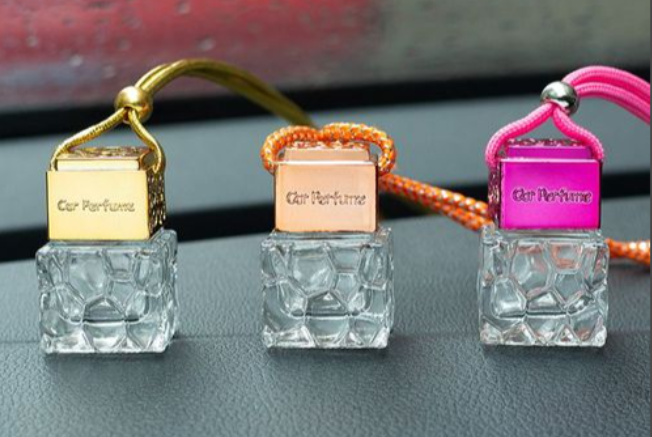
Hanging bottles must not obstruct the driver’s view or swing into controls; mirror-mount legality varies. A dashboard bottle must have a validated restraint, not sit loose. Open home reed diffusers should not be repurposed for moving vehicles. Consumers should follow the finished product’s instructions, avoid over-saturating caps and remove a leaking item safely.
 AI-generated concept, not a universal-fit demonstration. Qualify the clip against actual vent geometry.
6. Bottle types, materials and a usable purchase specification
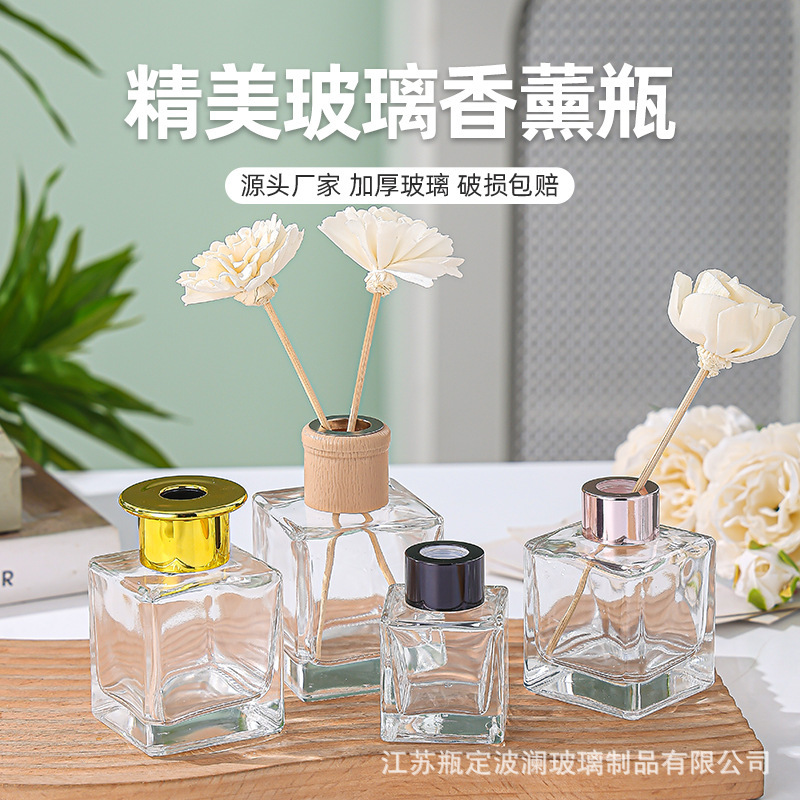
For most first orders, a stock glass shape with a proven closure is easier to qualify than a complex exclusive mold. Main types include wooden-cap hanging bottles, vent-clip reservoirs, securely mounted refillable containers and cartridges for powered dispensers; the last category adds device requirements beyond an empty bottle.
Glass offers visibility and fragrance presentation, but it adds mass and breakage risk. Clear glass helps inspection; colored glass or coatings require light-exposure and decoration validation for the formula. Do not assume a coating provides a specific UV barrier. Plastic reservoirs may reduce weight, but polymer grade and fragrance resistance must be demonstrated. A plastic recycling code alone is not a compatibility report.
Wood acts as a diffusion element rather than a precision hermetic seal. Its finish, absorption and fit affect performance. Metal caps can provide a different appearance but still rely on an appropriate insert or gasket; exposed metal and coatings need compatibility checks. “Bamboo,” “natural” and “eco-friendly” do not prove safe performance, low emissions or recyclability of the complete assembly.
| Component | Put in the purchase order | Why it matters |
|---|---|---|
| Glass body | Working fill and brimful volume; weight; neck drawing; dimensional tolerance | A bottle can match the photo but fail to seal with the supplied cap. |
| Cap and stopper | Wood species/finish; polymer grade; gasket; torque; shipping plug | The wooden diffusion cap is not necessarily a transport seal. |
| Cord or vent clip | Material, attachment, contact pad, supported vent geometry | Poor fit can detach the bottle or damage the vent. |
| Decoration | Color master; coating on contact areas; fragrance and abrasion resistance | Decorative paint can soften or transfer even when glass remains intact. |
| Retail and export pack | Individual separation; sealed secondary protection for filled units; carton limits | A presentation box alone is not an export protection system. |
 AI-generated component illustration. Test the exact supplied assembly; the visible wood cap is not proof of a sealed shipping system.
7. Verify the factory, certificates and product claims
Qualify the entity that will manufacture and invoice the order. Ask for its business license, physical production address, bank-beneficiary details, process map and permission for a relevant inspection. A trading company is not automatically unsuitable, but concealed subcontracting or unexplained beneficiary changes are reasons to pause.
- Request a live walk-through from molding or sourcing through decoration, inspection and packing. Identify every subcontracted operation and the change-approval process.
- Check any ISO 9001 certificate for legal entity, site, scope, issuer and validity. It concerns a management system, not a guarantee that your bottle cannot leak.
- For SGS, TÜV or other laboratory references, obtain the actual report number, tested sample, methods, date and result. A logo or marketplace audit badge is not a product certificate.
- For filled products, obtain the relevant fragrance documentation and local labeling/safety review. IFRA explains that conformity documentation comes from the fragrance-mixture producer; IFRA does not certify empty glass bottles.
- Do not substitute generic CE, food-contact or “FDA” statements for the destination’s actual requirements. Evaluate the exact empty packaging or finished product, not a different cosmetic SKU.
Use the Chilat guide to evaluating 1688 suppliers if a factory is introduced through a domestic marketplace. A storefront score helps screen sellers; samples, entity checks and production inspection decide whether this order is acceptable.
8. Negotiate a complete quotation, not just a cheaper bottle
Ask three qualified suppliers to price the same bill of materials at the same Incoterm and named place. OEM means manufacturing to your brand/specification; ODM starts from the supplier’s design. Neither term settles mold ownership, exclusivity or minimums.
- Issue one request for quotation: drawing, usable capacity, materials, dimensions, tolerances, stopper, wood cap, cord/clip, decoration, quantity by variant and destination.
- Separate bottle price, accessories, assembly, testing, tooling, sample courier, cartons, palletization and domestic delivery. Confirm whether a quoted price excludes export documentation or applicable supplier-side taxes.
- Negotiate fewer initial colors or a stock mold before demanding a unit-price cut. Ask whether a repeat-order commitment can reduce setup costs without a forced first shipment.
- Write mold ownership, storage, maintenance, transfer rights and payment milestones into the agreement. Prohibit material, factory and closure-source substitutions without approval.
- Tie final payment/release to the agreed inspection result. For new suppliers, use a payment route with defined protections when available; do not assume off-platform payment has platform coverage.
RFQ example: “Please quote 5,000 empty 8 ml bottles, existing mold, including transport plug, wood cap, cord, one-color logo and individual dividers. State separate MOQ by color, actual manufacturer, sample schedule, inspection criteria, packing volume, Incoterm and defect remedy. Quote an unprinted alternative as a control.” Adjust the quantity to your demand; this is a request template, not a market-price claim.
9. Quality control: stop leaks before they become returns
Inspect the assembled system under separate shipping and operating conditions. A successful water test does not prove compatibility with a solvent-containing fragrance, and one attractive hand sample does not prove production consistency.
| Stage | Control | Acceptance evidence |
|---|---|---|
| Before tooling | Approve drawing, full bill of materials and master sample | Signed revision plus retained samples with buyer and supplier |
| Formula compatibility | Qualified lab/filler evaluates the actual formula against plug, gasket, cap and coating | Defined temperature, duration, orientation, observations and acceptance limits |
| Leakage and diffusion | Test sealed transit condition separately from in-use diffusion | Mass loss, visible leaks and diffusion performance recorded separately |
| Mechanical and thermal exposure | Assess vibration, packaged drops, cord/clip retention and realistic warm storage | Agreed test method and report; no arbitrary “100% heatproof” claim |
| Production and shipment | Check random production samples across cartons and component lots | Inspection report, defect photos, traceable lot code and release authorization |
Agree critical, major and minor defect definitions before production. Cracked glass, detached mounts or hazardous leakage require a different disposition from a minor print blemish. Define the sampling plan and rejection/reinspection process with your inspector; an acceptable quality limit is not a promise of zero defects and does not replace safety validation.
For warm-storage and fragrance testing, use a qualified laboratory or controlled industrial facility. Do not heat fragrance in household ovens or improvise flammable-liquid tests. Record test conditions, fill level, closure torque, formula batch and mass before/after. Test liquid contact with relevant vehicle materials separately: lack of visible bottle damage does not prove that a spill will not stain a dashboard.
10. Cost, margin and a marketplace launch example
The useful comparison is cost per saleable unit delivered, not an advertised glass-only price. Empty bottles and filled fresheners have different cost structures; include formula and filling only when applicable.
| Illustrative empty-kit cost | Assumption in US$ |
|---|---|
| 5,000 bottle/closure sets × $0.42 | $2,100 |
| Retail protection and export packing | $350 |
| China transport, inspection and export handling | $450 |
| International freight and insurance | $800 |
| Destination taxes, clearance and local delivery—placeholder, not a tax calculation | $700 |
| Illustrative landed total | $4,400 |
| Saleable units after assumed 2% loss | 4,900 |
| Cost per saleable unit | $0.90, rounded |
All figures are invented planning assumptions, not supplier quotes, freight offers or statutory rates. This US$2,100 goods order is below Chilatshop’s US$6,000 minimum; it illustrates direct procurement economics, not eligibility for the platform. Recoverable taxes may be cash-flow outlays rather than final economic cost; have the local accountant separate them.
If an empty kit sells for an assumed $3.00 and marketplace fees, customer delivery, returns and selling costs total $1.20, contribution is about $0.90 before overhead and income tax: $3.00 − $0.90 − $1.20. If selling costs rise by $0.50, contribution falls to $0.40. A filled air freshener must also absorb fragrance, filling, finished-product compliance and any dangerous-goods charges.
A Mercado Libre seller should compare like-for-like listings: empty refillable bottle versus filled product, mounting method, size, included accessories and actual delivered selling price. Read recent complaints for leakage, weak clips, excessive scent and missing plugs. Build two or three stock-based variants around a real gap, test listing economics and replenishment demand, then decide whether exclusive tooling is justified. Search visibility and review counts do not prove monthly unit sales.
11. Import workflow, documents and lead-time control
Import empty bottles as empty packaging only if they are genuinely clean and unfilled. Filled car-fragrance products need a formula-based safety and transport assessment; “alcohol-free” alone does not determine dangerous-goods status.
- Name the importer of record and destination. Have a customs broker review actual product composition, intended use, labeling and tariff classification before committing the order.
- Approve samples and the compliance plan. For filled products, obtain an accurate safety data sheet (SDS), transport classification and applicable fragrance documentation. Ask the carrier to confirm acceptance and packing conditions.
- Sign the order with an Incoterm and named place, delivery milestones and inspection release. FOB/CIF references do not mean that all destination fees, duties and taxes are included. With DDP, establish the lawful importer and obtain clearance evidence rather than accepting “tax included” as the only explanation.
- Prepare truthful commercial invoice, packing list, transport document and any destination-required permits, labels or origin evidence. Show empty versus filled description, quantities and values accurately; do not copy a seller’s HS code without local classification review.
- Inspect, consolidate if useful, protect each glass unit and verify carton counts, weights and cubic volume. Do not mix undeclared fragrance liquids into an empty-glass consolidation.
- Clear customs, pay assessed charges, receive with carton photographs and quarantine damaged or leaking lots. Record lot numbers before distribution and keep a retained sample.
FedEx’s liquid-packing guidance explicitly applies to non-hazardous liquids; dangerous goods require a different assessment. Treat protective separation and leak containment as design inputs, not as permission to ship a hazardous formula through an ordinary service.
For Mexico, SAT’s importer-register guidance identifies the commercial importer-registration route; the broker must also check the exact product’s classification, labels and measures. The Chilat guide to China–Mexico import charges can help organize the cost questions, but no single duty rate applies to every empty bottle or filled freshener. Other Latin American destinations require their own customs and product review.
| Planning stage | Gate before the next stage | Timing approach |
|---|---|---|
| Specification and sample | Approve actual assembled sample and documents | Obtain a dated supplier commitment |
| Formula and closure validation | Resolve leakage, coating and cap issues | Allow retesting; do not overlap blindly with bulk production |
| Tooling/decoration and production | Approve master, production slot and QC plan | Separate stock, new mold and decoration schedules |
| Inspection, booking and export | Release compliant lot; confirm carrier acceptance | Add correction and vessel/flight buffer |
| Customs and local delivery | Complete destination documents and release | Use the actual route and broker forecast |
Some suppliers publish stock or sample dispatch periods; none equals delivery to your warehouse. Reverse-plan from your sale date using written sample, production, inspection, departure, transit and clearance milestones. Add holiday and rework buffers. A glass MOQ, a mold lead time and an ocean transit quotation are separate commitments.
 AI-generated packing concept. Confirm actual glass weight, separator strength, carton limits and pallet loading.
Published timing is not your delivery promise
| Published supplier indication | Scope and limit |
|---|---|
| Roetell: some stock dispatch within 7 days; custom program 35–45 working days | Category-page indications; obtain a dated SKU commitment and clarify sample versus bulk scope. |
| Xulang: stock 7–15 days; made-to-order 25–35 days; new mold/deep processing 50–75 days | Seller-published ranges on the reviewed product page; identity clarification and sample approval remain necessary. |
| Loci: samples 7–15 working days for the reviewed 8 ml product | Sample timing only, not bulk completion or international arrival. |
| Other shortlisted candidates | No sufficiently clear car-SKU schedule established; request sample, production and dispatch commitments separately. |
12. Aftersales, claims and reasons to stop an order
A usable warranty states the defect, evidence, deadline, remedy and freight responsibility. International returns of low-value glass can cost more than replacements, so negotiate credits, replacement components or local disposal authorization before the shipment.
- Require a receiving protocol: photograph sealed cartons and shipping marks, count broken/missing units, record affected lots and retain representative defects.
- Separate transit damage from manufacturing defects and filling errors. Notify carrier/insurer and supplier within their actual contractual periods; there is no universal claim deadline.
- For systemic leakage, suspend sale, isolate lots and investigate the approved formula, stopper dimensions, assembly torque and supplier changes. Agree corrective action and reinspection before replenishment.
- Pause if the bank beneficiary changes without explanation, the supplier refuses basic legal identification, test reports describe another product, or bulk specifications differ from the signed sample.
- Do not accept fake automotive logos, copied designs or unverifiable “safe for every car” claims. Confirm design rights and legally supportable consumer claims.
13. Frequently asked questions
Which manufacturer should I contact first?
Boyu Packaging is the first RFQ candidate here for coordinated packaging. Keep at least two alternatives until sample performance, MOQ, quote scope and factory identity are confirmed. The list does not establish a universally best manufacturer.
Can I start with 100 bottles?
The reviewed factory references generally target larger batches. A distributor or stock reseller may support a smaller trial, but verify origin and closure quality. Do not assume a listed custom MOQ or the Chilatshop total-order minimum will be waived.
Is a wooden cap leak-proof?
Not by itself. It can be a diffusion element; shipping may require an inner stopper or another validated barrier. Approve sealed-transit testing separately from instructions for in-use fragrance diffusion.
Does an empty bottle need an IFRA certificate?
IFRA conformity relates to fragrance mixtures and their intended use, not empty glass. Filled products still require a separate assessment of the actual mixture, local obligations and transport.
Can the same bottle fit every car?
No universal fit was established. Test clips and mounts on the intended vent geometry and check sightlines, airbags, controls, heat and vibration. State limitations clearly in the product listing.
Is importing filled fragrance more profitable?
Not automatically. Higher selling price may be offset by formula, filling, documentation, transport restrictions, returns and local compliance. Compare contribution after these costs, not bottle markup.
14. Conclusion: qualify the closure before scaling the brand
Send a shared technical brief to Boyu and two volume-appropriate alternatives. Approve the complete sample, verify the contracting entity and agree testing, inspection, defect remedies and delivery milestones before committing to tooling or bulk stock. For a mixed Latin American import, consolidation may simplify purchasing; for a technically demanding repeat bottle, direct plant qualification remains important. For wider bottle-sourcing context, see the Chilat perfume-bottle import guide.
15. Sources and verification notes
Reviewed on 19 November 2026. Manufacturer links in the profiles are primary seller disclosures; they support product availability claims and published terms, not independent factory endorsements. Official safety and customs sources below have their own scope. Images are AI-generated illustrations, not supplier photographs.