'%3e%3cpath%20id='Vector'%20d='M0.775%206.60234L3.375%204.00234L0.775%201.40234'%20stroke='%23F2F2F2'%20stroke-linecap='round'%20stroke-linejoin='round'/%3e%3c/g%3e%3cdefs%3e%3cclipPath%20id='clip0_13602_6886'%3e%3crect%20width='4'%20height='6.4'%20fill='white'%20transform='matrix(-1%200%200%201%204.07812%200.800781)'/%3e%3c/clipPath%3e%3c/defs%3e%3c/svg%3e)
 10,013
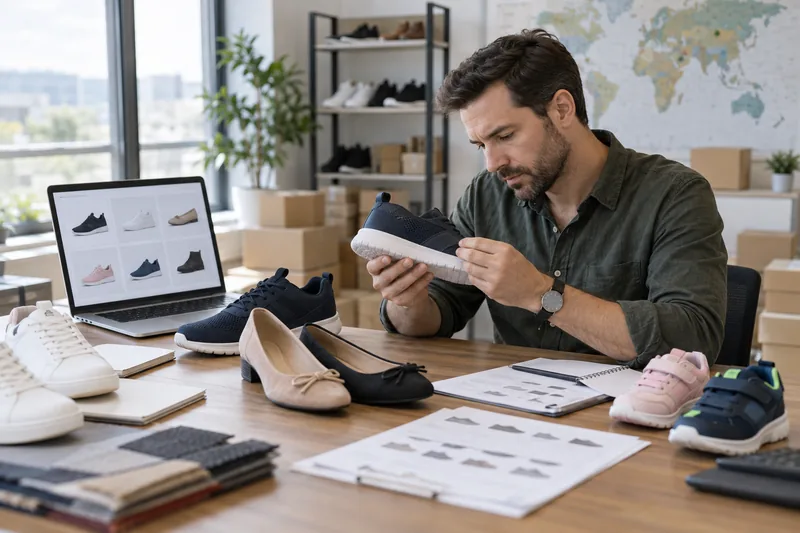
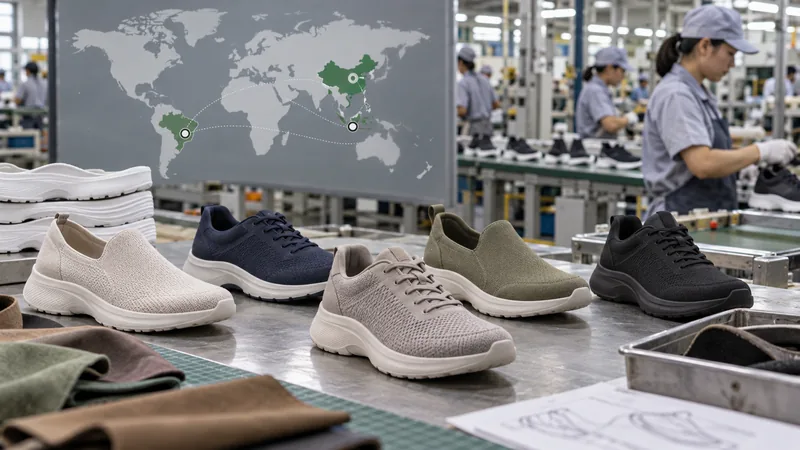
Quick answer: Skechers shoes are made by independent contract manufacturers, mainly in China and Vietnam, with additional production in countries such as Indonesia and Brazil. Skechers’ 2025 annual filing says its products are produced primarily in Asia and that the company does not own or operate manufacturing facilities. Market disclosures in 2025 placed roughly 40% of U.S.-bound supply in China and another 40% in Vietnam, but the exact mix can change.
The search “where are Sketcher shoes made” commonly misspells the brand: the correct name is Skechers. This guide separates confirmed company disclosures from factory claims, explains how comfort and performance shoes are produced, and shows how consumers and wholesale buyers can purchase through legitimate channels.
1. Where are Skechers shoes made?
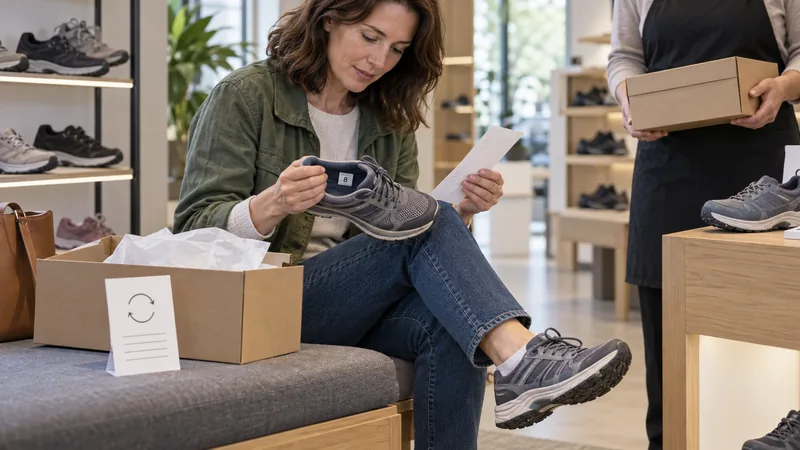
Skechers is an American brand headquartered in Manhattan Beach, California, but its footwear is manufactured abroad. The official 2025 annual report describes a network of independent contractors located primarily in Asia.
| Country | Evidence-based role | What buyers should understand |
|---|---|---|
| China | One of the two principal sourcing countries; broad footwear and component capability | Common on lifestyle, children’s, sandals and other categories, but allocation varies by style |
| Vietnam | Other principal sourcing country with a large export-footwear ecosystem | Major source for athletic, walking and casual products; not every Vietnam factory makes Skechers |
| Indonesia | Additional diversified production | Smaller role than China or Vietnam; exact annual share is not publicly fixed |
| Brazil | Additional and regional production reported by industry sources | Can serve local or regional demand; verify the exact pair’s origin label |
| Other countries | Flexible capacity and risk diversification | The supplier portfolio can change with tariffs, capacity and commercial needs |
The often-cited “40% China / 40% Vietnam” figure refers to sourcing exposure reported around the U.S. business, not a permanent SKU-by-SKU global formula. The inside label on the exact pair is the appropriate country-of-origin reference.
2. Why Skechers uses contract manufacturing
Skechers says outsourcing improves flexibility and capacity while avoiding the capital and workforce costs of owning a global factory estate. It also sources from multiple facilities and countries to reduce exposure to disruption.
The model divides responsibilities:
- Skechers: product concept, design direction, merchandising, specifications, production monitoring, marketing and distribution.
- Contract manufacturer: industrialization, material procurement under specifications, tooling, labor, assembly, in-process controls and packing.
- Material suppliers: knit, synthetic leather, foam chemicals, rubber compounds, components, insoles, laces and packaging.
China brings a deep component, mold and material base. Vietnam offers concentrated export-footwear capacity. Using both helps a brand balance capability, lead time, tariff exposure and continuity.
3. Which factories make Skechers shoes?
Skechers does not publish a complete consumer-facing factory map equivalent to Nike’s. Factory lists found online should therefore be graded by evidence.
| Name or group | Evidence | Interpretation |
|---|---|---|
| TBS Group, Vietnam | TBS identifies Skechers as a long-term footwear customer and describes a dedicated relationship dating back many years | Strong manufacturer self-disclosure; TBS operates multiple facilities, so confirm the exact legal plant |
| Kingmaker operations | Historical labor and supply-chain records have associated Kingmaker facilities in China/Vietnam with Skechers | Useful historical example, not proof that every current Kingmaker plant or line produces the brand |
| Other unnamed contractors | Skechers’ annual report confirms multiple facilities and countries but does not enumerate them publicly | Do not treat unsourced blog lists as an official roster |
A supplier saying “we make for Skechers” should provide evidence appropriate to a confidential relationship, such as an auditable facility history or permitted customer reference. Even genuine production experience does not authorize the supplier to sell branded Skechers overruns, molds, designs or components.
4. How Skechers-style footwear is produced
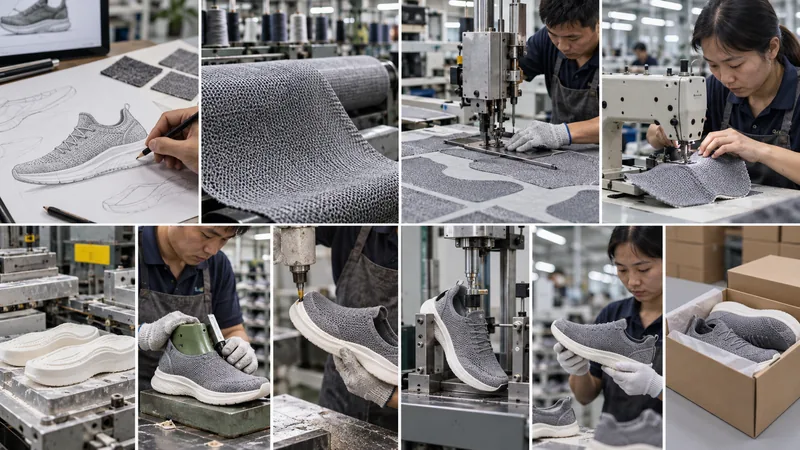
The exact recipe is model-specific and proprietary, but walking, lifestyle and performance footwear generally moves through the following stages:
- Consumer and product brief: use, fit, weight, comfort objective, price and appearance are defined.
- Design and engineering: last, upper pattern, cushioning geometry, outsole and flex zones are developed.
- Prototype: early samples test fit, silhouette, material behavior and manufacturability.
- Material approval: knit or mesh, leather/synthetics, foam, rubber, adhesive, lining and insole are specified.
- Tooling and grading: molds and patterns are produced across the intended size range.
- Upper making: materials are knitted or cut, reinforced, stitched, welded and fitted with eye stays or elastic structures.
- Sole making: midsoles and outsoles are molded; density, rebound, hardness and color are controlled.
- Lasting and attachment: the upper is shaped and joined to the sole by cementing, molding, stitching or a hybrid process.
- Finishing and inspection: insoles, laces and labels are added; pairs are checked for fit, appearance and construction.
- Packing: size/SKU labels are matched across shoes, box and shipping carton.
Features marketed under specific Skechers technology names may use different foams, insoles or construction. A generic factory cannot legitimately claim identical branded technology merely because it uses visually similar foam.
5. How Skechers monitors quality and suppliers
Skechers states that its U.S. production team and staff in China and Vietnam monitor production from prototypes through final manufacturing. Quality personnel inspect raw-material prototypes, in-process samples and finished products before shipment.
Its social-responsibility disclosures say Tier 1 factories and Tier 2 material suppliers must acknowledge the Supplier Code of Conduct annually, and factories are subject to training, monitoring and audits. Useful product controls include:
- approved sample and bill of materials;
- size, width and left-right matching;
- foam density, hardness, rebound and compression behavior;
- sole bond, flex and abrasion;
- stitching, symmetry and color consistency;
- restricted-substance and destination-market requirements;
- box, barcode and carton accuracy.
These policies describe the management framework; they are not a guarantee that no defect or labor problem can ever occur. Current factory-specific assessment requires current evidence.
6. Does China or Vietnam mean different quality?
Country is not a quality grade. A budget slip-on and a performance running shoe can come from the same country with different materials, tooling and specifications. A model can also move between facilities over time.
Judge model suitability, fit, seller provenance and warranty. Small cosmetic variation does not prove a fake; conversely, a perfect-looking box does not prove authenticity. If two pairs of the same style fit differently, compare the complete SKU, production label, size standard and purchase channel before blaming the country.
7. How to buy authentic Skechers
Use the official Skechers country site, Skechers stores, licensed stores or established retailers with invoices and a clear returns process.
- Start from the official country selector or verified store locator, not a social ad.
- Check the seller’s legal identity, contact information and return address.
- Match model code, color code and size on both shoes and the box.
- Assess fit using the official model chart; origin does not standardize every last.
- Keep the invoice and packaging until comfort and construction have been tested indoors.
- Treat “factory original,” “export surplus,” “same line” and unusually deep discounts as risk signals, not authentication.
For online purchases, payment protection and a usable return policy are often more valuable than close-up photos supplied by the seller.
8. How to buy Skechers wholesale
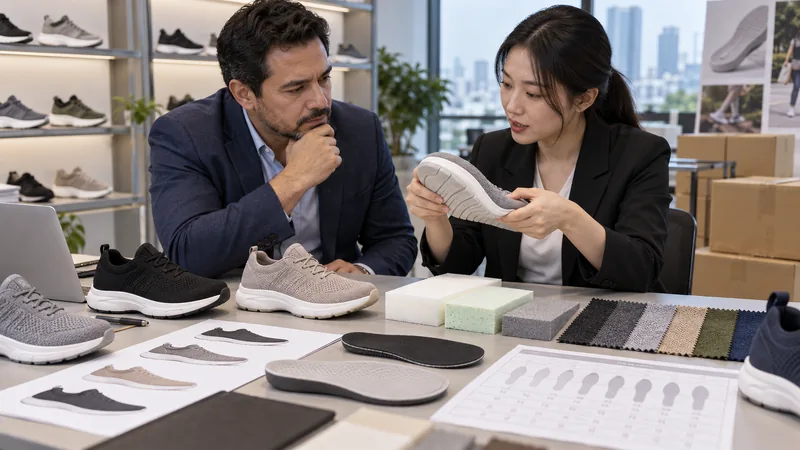
Authentic wholesale requires onboarding by Skechers or an authorized regional distributor. A public wholesale portal or tax-certificate guide is for approved accounts; it is not proof that any visitor can open an account or resell in any territory.
Prepare a company registration, tax/resale documents, store or ecommerce profile, sales territories, channel plan, expected volume and references. Ask Skechers’ regional office which entity controls your country. For a franchise or licensed Skechers store, use the company’s official retail-licensing contact and review investment, territory, store design and purchasing commitments directly.
Never substitute a contract factory for a distributor. The factory’s right to manufacture branded shoes does not include the right to sell them to outsiders. Imported “overruns” without a documented chain of title expose the buyer to counterfeit, trademark, customs and warranty risk.
9. Private-label comfort shoes from China
If the business goal is a comfort-footwear assortment rather than the Skechers brand itself, source a differentiated private-label product. Latin American buyers can evaluate Chilatshop as a China sourcing channel for lawful unbranded or own-brand footwear, subject to confirming current fees, MOQ, inspection scope and logistics.
Write a specification around customer need: foot shape, weight, walking distance, slip resistance, removable insole, foam performance, upper breathability, size curve and target landed cost. Do not copy Skechers logos, boxes, product names, outsole artwork or protected trade dress. Chilat’s guides to finding footwear manufacturers and controlling sneaker MOQ, sizes and quality cover the broader sourcing process.
10. Key risks and practical checks
- Misspelled brand domains: “Sketcher” sites may exploit the common typo; verify the real Skechers domain.
- Factory claims: ask for evidence, but never interpret OEM experience as resale authorization.
- Counterfeits: reject branded goods without invoices and trademark-authorized distribution.
- Fit: approve model-specific length and width; memory or comfort foam does not correct a wrong last.
- Durability: test flex, bond, abrasion and compression instead of judging softness on day one.
- Medical language: comfort footwear is not automatically therapeutic; avoid unsupported health claims.
- Import compliance: classify footwear by upper/sole material and construction, then verify labeling, duty and testing locally.
11. Frequently asked questions
Are Skechers made in China?
Yes. China is one of Skechers’ two principal sourcing countries, alongside Vietnam.
Are Skechers made in the USA?
Skechers is headquartered and designs/manages products in the United States, but its filing says products are made by overseas independent contractors; it does not own factories.
Are Vietnam-made Skechers genuine?
They can be, because Vietnam is a major production country. Authentication depends on the seller and supply chain, not the origin label alone.
Who is the biggest Skechers factory?
Skechers does not publish a complete ranked factory list. TBS Group publicly names Skechers as a long-term customer, but this does not establish a universal “largest” supplier.
Can I buy Skechers from its factories?
Not as a legitimate shortcut. Buy through Skechers or an authorized distributor; contract factories do not obtain public resale rights from manufacturing orders.
Is the brand spelled Sketchers or Skechers?
The official spelling is Skechers, without the first “t.”
12. Conclusion
Skechers is designed and managed by a U.S. company but manufactured through independent partners, principally in China and Vietnam. Public evidence confirms the outsourced model and names TBS Group as one disclosed partner, while the full current factory roster remains private. Consumers should prioritize official or traceable sellers; wholesale buyers need authorized onboarding. Entrepreneurs seeking similar product categories should build original private-label comfort shoes rather than buy questionable branded “factory stock.”
13. Sources consulted