'%3e%3cpath%20id='Vector'%20d='M0.775%206.60234L3.375%204.00234L0.775%201.40234'%20stroke='%23F2F2F2'%20stroke-linecap='round'%20stroke-linejoin='round'/%3e%3c/g%3e%3cdefs%3e%3cclipPath%20id='clip0_13602_6886'%3e%3crect%20width='4'%20height='6.4'%20fill='white'%20transform='matrix(-1%200%200%201%204.07812%200.800781)'/%3e%3c/clipPath%3e%3c/defs%3e%3c/svg%3e)
 10,531
Short answer: New Balance makes a limited premium range in company-operated factories in the United States and at Flimby in the United Kingdom, while most of its global footwear is produced by disclosed supplier factories, principally in Asia. The country varies by model, colorway and production run, so the tongue label on the exact pair is more reliable than a model-level assumption.
This guide explains the difference between Made in USA, Made in UK and internationally made New Balance shoes, identifies factories that can be verified publicly, follows the production process, and shows consumers and wholesale buyers how to purchase with lower risk.
Contents
- Where are New Balance shoes made?
- United States factories and the 70% rule
- The Flimby Made in UK factory
- Production in Asia and other countries
- Which factories make New Balance?
- How New Balance shoes are produced
- Quality, labor and material controls
- Does production country determine quality?
- How to buy genuine New Balance
- Wholesale and private-label sourcing
- Frequently asked questions
- Conclusion and sources
1. Where are New Balance shoes made?
New Balance uses a hybrid manufacturing system. It owns footwear factories in New England and the Flimby facility in England, but it also relies on independent Tier 1 factories and Tier 2 material suppliers. Public supplier disclosures show production relationships in countries including Vietnam, China, Indonesia and Cambodia; the current list should be consulted because factories and allocations change.
The useful distinction is not simply “American versus Asian.” A label normally states where the shoe acquired its declared origin, while leather, mesh, foam, rubber, laces and boxes can come from multiple countries. One model family can also be split between plants or seasons.
2. United States factories and the 70% rule
New Balance says its Made U.S. footwear contains domestic value of 70% or greater and represents a limited portion of U.S. sales. That wording is important: it does not claim that every input is American. The company’s product pages also disclose that this threshold is below the Federal Trade Commission’s stricter standard for an unqualified “Made in USA” claim.
Publicly identified U.S. manufacturing locations include:
- Norridgewock, Maine: a long-standing athletic-shoe plant.
- Skowhegan, Maine: an owned plant undergoing modernization in recent company statements.
- Norway, Maine: part of the Maine manufacturing network.
- Lawrence, Massachusetts: long-established production in the Merrimack Valley.
- Methuen, Massachusetts: opened to expand domestic capacity.
New Balance has also discussed a New Hampshire facility and a Massachusetts manufacturing innovation center. Because expansion status can change, readers should distinguish an announced or developing site from a plant already producing a specific retail SKU.
Models within the 990 family and other premium lifestyle shoes commonly appear in the Made in USA collection, but not every version, color or future release is guaranteed to use the same plant. Check the product description and inside label.
3. The Flimby Made in UK factory
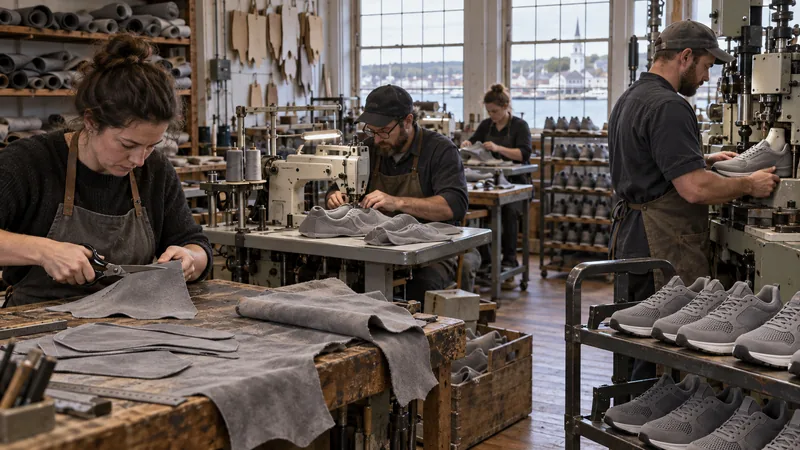
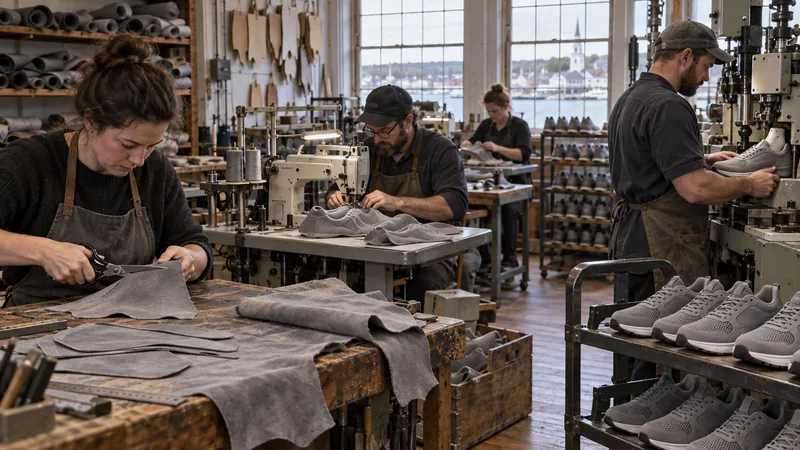
New Balance’s Flimby factory in Cumbria, England, has produced shoes for more than 35 years. It combines hand-guided operations such as cutting, stitching and finishing with industrial molding, pressing and quality equipment.
The Made in UK collection has included premium interpretations of the 991, 1500 and other heritage silhouettes. Flimby production is a specialized, lower-volume part of the global business, not the source of every pair sold in Europe. “Made in UK” identifies a particular product line and origin, rather than a universal quality guarantee for the entire brand.
4. Production in Asia and other countries
Most accessible, high-volume running and lifestyle ranges are made through external suppliers. Vietnam is a major athletic-footwear hub; China has deep component, tooling and shoe-development clusters; Indonesia and Cambodia also appear in footwear supply networks.
| Region | Typical role | What buyers should verify |
|---|---|---|
| United States | Limited premium Made U.S. collection | 70%+ domestic-value disclosure and exact SKU label |
| United Kingdom | Premium Made in UK heritage footwear | Flimby origin on product page and shoe |
| Vietnam | Large-scale performance and lifestyle production | Seller, style code and factory disclosure—not origin alone |
| China | Footwear assembly, components, molds and materials | Specific supplier and intellectual-property authorization |
| Other Asian countries | Additional assembly and material capacity | Current list, product label and traceable invoice |
5. Which factories make New Balance?
The most reliable roster is New Balance’s disclosure through Open Supply Hub, which covers owned manufacturing, Tier 1 suppliers, strategic Tier 2 suppliers and licensee suppliers. New Balance says its strategic Tier 2 list covers approximately 60% of material purchases, including textile mills and leather suppliers.
Do not treat a blog’s factory-name list as permanent. A factory may assemble finished footwear, produce a component, work for a licensee, or cease the relationship. Verify the legal company name, address, facility type and latest disclosure. New Balance’s 2025 licensee manual states that a new factory or subcontractor must receive approval before producing licensed goods.
A supplier appearing in the network is not permission for a third-party trader to sell “factory surplus.” Authentic branded wholesale requires an authorized distribution chain and documents linking the inventory to it.
6. How New Balance shoes are produced
- Product brief: designers define intended use, last, fit, cushioning, stability, weight and target cost.
- Engineering: developers create patterns, select materials and design molds for midsole and outsole components.
- Sampling: prototypes are built and revised after fit, flex, wear and performance tests.
- Material preparation: mesh, leather or synthetic panels are inspected, cut, skived, printed or welded.
- Upper construction: panels, linings and reinforcements are stitched or bonded into a completed upper.
- Sole production: foam midsoles and rubber outsoles are molded and conditioned.
- Lasting and assembly: the upper is shaped around a last, surfaces are prepared, and sole units are cemented and pressed.
- Finishing: insoles, laces and labels are fitted; excess adhesive and marks are removed.
- Inspection: size, symmetry, appearance, bonding and packing details are checked before carton sealing.
The balance of manual craft and automation varies. Premium suede-and-mesh heritage shoes require different cutting and finishing from technical running shoes with engineered mesh and specialized foams.
7. Quality, labor and material controls
New Balance publishes a Supplier Code, Supplier Standards Manual, restricted-substances rules and responsible-purchasing policy. It reports annual audits by its team or third parties and discloses owned, Tier 1, strategic Tier 2 and licensee sites.
For product quality, useful controls include approved golden samples, material traceability, dimensional tolerances by size, sole hardness, bond strength, flex resistance, abrasion, colorfastness and final random inspection. An importer should record the acceptable quality limit and defect definitions in the purchase contract rather than relying on “premium quality.”
8. Does production country determine quality?
No. Made in USA and Made in UK lines often use premium positioning, materials and smaller production programs, but origin alone does not prove that every pair will fit better or last longer. Asian factories can also produce sophisticated performance footwear to demanding specifications.
Compare the exact model’s materials, construction, intended use, fit, warranty and inspection outcome. Suede softness or a higher retail price is not a universal durability measure; running foam can intentionally prioritize low weight and energy return over decades of storage.
9. How to buy genuine New Balance
Use New Balance’s official country site, brand stores or established authorized retailers. Confirm who the actual seller is on a marketplace, and check delivery territory, taxes, size/width code, return period and warranty before payment. New Balance offers multiple widths in many models, so width selection is as important as length.
Match the style code on the shoe and box, examine label printing and construction, retain the invoice, and reject sellers whose only proof is a QR code or “same factory” claim. A Vietnam- or China-made label can be authentic; a U.S.-looking label can be counterfeited.
10. Wholesale and private-label sourcing
For genuine New Balance resale, apply through the brand or its territorial distributor. Obtain written terms for approved channels, territory, minimum purchase, invoicing, returns, warranty and trademark use. Never import branded stock merely because a supplier says it is an overrun.
For an independent, lawful private-label shoe, source an OEM/ODM factory without copying New Balance marks or protected designs. Chilat’s guide to Chinese footwear manufacturers explains factory categories, while the sneaker importing and quality-control guide covers samples, MOQ and inspection. Buyers who need help navigating Chinese marketplaces and consolidating compliant unbranded orders may evaluate Chilatshop’s purchasing workflow; it is not an unauthorized source of New Balance goods.
Calculate landed cost before ordering: product, development and molds, inspection, inland transport, export documents, freight, insurance, duty, tax, brokerage and final delivery. Confirm footwear labeling and trademark requirements in the destination country.
11. Frequently asked questions
Are all 990 shoes made in the USA?
No. Many premium 990 releases are in the Made in USA collection, but verify the exact style and label because model families, editions and production plans change.
Does Made in USA mean 100% U.S. materials?
No. New Balance states that its Made U.S. footwear has domestic value of 70% or greater and notes that this falls below the FTC threshold for an unqualified claim.
Are New Balance shoes made in Vietnam genuine?
They can be. Authenticity depends on the authorized chain and product evidence, not country alone.
Can I buy directly from a New Balance supplier factory?
A factory relationship does not authorize public resale. Genuine wholesale should be arranged through New Balance or an authorized distributor.
12. Conclusion and sources
New Balance is unusual among major athletic brands because it combines owned U.S. and UK factories with a much larger global supplier network. Check the exact pair’s label, understand the qualified 70% domestic-value statement, and use an authorized seller. Businesses seeking private-label footwear should source independently and protect specifications, inspection and intellectual property.