'%3e%3cpath%20id='Vector'%20d='M0.775%206.60234L3.375%204.00234L0.775%201.40234'%20stroke='%23F2F2F2'%20stroke-linecap='round'%20stroke-linejoin='round'/%3e%3c/g%3e%3cdefs%3e%3cclipPath%20id='clip0_13602_6886'%3e%3crect%20width='4'%20height='6.4'%20fill='white'%20transform='matrix(-1%200%200%201%204.07812%200.800781)'/%3e%3c/clipPath%3e%3c/defs%3e%3c/svg%3e)
 10,018
Short answer: Adidas is a German company, but almost all of its products are made by independent manufacturing partners. According to the Adidas 2025 Annual Report, Vietnam supplied 27% of total product volume, Indonesia 18%, China 16%, and Asia as a whole 92%. Those figures cover all product categories, not footwear alone, so the label inside a specific pair remains the best answer for that shoe.
The frequent search “where are Adidas shoes made?” is sometimes typed as “where are Adidas shoes manufactured.” This guide explains the current country mix, what can honestly be said about individual factories, how sneakers are produced, and how consumers or importers should buy.
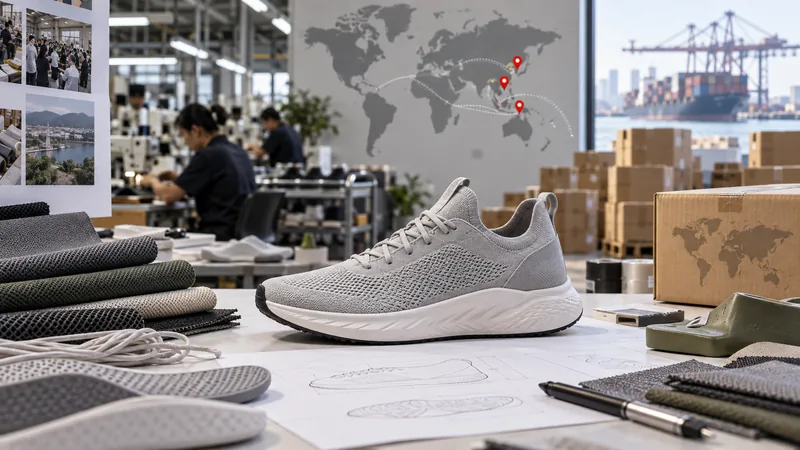
Contents
- Where are Adidas shoes made?
- Main manufacturing countries
- Which factories make Adidas shoes?
- Does Adidas own its factories?
- How Adidas shoes are made
- Quality and supplier controls
- Does the country prove authenticity?
- How to buy genuine Adidas shoes
- Wholesale and private-label sourcing
- Frequently asked questions
- Conclusion
- Sources consulted
1. Where are Adidas shoes made?
Adidas shoes are made across a global network, with the largest production concentration in Asia. The company’s 2025 report identifies Vietnam, Indonesia and China as its three largest sourcing countries across footwear, apparel and accessories. Production may also occur in Cambodia, India, Turkey, Brazil, Argentina and other markets listed in Adidas’s current factory disclosure.
“Made in Vietnam” or “Made in China” normally refers to the country where the product underwent the manufacturing transformation required by origin rules, usually final assembly. It does not mean every component came from that country: mesh, foam, rubber, laces, adhesives and packaging can have different upstream origins.
2. Main manufacturing countries
| Country/region | Official 2025 share of total Adidas volume | Practical interpretation |
|---|---|---|
| Vietnam | 27% | Largest sourcing country; a mature export-footwear cluster with assembly and component capability. |
| Indonesia | 18% | Major athletic-footwear base with experienced large-scale suppliers. |
| China | 16% | Deep network for footwear, molds, textiles, soles, packaging and rapid product development. |
| Rest of Asia | Part of Asia’s 92% total | Includes additional locations shown in the live supplier list; allocation changes by season and category. |
| Other regions | 8% combined | Supports local-for-local production, licensing, special requirements and regional demand. |
These are sourcing-volume shares, not a shoe-only breakdown. Adidas says it has expanded local-for-local sourcing in Greater China, India, Brazil and Argentina. This helps shorten replenishment times and adapt products to a regional market. It also explains why two legitimate pairs from the same model family can show different countries of origin.
3. Which factories make Adidas shoes?
There is no single “Adidas factory.” The most defensible factory list is Adidas’s own downloadable Global Factory List, which is updated as supplier relationships change. The 2025 report states that the company worked with 123 independent manufacturing partners operating 279 facilities; one partner group can operate several plants.
Examples that appear in public supplier disclosures include facilities belonging to large footwear groups in Vietnam, Indonesia and China. Names often associated with global athletic-footwear manufacturing include Pou Chen/Yue Yuen and Ching Luh group entities, but a group name does not prove that every plant currently makes every Adidas model. Check the current Adidas spreadsheet for the facility name, address, product type and disclosure date, or ask Adidas to confirm a specific supplier through the contact on its supplier-list page.
A factory can leave or enter the network, act as a subcontractor, or produce components rather than finished shoes. Therefore, claims such as “direct from the Adidas factory,” “overrun,” or “same factory original” are not evidence of authorization. A legitimate factory relationship does not grant a trader the right to sell branded goods outside Adidas’s approved channel.
4. Does Adidas own its factories?
Adidas reports that it outsources almost 100% of production to independent manufacturing partners. Adidas defines the product, performance requirements, design, materials and sustainability expectations; suppliers contribute manufacturing engineering, workforce, machinery and high-volume execution.
The network includes direct manufacturing partners, approved subcontractors, material providers, licensees and sourcing agents. This layered structure matters: the Tier 1 factory assembles the shoe, while Tier 2 suppliers may mold soles or process textiles and Tier 3/4 suppliers provide yarns, polymers, leather or natural rubber.
Long relationships reduce execution risk. In 2025, 65% of independent manufacturing partners had worked with Adidas for at least ten years and 37% for more than twenty. Still, no single factory dominates: the largest factory represented about 6% of total sourcing volume.
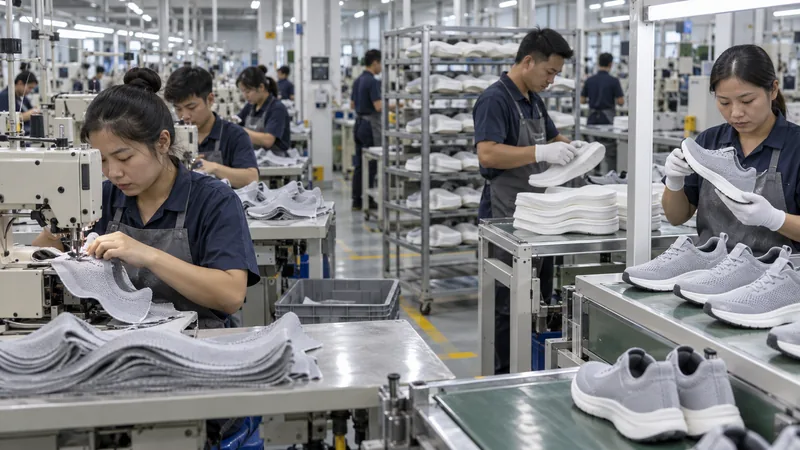
5. How Adidas shoes are made
A performance sneaker moves from specifications to repeatable mass production through controlled stages:
- Design and performance brief: teams define use, fit, weight, cushioning, traction, target cost and visual language.
- Last and tooling development: engineers establish the foot-shaped last and create molds for midsoles and outsoles.
- Material qualification: textiles, synthetic overlays, rubber compounds, foams and adhesives are tested against the specification.
- Prototype and wear testing: samples are checked for fit, flex, stability and performance; revisions may require new tooling.
- Upper preparation: fabric or synthetic panels are cut, printed or welded, stitched, and reinforced.
- Sole production: midsoles are molded or foamed; outsoles are molded and prepared for bonding.
- Lasting: the completed upper is pulled around a last to create the shoe’s three-dimensional form.
- Assembly: surfaces are prepared, adhesive is applied, and the upper, midsole and outsole are pressed together.
- Finishing and inspection: laces, insoles and labels are added; shoes are cleaned and checked for symmetry, bonding and appearance.
- Packing and shipment: pairs are boxed, carton labels are verified and lots move to distribution centers.
The exact method changes by model. A knitted running upper, a leather terrace shoe and a molded slide require different machinery, tolerances and tests.
6. Quality and supplier controls
Country of manufacture is not a quality grade. Quality depends on the approved bill of materials, process controls, worker training, tooling condition, inspection plan and how deviations are corrected.
Adidas describes initial approval assessments and ongoing social and environmental monitoring. It expects Tier 2 facilities to improve water efficiency and use chemical formulations aligned with the ZDHC Manufacturing Restricted Substances List. Its public supplier system also distinguishes direct factories from subcontractors and material providers.
For a buyer creating a separate private-label shoe, practical quality checkpoints include pre-production samples, signed specifications, size tolerances, sole-hardness range, flex and abrasion tests, bond-strength testing, colorfastness, needle control, metal detection where relevant, and a final random inspection before the balance is paid.
7. Does the country prove authenticity?
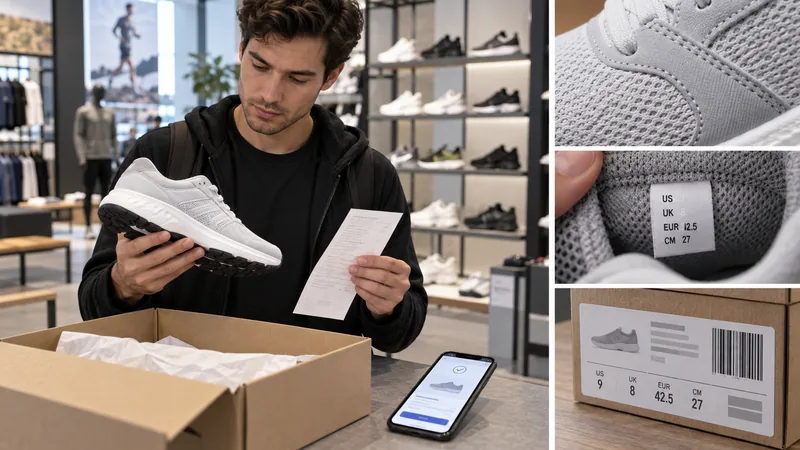
No. Authentic Adidas shoes can be made in Vietnam, Indonesia or China, while counterfeit shoes can copy any country label. Evaluate the selling channel and the complete product record, not one label.
- Compare the article/style code on the shoe, box and official product information.
- Inspect size labels, typography, stitching, symmetry, glue control and packaging together.
- Ask for an invoice and a clear return policy.
- Be cautious when a new, high-demand model is sold far below normal market price.
- Do not treat QR codes, receipts or “factory surplus” stories as conclusive; all can be copied.
8. How to buy genuine Adidas shoes
For personal purchases, use the official Adidas site or app for your country, Adidas-owned stores, or established authorized retailers. Before paying, confirm the seller identity, delivery country, taxes, size chart, return window and whether discounted items are returnable. Marketplaces require more scrutiny because the platform may host multiple independent sellers.
Choose by use rather than country: running gait and distance, football surface, court stability, casual fit or children’s sizing. Try shoes late in the day when feet may be slightly larger, leave appropriate toe space, and test both feet. A shoe’s origin label cannot compensate for a poor fit.

9. Wholesale and private-label sourcing
Businesses wanting genuine branded Adidas inventory should approach Adidas or an officially appointed distributor in their territory and request written authorization terms. Verify territory, permitted channels, minimum orders, trademark use, warranties, invoices and after-sales responsibilities. Buying from an unknown trader who claims access to an Adidas factory creates counterfeit, trademark, customs and payment risks.
If the goal is to develop a lawful unbranded or private-label sports shoe—not to copy Adidas designs or marks—China offers a broad supplier base. Chilat’s guide to shoe manufacturers in China explains factory types, while its sneaker sourcing and quality-control guide covers samples, MOQ and inspection. Buyers who need assistance searching Chinese marketplaces and consolidating orders can also evaluate Chilatshop’s China purchasing workflow. It is not a channel for unauthorized Adidas goods.
For imports, calculate landed cost: product, sample and mold fees, inspection, domestic China freight, export documentation, international freight, insurance, duty, VAT/sales tax, customs brokerage and last-mile delivery. Confirm local footwear labeling and trademark rules with a licensed customs professional before ordering.
10. Frequently asked questions
Are Adidas shoes made in Germany?
Adidas is headquartered in Germany, but Germany is not its main mass-production base. Limited, specialized or heritage production can occur in Europe; check the specific product label rather than assuming.
Are Adidas shoes made in Vietnam original?
They can be. Vietnam was Adidas’s largest sourcing country in 2025. Origin alone neither proves nor disproves authenticity.
Can the same model be made in different countries?
Yes. In a multi-factory network, allocations can change by production run, season, region and capacity. Read the label on the pair you are buying.
Can I buy genuine Adidas directly from a factory?
Not merely because a seller claims a factory connection. Genuine wholesale requires an authorized commercial channel and traceable invoices. Unauthorized surplus claims are high risk.
What MOQ should a private-label shoe factory require?
There is no universal MOQ. It changes with stock versus custom materials, color count, size run, outsole mold and packaging. Ask suppliers to separate sample MOQ, trial-order MOQ and repeat-order MOQ.
11. Conclusion
Most Adidas production is outsourced to specialist partners in Asia. Vietnam, Indonesia and China lead the company’s 2025 sourcing mix, but the correct origin for any pair is the country printed on that product. For authenticity, prioritize an authorized seller and traceable transaction; for private-label importing, control specifications, intellectual property, inspection and landed cost instead of chasing a supposed “Adidas factory.”
12. Sources consulted